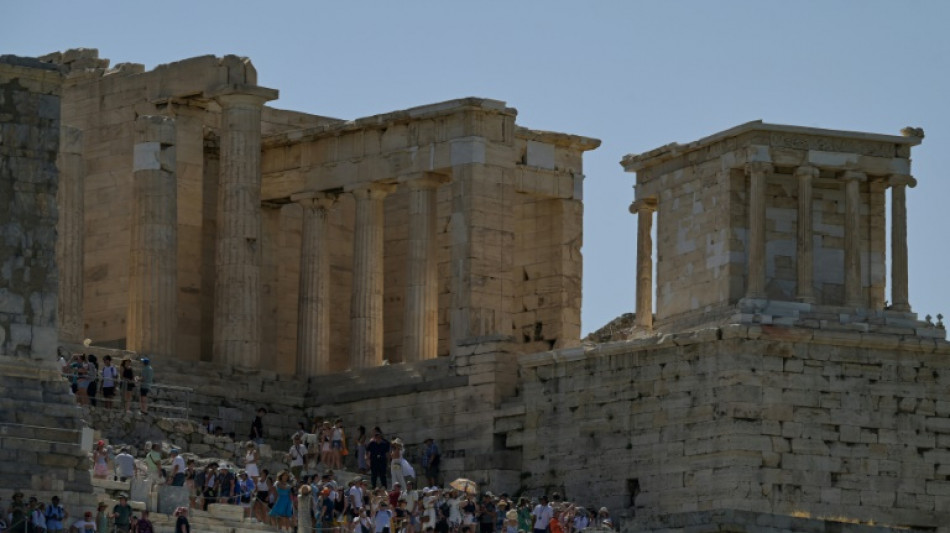
Earliest-ever Greek heatwave shuts Acropolis for second day / Photo: STRINGER - AFP

 Kenya's economy faces climate change risks: World Bank

 Far right and far left battle for power in polarised Berlin

 The last trio: S.Africa's zoo elephants await their fate
 Oil industry sees war windfall but girds for political blowback

 Amazon beats expectations with cloud and AI growth

 Blowout Microsoft results lift US stocks as oil retreats

 'Beginning of the end': Relief but no party as French wildfire winds down

 Southern Europe 'becoming more flammable' in hotter climate, experts say

 Mammoth bones found on parched bed of Danube in Bulgaria

 MEXC Lists Grvt (GRVT) with $60,000 Worth of GRVT and 10,000 USDT in Airdrop+ Rewards

 George and Amal Clooney flee French home due to wildfire

 MEXC Ventures Supports Alpha Arena's APAC Debut at Coinfest Bali

 AI data centre supplier Zhongji InnoLight slips on Hong Kong debut

 May, June heatwaves caused 2,877 extra deaths in England: govt

 BMW profit down a third as carmaker plans job cuts

 Seoul extends losses as most Asian markets drop, oil rises again

 Gambling.com Group Is Now Grandstand

 Meet the astronomer digging into the Milky Way's 'fossils'

 AI data centre supplier Zhongji InnoLight falls on Hong Kong debut

 Samsung operating profit up 1,800% in second quarter on AI boom

 Japanese population below 120 million for first time in decades

 US actor Jared Leto denies latest accusations of sexual assault

 Danube drops to 'historic lows' as fresh heatwave hits

 BTS pulls out of Grammys after Asian pop category introduction

 OpenAI says rogue AI agent attack hit other companies

The Athens Acropolis, Greece's most visited tourist attraction, was closed to the public during the hottest hours on Thursday for the second day running, as the country's earliest-ever heatwave neared its peak.
Tourists were unable to visit the Parthenon and other ancient masterpieces atop the UNESCO-listed archaeological site between noon and 5:00 pm local time (0900 to 1400 GMT).
Meteorologists have noted it is the earliest heatwave -- which for Greece is temperatures exceeding 38 degrees Celsius (100 degrees Fahrenheit) for at least three days -- on record.
Temperatures of up to 44 degrees Celsius were expected on Thursday, with up to 43 degrees forecast in the capital, prompting health warnings and school closures.
By midday, however, the mercury was still at 37 degrees Celsius in Athens, according to the Poseidon System website.
Several other Greek archaeological sites in Crete, the Dodecanese, the Cyclades and the Peloponnese were also shut as a precaution against the heat.
Other world-renowned attractions, such as Delphi, Olympia and Knossos, remained open without interruption.
The heatwave prompted the climate crisis and civil protection ministry to issue a "very high" wildfire risk for eight Greek regions on Wednesday.
Temperatures are expected to ease from Friday onwards.
The Acropolis was forced to close in July last year during a two-week heatwave that was unprecedented in its duration.
It was followed by fires that, according to the National Observatory of Athens, consumed nearly 175,000 hectares (432,000 acres) of forest and farmland.
A record number of almost four million visitors flocked to the Acropolis in 2023, with its popularity boosted in part due to tourists arriving on cruise ships calling in at the nearby port of Piraeus.
A.Leibowitz--CPN