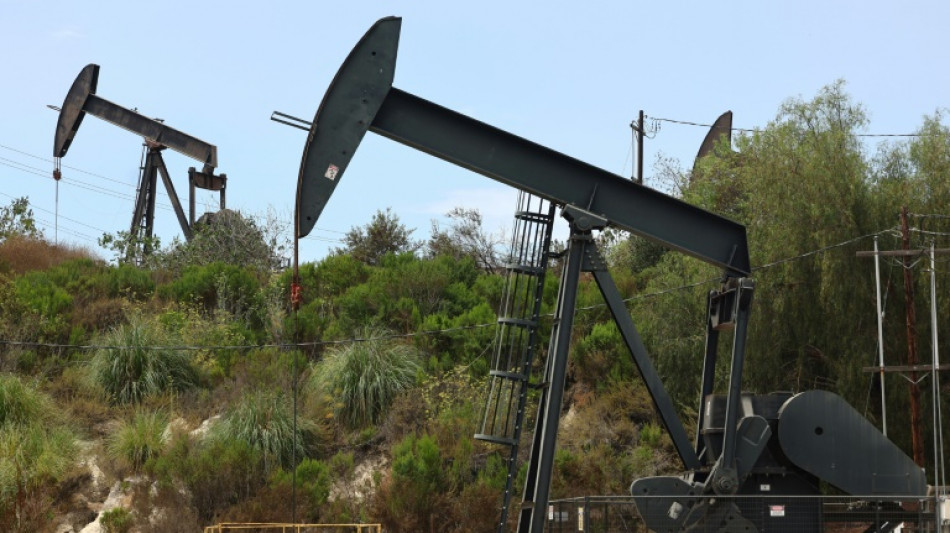
World will amass 'major' oil surplus by 2030: IEA / Photo: MARIO TAMA - GETTY IMAGES NORTH AMERICA/AFP/File

 Kenya's economy faces climate change risks: World Bank

 Chipmaker Kioxia reports AI-driven 45-fold surge in quarterly net profit

 Far right and far left battle for power in polarised Berlin

 The last trio: S.Africa's zoo elephants await their fate

 Oil industry sees war windfall but girds for political blowback

 Amazon beats expectations with cloud and AI growth

 Blowout Microsoft results lift US stocks as oil retreats

 'Beginning of the end': Relief but no party as French wildfire winds down

 Southern Europe 'becoming more flammable' in hotter climate, experts say

 Mammoth bones found on parched bed of Danube in Bulgaria

 MEXC Lists Grvt (GRVT) with $60,000 Worth of GRVT and 10,000 USDT in Airdrop+ Rewards

 George and Amal Clooney flee French home due to wildfire

 MEXC Ventures Supports Alpha Arena's APAC Debut at Coinfest Bali

 AI data centre supplier Zhongji InnoLight slips on Hong Kong debut

 May, June heatwaves caused 2,877 extra deaths in England: govt

 BMW profit down a third as carmaker plans job cuts

 Seoul extends losses as most Asian markets drop, oil rises again

 Gambling.com Group Is Now Grandstand

 Meet the astronomer digging into the Milky Way's 'fossils'

 AI data centre supplier Zhongji InnoLight falls on Hong Kong debut

 Samsung operating profit up 1,800% in second quarter on AI boom

 Japanese population below 120 million for first time in decades

 US actor Jared Leto denies latest accusations of sexual assault

 Danube drops to 'historic lows' as fresh heatwave hits

 BTS pulls out of Grammys after Asian pop category introduction

The world is likely to have a major surplus of oil by 2030 as production is ramped up while the clean energy transition tempers demand, the International Energy Agency said Wednesday.
Global demand is expected to "level off" at 106 million barrels per day (bpd) toward the end of this decade while overall supply capacity could reach 114 million bpd, the IEA said in an annual report.
This would result in a "staggering" surplus of eight million bpd that oil markets should prepare for, the Paris-based agency said.
"As the pandemic rebound loses steam, clean energy transitions advance, and the structure of China's economy shifts, growth in global oil demand is slowing down and set to reach its peak by 2030," said IEA executive director Fatih Birol.
With "a major supply surplus emerging this decade," Birol said, "oil companies may want to make sure their business strategies and plans are prepared for the changes taking place."
The forecast comes days after the OPEC+ group of major crude producers signalled they would start to unwind output cuts this autumn, implemented in a bid to support prices against fears of weakening worldwide demand.
In its report, the IEA noted that fast-developing Asian countries like China and India along with the aviation and petrochemical sectors would still drive oil demand, which stood at 102 million bpd in 2023.
But the shift toward electric cars along with fuel efficiency gains for conventional vehicles, and declining use of oil by Middle Eastern countries for electricity production, would help limit the overall demand increase to around four percent by 2030.
- 'Lower oil price environment' -
The IEA said demand in advanced economies is expected to continue a decades-long decline, falling from 46 million bpd in 2023 to less than 43 million bpd in 2030 -- the lowest since 1991 apart from during the pandemic.
At the same time, oil production capacity appears set to surge, led by the United States and other countries in the Americas, leading to the forecast of an eight-million-barrel surplus -- a level reached only during the Covid-19 lockdowns of 2020.
"Such a massive oil production buffer could usher in a lower oil price environment, posing tough challenges" for the US shale industry and the OPEC+ bloc led by Saudi Arabia and Russia, the report said.
"Such a massive cushion could upend the current OPEC+ market management strategy aimed at supporting prices," it said.
In a separate monthly report on the global oil market, the IEA cut its forecast for demand growth for 2024 to 960,000 bpd compared to 1.1 million bpd in its previous outlook.
Its forecast for 2025 was also lowered to one million bpd from 1.2 million in its May report.
H.Cho--CPN