World will likely temporarily pass 1.5C climate limit by 2028: UN / Photo: Julia Han JANICKI, Hervé BOUILLY - AFP

 Kenya's economy faces climate change risks: World Bank
 Chipmaker Kioxia reports AI-driven 45-fold surge in quarterly net profit
 Far right and far left battle for power in polarised Berlin

 The last trio: S.Africa's zoo elephants await their fate

 Oil industry sees war windfall but girds for political blowback

 Amazon beats expectations with cloud and AI growth

 Blowout Microsoft results lift US stocks as oil retreats

 'Beginning of the end': Relief but no party as French wildfire winds down

 Southern Europe 'becoming more flammable' in hotter climate, experts say

 Mammoth bones found on parched bed of Danube in Bulgaria

 MEXC Lists Grvt (GRVT) with $60,000 Worth of GRVT and 10,000 USDT in Airdrop+ Rewards

 George and Amal Clooney flee French home due to wildfire

 MEXC Ventures Supports Alpha Arena's APAC Debut at Coinfest Bali

 AI data centre supplier Zhongji InnoLight slips on Hong Kong debut

 May, June heatwaves caused 2,877 extra deaths in England: govt

 BMW profit down a third as carmaker plans job cuts

 Seoul extends losses as most Asian markets drop, oil rises again

 Gambling.com Group Is Now Grandstand

 Meet the astronomer digging into the Milky Way's 'fossils'

 AI data centre supplier Zhongji InnoLight falls on Hong Kong debut

 Samsung operating profit up 1,800% in second quarter on AI boom

 Japanese population below 120 million for first time in decades

 US actor Jared Leto denies latest accusations of sexual assault

 Danube drops to 'historic lows' as fresh heatwave hits

 BTS pulls out of Grammys after Asian pop category introduction

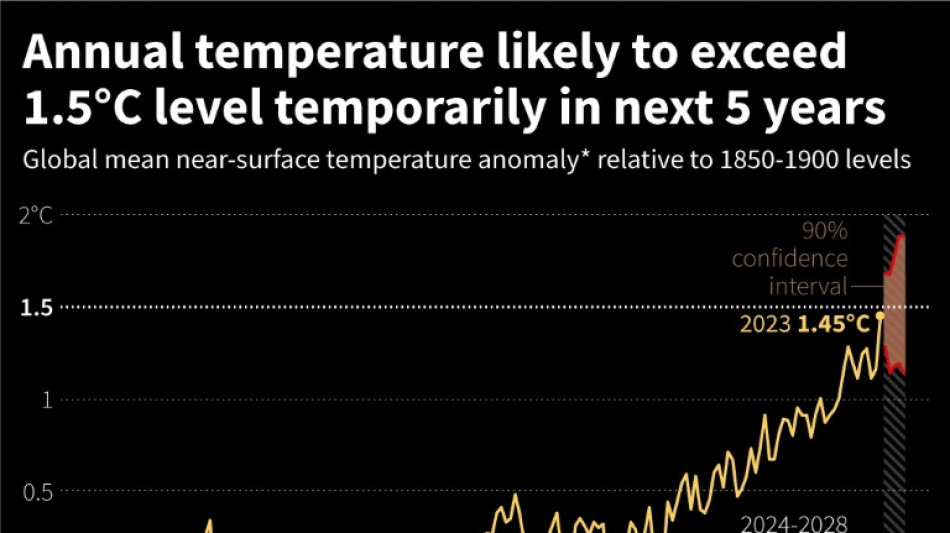
Humanity now faces an 80 percent chance that Earth's temperatures will at least temporarily exceed the key 1.5-degree Celsius mark during the next five years, the UN predicted Wednesday.
The 2015 Paris climate accords, which set the ambitious target of limiting the world to a temperature increase of 1.5 C over pre-industrial levels, meant to refer "to long-term temperature increases over decades, not over one to five years", the UN's World Meteorological Organization said.
The report came alongside another by the EU's Copernicus Climate Change Service announcing that last month was the hottest May on record, pointing to human-induced climate change -- and spurring UN chief Antonio Guterres to compare humanity's impact on the world to "the meteor that wiped out the dinosaurs".
The chance of temporarily exceeding the limit in the next five years ahead has been rising steadily since 2015, when such a chance was estimated to be close to zero, the UN's weather and climate agency noted.
"There is an 80 percent likelihood that the annual average global temperature will temporarily exceed 1.5C above pre-industrial levels for at least one of the next five years," WMO said.
In 2023, the risk of temporarily breaching the limit within five years was estimated at 66 percent.
Already, dramatic climate shifts have begun taking a heavy toll worldwide, fuelling extreme weather events, flooding and drought, while glaciers are rapidly melting away and sea levels are rising.
- 'Record-breaking' path -
"We are on a record-breaking warming path," WMO deputy chief Ko Barrett told reporters in Geneva.
"WMO is sounding the alarm that we will be exceeding the 1.5 C level on a temporary basis with increasing frequency."
She added that "we have already temporarily surpassed this level for individual months".
Barrett noted though that temporary breaches "do not mean that the 1.5 C goal is permanently lost because this refers to long-term warming over decades".
"But the trend is alarming and cannot be denied."
Temperature levels are rising, with 2023 by far the hottest year on record, amid warnings that 2024 could be even hotter.
Currently, the WMO predicts that the mean near-surface temperature for each year between 2024 and 2028 will be 1.1-1.9 C above the pre-industrial levels recorded between 1850 and 1900.
- 'Way off track' -
Pointing to repeated monthly temperature records over the past year, the WMO highlighted that already the past 12 months, from June 2023 to May 2024, were "the highest on record".
And it said there was now an 86-percent chance that one of the years between 2024 and 2028 would unseat 2023 as the annual record-holder.
It also said there was a 90-percent likelihood that the mean temperature for 2024-2028 would be higher than that over the past five-year period.
"We are way off track to meet the goals set in the Paris Agreement," Barrett said.
S.F.Lacroix--CPN