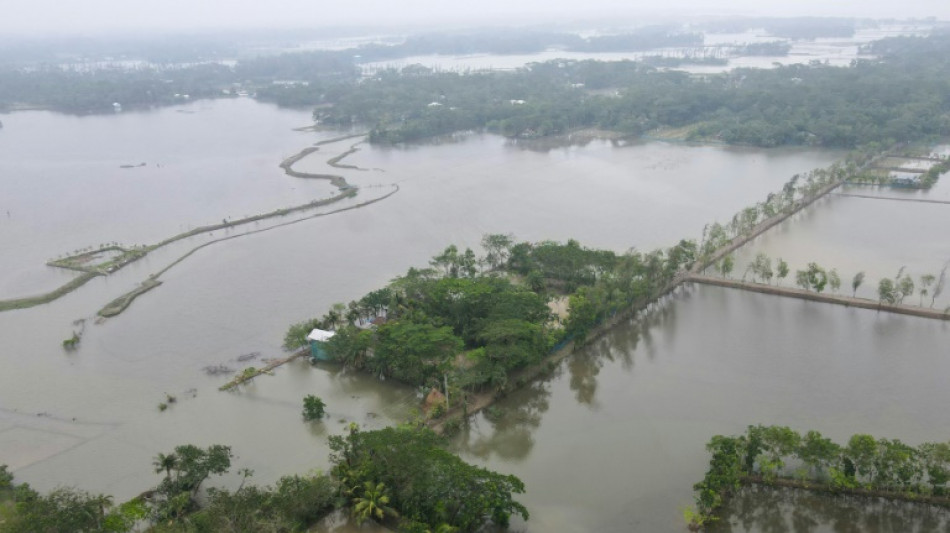
Key tiger habitat swamped by deadly Bangladesh cyclone / Photo: Munir Uz Zaman - AFP

 Kenya's economy faces climate change risks: World Bank

 Chipmaker Kioxia reports AI-driven 45-fold surge in quarterly net profit

 Far right and far left battle for power in polarised Berlin

 The last trio: S.Africa's zoo elephants await their fate

 Oil industry sees war windfall but girds for political blowback

 Amazon beats expectations with cloud and AI growth

 Blowout Microsoft results lift US stocks as oil retreats

 'Beginning of the end': Relief but no party as French wildfire winds down

 Southern Europe 'becoming more flammable' in hotter climate, experts say

 Mammoth bones found on parched bed of Danube in Bulgaria

 MEXC Lists Grvt (GRVT) with $60,000 Worth of GRVT and 10,000 USDT in Airdrop+ Rewards
 George and Amal Clooney flee French home due to wildfire

 MEXC Ventures Supports Alpha Arena's APAC Debut at Coinfest Bali

 AI data centre supplier Zhongji InnoLight slips on Hong Kong debut

 May, June heatwaves caused 2,877 extra deaths in England: govt

 BMW profit down a third as carmaker plans job cuts

 Seoul extends losses as most Asian markets drop, oil rises again

 Gambling.com Group Is Now Grandstand

 Meet the astronomer digging into the Milky Way's 'fossils'

 AI data centre supplier Zhongji InnoLight falls on Hong Kong debut

 Samsung operating profit up 1,800% in second quarter on AI boom

 Japanese population below 120 million for first time in decades

 US actor Jared Leto denies latest accusations of sexual assault

 Danube drops to 'historic lows' as fresh heatwave hits

 BTS pulls out of Grammys after Asian pop category introduction

Bangladesh forest experts warned Tuesday a key tiger habitat hit by a deadly cyclone had been submerged by seawater deeper and longer than ever before, raising fears for endangered wildlife.
Cyclone Remal, which made landfall in low-lying Bangladesh and neighbouring India on Sunday evening, killed at least 38 people in both nations and affected millions more.
More than a million people fled inland to concrete storm shelters before the cyclone hit.
But it was the vast Sundarbans mangrove forest straddling Bangladesh and India -- where the Ganges, Brahmaputra and Meghna rivers meet the sea -- that took the brunt of the force.
The forest, which hosts one of the world's largest populations of Bengal tigers, was swamped, said Mihir Kumar Doe, the head of Bangladesh's southern forest department.
"The entire Sundarbans was under water for more than 36 hours during the cyclone," Doe told AFP.
"All its freshwater ponds, numbering more than 100, were washed away by saline tidal water."
At least 114 Bengal tigers live in Bangladesh's portion of the Sundarbans, according to official figures.
Abu Naser Mohsin Hossain, Bangladesh's senior forest official for the Sundarbans, had said he feared for the wildlife if the freshwater lakes were tainted.
"We are worried," said Hossain. "These ponds were the source of fresh water for the entire wildlife in the mangroves -- including the endangered Bengal tigers."
- 'Tigers can climb trees' -
The Sundarbans, the world's biggest mangrove forest, is regularly battered by intense monsoon storms.
But Azizur Rahman, director of the state-run Bangladesh Meteorological Department, said the cyclone was "one of longest in the country's history", blaming climate change for the shift.
Doe said his teams had recovered dozens of dead spotted deer, as well as boars, the tigers' main prey.
"We are very concerned over the wild animals including tigers," Doe said.
"The Sundarbans is such a dynamic ecosystem, it is tough to know whether any tigers or wild animals were washed away or died."
Mangroves grow mainly in seawater or brackish water but Doe said the flooding was on a scale he had not witnessed before.
"This 36-hour inundation is very unusual," he said, noting that it was three times longer than during Cyclone Sidr in 2007.
During the latest cyclone, areas nearer the sea were three metres (10 feet) underwater, while areas further upstream were under 1.2-1.5 metres (4-5 feet) of water.
"Even during low tide, the water did not recede," Doe said. "This is very unusual."
Tiger expert Monirul Khan, zoology professor at Jahangirnagar University, said he feared smaller animals such as deer would be hardest hit.
"I fear for the animals who are less strong such as spotted deer," he said.
"Spotted deer are helpless to strong tides during cyclones or longer inundation of the forest. But Bengal tigers can climb trees."
P.Schmidt--CPN