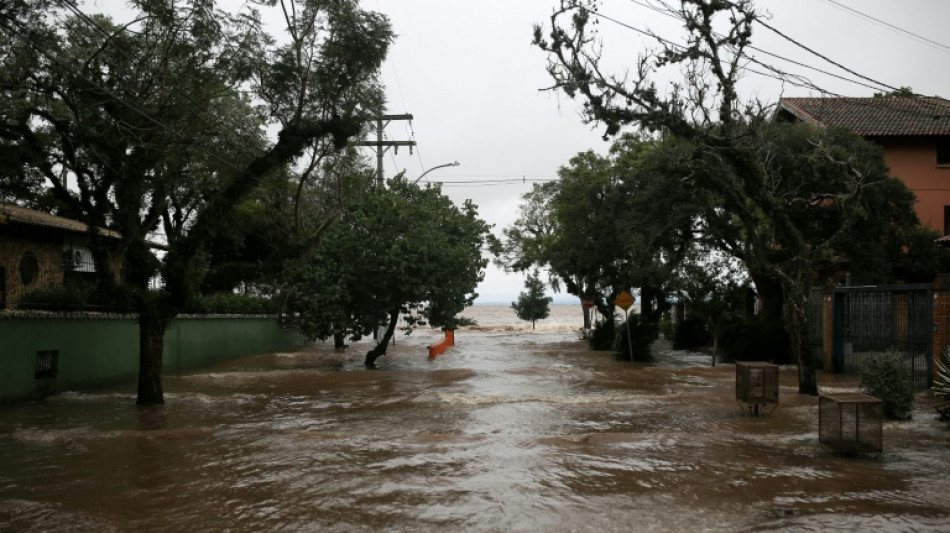
Brazil's flooded south paralyzed as rivers swell, again / Photo: ANSELMO CUNHA - AFP

 Kenya's economy faces climate change risks: World Bank
 Chipmaker Kioxia reports AI-driven 45-fold surge in quarterly net profit
 Far right and far left battle for power in polarised Berlin

 The last trio: S.Africa's zoo elephants await their fate
 Oil industry sees war windfall but girds for political blowback

 Amazon beats expectations with cloud and AI growth

 Blowout Microsoft results lift US stocks as oil retreats

 'Beginning of the end': Relief but no party as French wildfire winds down

 Southern Europe 'becoming more flammable' in hotter climate, experts say

 Mammoth bones found on parched bed of Danube in Bulgaria

 MEXC Lists Grvt (GRVT) with $60,000 Worth of GRVT and 10,000 USDT in Airdrop+ Rewards
 George and Amal Clooney flee French home due to wildfire

 MEXC Ventures Supports Alpha Arena's APAC Debut at Coinfest Bali

 AI data centre supplier Zhongji InnoLight slips on Hong Kong debut

 May, June heatwaves caused 2,877 extra deaths in England: govt

 BMW profit down a third as carmaker plans job cuts

 Seoul extends losses as most Asian markets drop, oil rises again

 Gambling.com Group Is Now Grandstand

 Meet the astronomer digging into the Milky Way's 'fossils'

 AI data centre supplier Zhongji InnoLight falls on Hong Kong debut

 Samsung operating profit up 1,800% in second quarter on AI boom

 Japanese population below 120 million for first time in decades

 US actor Jared Leto denies latest accusations of sexual assault

 Danube drops to 'historic lows' as fresh heatwave hits
 BTS pulls out of Grammys after Asian pop category introduction

Rivers in south Brazil rose anew Monday as flood rescue efforts intensified and President Luiz Inacio Lula da Silva conceded authorities had not been "prepared" for a disaster of such magnitude.
More than 600,000 people have been displaced by heavy rains, flooding and mudslides that have ravaged the southern Rio Grande do Sul state for about two weeks.
At least 147 people have been killed and more than 800 injured in the deluge, and rescuers searched Monday in boats and on jet skis for 127 people reported missing.
Hundreds of cities and towns and part of the regional capital Porto Alegre -- a bustling city of 1.4 million inhabitants -- have been under water for days, with streets turned into waterways.
"It is a catastrophe for which we were not prepared," Lula said in a conference call with Finance Minister Fernando Haddad and Rio Grande do Sul Governor Eduardo Leite.
The state remained paralyzed Monday, with some 360,000 pupils not in school, the international airport shuttered, and numerous roads and bridges impassable.
Many farms were also underwater in a region that supplies more than two-thirds of the rice consumed in Brazil. The federal government has said it would import 200,000 tons of rice to guarantee supplies and preempt price speculation.
Some 80,000 people have found refuge in schools, sports clubs and other buildings transformed into makeshift shelters.
The floods are the latest weather extreme to hit Brazil, following record-breaking forest fires, unprecedented heat waves and drought.
The government and experts have blamed the El Nino weather phenomenon, exacerbated by climate change.
Rains eased on Monday, but fresh downpours over the weekend caused rivers to swell once again.
"It is not the moment to return to homes in risk zones," Leite urged residents of affected areas on Monday.
- 'Endless drama' -
Lula put off a state visit to Chile to focus on the disaster, and said he would visit the region for a third time on Wednesday.
The president also announced he would propose suspending Rio Grande do Sul's debt payments to the state for a period of three years. The plan needs approval by Congress.
The Guaiba, an estuary bordering Porto Alegre which overflows when its level reaches three meters (about 9.8 feet), hit a historic high of 5.3 meters last week, and is rising again after receding briefly.
Municipal officials have erected a sandbag barrier in the city center to try and keep the deluge away from a water pumping station serving several neighborhoods of the capital.
In Canoas on the outskirts of Porto Alegre, residents were rescuing whatever belongings they could from their homes.
"It flooded in October, and now again. This time I lost everything," 58-year-old stonemason Alcedir Alves told AFP.
Leite said the worst-affected families will receive the equivalent of about $400 for "rebuilding their lives."
Brazil's federal government last week vowed some $10 billion for reconstruction.
"We are experiencing the aftermath of an endless drama here in Rio Grande do Sul," Deputy Governor Gabriel Souza told broadcaster Globo on Monday.
In Porto Alegre, aid workers continued to deliver food, drinking water, medicine and clothing -- much of it donated -- to displaced residents.
This is "the largest logistics operation in the history of the state," said Leite.
Among those seriously affected are about 80 Indigenous communities, according to the Indigenous Missionary Council of Brazil.
The government said it had delivered food parcels and drinking water for 240 Indigenous families in the Taquari Valley.
The heavy rains have also led to the flooding of the Uruguay River which flows between Brazil, Argentina, and Uruguay.
Argentine authorities said about 600 people had to be evacuated in the riverside city of Concordia and floodwaters were likely to rise even more.
A.Agostinelli--CPN