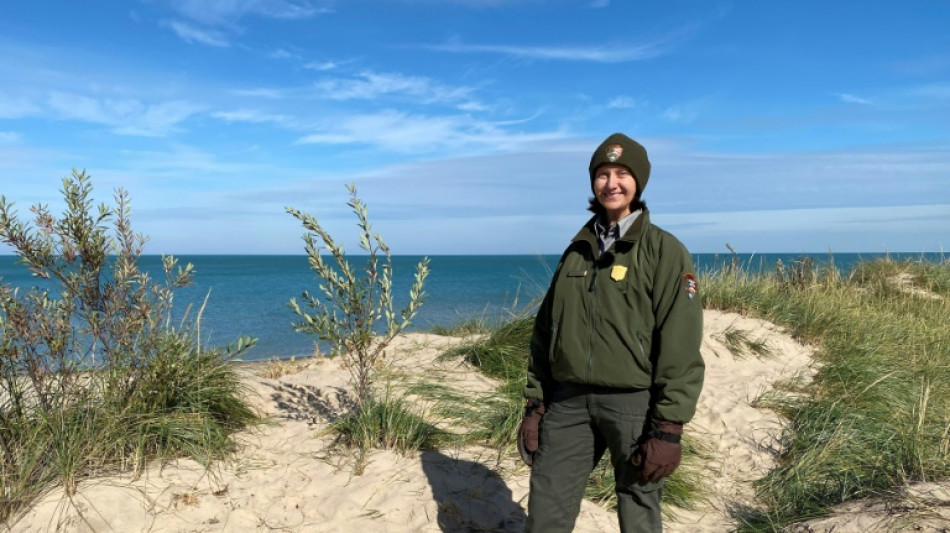
Loss and hope: US park rangers' climate crisis fight / Photo: Lucie AUBOURG - AFP

 Kenya's economy faces climate change risks: World Bank

 Chipmaker Kioxia reports AI-driven 45-fold surge in quarterly net profit
 Far right and far left battle for power in polarised Berlin

 The last trio: S.Africa's zoo elephants await their fate

 Oil industry sees war windfall but girds for political blowback

 Amazon beats expectations with cloud and AI growth

 Blowout Microsoft results lift US stocks as oil retreats

 'Beginning of the end': Relief but no party as French wildfire winds down

 Southern Europe 'becoming more flammable' in hotter climate, experts say

 Mammoth bones found on parched bed of Danube in Bulgaria

 MEXC Lists Grvt (GRVT) with $60,000 Worth of GRVT and 10,000 USDT in Airdrop+ Rewards

 George and Amal Clooney flee French home due to wildfire

 MEXC Ventures Supports Alpha Arena's APAC Debut at Coinfest Bali

 AI data centre supplier Zhongji InnoLight slips on Hong Kong debut

 May, June heatwaves caused 2,877 extra deaths in England: govt

 BMW profit down a third as carmaker plans job cuts

 Seoul extends losses as most Asian markets drop, oil rises again

 Gambling.com Group Is Now Grandstand

 Meet the astronomer digging into the Milky Way's 'fossils'

 AI data centre supplier Zhongji InnoLight falls on Hong Kong debut

 Samsung operating profit up 1,800% in second quarter on AI boom

 Japanese population below 120 million for first time in decades

 US actor Jared Leto denies latest accusations of sexual assault

 Danube drops to 'historic lows' as fresh heatwave hits

 BTS pulls out of Grammys after Asian pop category introduction

American biologist Laura Brennan describes the coin-sized Karner blue butterfly as "very delicate and graceful" with a "lovely blue" coloring and "just a little speckling of orange."
The species, declared endangered in 1992, used to flourish in Indiana Dunes National Park, where Brennan has worked for two decades.
But the butterfly is now believed to have disappeared entirely from the midwestern US park -- becoming a victim of rising temperatures fueled by human activity, among other stressors.
Brennan and thousands of others in the National Park Service (NPS) are witnessing firsthand the consequences of the climate crisis and struggling to mitigate its impacts.
In picturesque Glacier National Park, near the US-Canada border in Montana, biologist Dawn LaFleur is working to save an at-risk pine species.
"Pretty much everything we do is in light of climate change," she told AFP.
Some battles, like hers, seem winnable. Others are already lost.
In Indiana, the Karner blue butterfly (Plebejus samuelis) is the first known endangered species to have disappeared from an American national park due to global warming.
Though they remain in other places, their loss in the park was "heartbreaking" and "incredibly scary," Brennan told AFP.
It's "terrifying to know how fragile these systems are, and how interconnected everything is, and how little control we have," she said.
- 'Nothing to eat' -
John Gross with the NPS climate change response program told AFP that witnessing the crisis impacts "is hugely emotional" for park rangers.
"It's not a career for many people. It's a way of life," he said, explaining that many employees are the second or third generation in their families to work at the parks.
"So they're very connected to their resources and their parks and care very deeply about it."
Brennan grew up just a few hours from the Indiana Dunes site, which lies along Lake Michigan, some 40 miles (65 kilometers) east of Chicago.
In 2012, her beloved butterflies fell victim to what scientists call a "phenological mismatch."
Due to unusually warm springtime weather, the butterfly larvae emerged ahead of their plant food source, lupine.
"Plants are more reliant on soil temperatures, whereas insects are more reliant on the air temperatures" for seasonal transitions, she explained.
Once emerged, the larvae "have nothing to eat," she said.
"That was the beginning of the end of the Karner story here at Indiana Dunes National Park."
Strenuous efforts were made to restore the butterfly habitat -- as lupines need ample light to grow, major clearing operations were launched, but to no avail.
Models and research on how to make lands more "resilient" against climate change need to be ramped up, she said.
"We need the ability to remove those stressors faster."
- Genetic selection -
In Montana, the whitebark pine has been threatened for years by an invasive fungus known as blister rust, but is increasingly threatened by drought due to early snowmelts and changing weather patterns.
Declared endangered, the trees grow only in the western United States and Canada, and at high altitudes that are particularly sensitive to global warming.
With rising temperatures, mountain pine beetles also risk spreading to those higher altitudes, where they would then attack whitebark pines.
Saving the pines is essential, as their seeds provide food for many species, including grizzly bears and the Clark's nutcracker bird.
For over 20 years, some 1,000 whitebark pines have been replanted every year in Glacier National Park -- a difficult task due to the park's mountainous terrain.
The seeds are chosen after genetic testing for blister rust resistance, and increasingly for drought resistance, LaFleur said.
Having worked in the park for over three decades, she said the work can sometimes leave her feeling "overwhelmed."
"The more we spend in these environments, we realize how fragile they are in terms of the changes being wrought by climate change," she said.
Nonetheless, LaFleur said she remains hopeful about saving the pines.
"We can't change how hot and dry it gets in the summer now, for extended periods of time, we can't control that," she said philosophically.
"So it's more coming up with solutions to be able to adapt and direct our resources... to be able to really address what things we have control over and make a difference that way."
M.Anderson--CPN