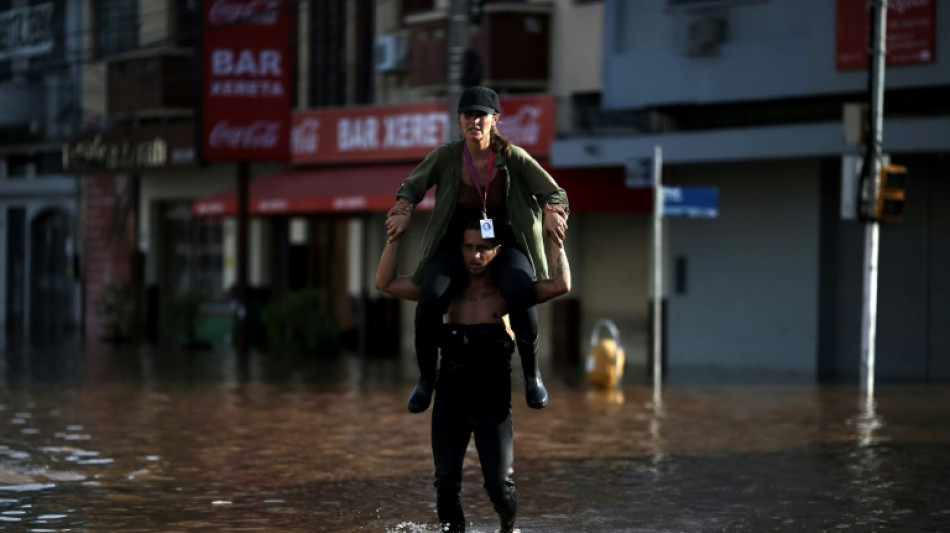
2023 'year of record climatic hazards' in Latin America: UN / Photo: Anselmo CUNHA - AFP

 Kenya's economy faces climate change risks: World Bank

 Chipmaker Kioxia reports AI-driven 45-fold surge in quarterly net profit

 Far right and far left battle for power in polarised Berlin

 The last trio: S.Africa's zoo elephants await their fate

 Oil industry sees war windfall but girds for political blowback

 Amazon beats expectations with cloud and AI growth

 Blowout Microsoft results lift US stocks as oil retreats

 'Beginning of the end': Relief but no party as French wildfire winds down

 Southern Europe 'becoming more flammable' in hotter climate, experts say

 Mammoth bones found on parched bed of Danube in Bulgaria

 MEXC Lists Grvt (GRVT) with $60,000 Worth of GRVT and 10,000 USDT in Airdrop+ Rewards

 George and Amal Clooney flee French home due to wildfire

 MEXC Ventures Supports Alpha Arena's APAC Debut at Coinfest Bali

 AI data centre supplier Zhongji InnoLight slips on Hong Kong debut

 May, June heatwaves caused 2,877 extra deaths in England: govt

 BMW profit down a third as carmaker plans job cuts

 Seoul extends losses as most Asian markets drop, oil rises again

 Gambling.com Group Is Now Grandstand

 Meet the astronomer digging into the Milky Way's 'fossils'

 AI data centre supplier Zhongji InnoLight falls on Hong Kong debut

 Samsung operating profit up 1,800% in second quarter on AI boom

 Japanese population below 120 million for first time in decades

 US actor Jared Leto denies latest accusations of sexual assault

 Danube drops to 'historic lows' as fresh heatwave hits

 BTS pulls out of Grammys after Asian pop category introduction

Latin America and the Caribbean had their warmest year on record in 2023 as a "double-whammy" of El Nino and climate change caused major weather calamities, the World Meteorological Organization said Wednesday.
Droughts, heatwaves, extreme rainfall and a record-breaking hurricane had major impacts on health, food and energy security, and economic development, the UN body said in a new report.
"Unfortunately, 2023 was a year of record climatic hazards in Latin America and the Caribbean, WMO Secretary-General Celeste Saulo said in a statement.
"El Nino conditions during the second half of 2023 contributed to a record warm year and exacerbated many extreme events. This combined with rising temperatures and more frequent and extreme hazards due to human-induced climate change," she added.
The report said the mean temperature for 2023 was the highest on record, with Mexico experiencing the fastest warming rate in the region.
Severe drought -- exacerbated by heatwaves -- affected large areas of Latin America, including much of Central America, forcing a reduction in shipping through the Panama Canal.
Further south, parts of Brazil, Peru, Bolivia, Paraguay and Argentina were stricken by wildfires amid record temperatures. Uruguay saw its drinking water supply pushed to the brink.
The report also listed Hurricane Otis, which caused 51 deaths and more than $3 billion in damages when it struck the Mexican resort city of Acapulco in October.
- 'Acute food crisis' -
Brazil was hit by extreme floods and landslides in 2023 that killed dozens of people and caused massive economic losses and displacement, said the WMO.
The South American giant is once again in the grip of floods ravaging its southern Rio Grande do Sul state, where the death toll on Wednesday reached 100.
The report said sea levels rose at a higher rate than the global average in much of the Atlantic part of the region, threatening coastal areas and small island states.
Climate disasters hit agriculture and food security, with 13.8 million people having faced "acute food crisis" -- especially in Central America and the Caribbean, according to the WMO.
Sea temperature rises also reduced fishing catches in countries like Peru and Ecuador.
The report said economic damage of about $21 billion was reported for the region in 2023, mainly due to storms. Almost half of the damage was associated with Hurricane Otis.
"The actual amount of damage is likely to be worse because of under-reporting and because data on impacts are not available for some countries," it added.
"This is especially the case for heat-related extremes."
The report showed that changing rainfall patterns and warming temperatures were widening the geographic distribution of diseases such as malaria.
"In 2019, over three million cases of dengue were reported in the Americas, the highest number on record. This number was exceeded in the first seven months of 2023," it said.
The findings, said the WMO, illustrated that the region must invest more in forecasting and early-warning systems.
C.Peyronnet--CPN