Rains, mudslides kill 29 in southern Brazil's 'worst disaster' / Photo: Anselmo Cunha - AFP

 Kenya's economy faces climate change risks: World Bank
 British oil giant BP aims to sell North Sea business

 China factory activity slides as leaders seek spending boost

 Tech rebound fuels record-breaking rally in South Korean stocks

 Cables and cooling bring AI windfall to Indian suppliers

 Anthropic's models gained unauthorized 'real-world' access during testing

 Apple tops estimates in CEO Cook's final quarter, but shares fall

 Milei demands expulsion of foreigners expressing 'hate' against Argentina

 Italy's Po River valley on drought alert

 Prada profits pinched as growth hard to chase

 Stocks climb on earnings and rates, oil retreats

 US economic growth slows in second quarter, missing expectations

 Russia adds Telegram founder Durov to 'terrorist' blacklist

 Stocks diverge on earnings, as oil steadies

 Eurozone economy grows despite Middle East war

 Singapore group will develop 'most promising' Ebola vaccine

 Shell profit surges as Mideast war fuels oil prices

 Car maker Stellantis says back in profit in second quarter

 Samsung quarterly operating profit up 1,800% on AI boom

 South Korean stocks bounce after rout, oil holds gains on Mideast woes

 South Korea's women web sleuths fight AI deepfake porn

 Anything but programmable: New cost-efficient EC-power-supply-series for the DIN rail by CAMTEC PS

 Meta misses profit expectations, sticks to massive AI spending

 Campari - king of the spritz - hopes to conquer American heartland
 Air France-KLM and Lufthansa bid for Portugal's TAP airline

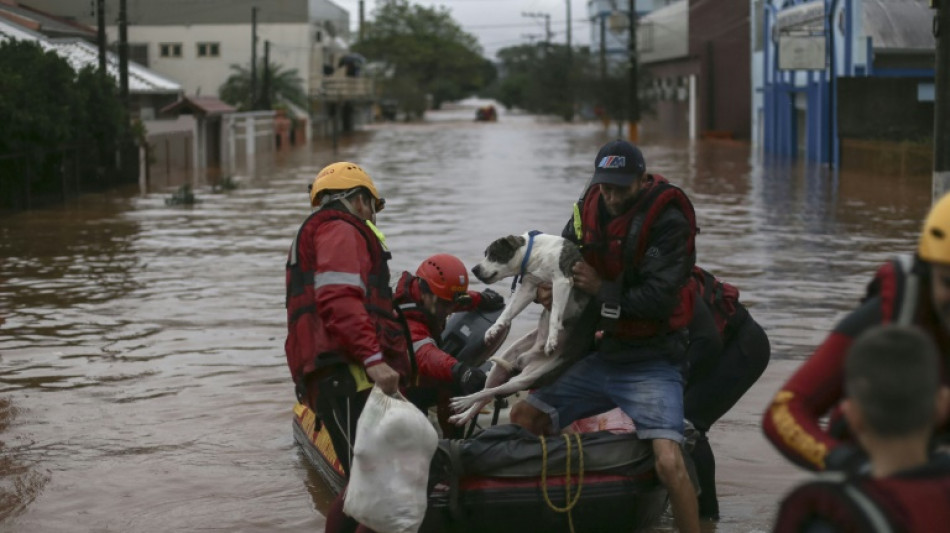
Brazilian President Luiz Inacio Lula da Silva on Thursday visited the country's south where floods and mudslides caused by torrential rains have killed 29 people, with the toll expected to rise.
Authorities in Rio Grande do Sul have declared a state of emergency as rescuers continue to search for dozens of people reported missing among the ruins of collapsed homes, bridges and roads.
Storm damage has affected nearly 150 municipalities in the state, also injuring at least a dozen people and displacing close to 10,000.
Governor Eduardo Leite said Rio Grande do Sul was dealing with "the worst disaster in (its) history."
In a live broadcast, he updated the death toll from 13 earlier Thursday to 29, and the number of people missing from 21 to 60.
"With the deepest pain in my heart, I know it will be even more," said the governor.
Lula, who has blamed the torrent on climate change, arrived in the town of Santa Maria in the morning with a delegation of ministers and held a working meeting with Leite and other officials to coordinate rescue efforts, the government said.
The president promised "there will be no lack of human or material resources" to "minimize the suffering this extreme event... is causing in the state."
The federal government, he added, "will be 100 percent at the disposition" of state officials.
Central authorities has already made available 12 aircraft, 45 vehicles and 12 boats as well as 626 soldiers to help clear roads, distribute food, water and mattresses, and set up shelters, a press statement said.
As the rains continued, forecasts warned the state's main Guaiba River, which has already overflowed its banks in some areas, would reach an extraordinary level of three meters (9.8 feet) by Thursday and four meters the next day.
- 'Completely destroyed' -
Entire communities in Rio Grande do Sul have been completely cut off as persistent rains have destroyed bridges and blocked roads, and left towns without even telephone or internet services.
Rescuers and soldiers have been scrambling to free families trapped in their homes, many stuck on rooftops to escape rising waters.
"I've never seen anything like this... it's all under water," said Raul Metzel, a 52-year-old machine operator in the municipality of Capela de Santana.
Authorities have urged people to avoid areas along state highways due to a risk of mudslides, and those who live near rivers or on hillsides to evacuate.
Hundreds of thousands of people have been left without access to electricity and drinking water, while classes have been suspended state-wide.
On Wednesday, the state's deputy governor, Gabriel Souza, said damages have been estimated at $20 million.
Mayor Sandra Backes of Sinimbu said the situation in her town was "a nightmare."
"Sinimbu is like a war zone, completely destroyed... All the stores, businesses, supermarkets -- everything is devastated," she said in a video posted on Instagram.
Elsewhere, in Santa Cruz do Sul, lifeguards used boats to transport residents, many of them children, to safety.
The region's rivers had already been swollen from previous storms.
Last September at least 31 people died as a cyclone hit the state.
South America's largest country has suffered a string of recent extreme weather events, which experts say are made more likely by climate change.
The floods came amid a cold front battering the south and southeast, following a wave of extreme heat.
L.K.Baumgartner--CPN