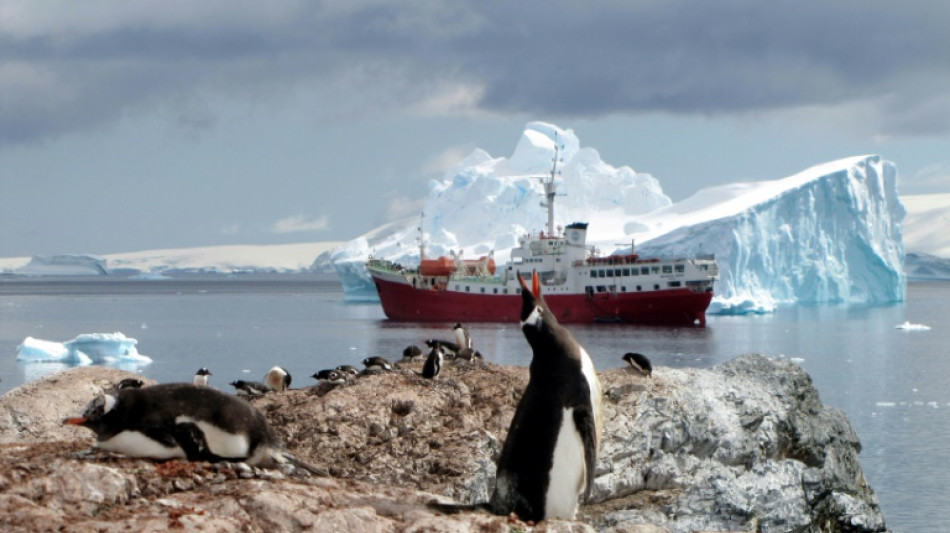
Emperor penguins perish as ice melts to new lows: study / Photo: SARAH DAWALIBI - AFP/File

 Kenya's economy faces climate change risks: World Bank

 British oil giant BP aims to sell North Sea business

 China factory activity slides as leaders seek spending boost

 Tech rebound fuels record-breaking rally in South Korean stocks
 Cables and cooling bring AI windfall to Indian suppliers

 Anthropic's models gained unauthorized 'real-world' access during testing

 Apple tops estimates in CEO Cook's final quarter, but shares fall

 Milei demands expulsion of foreigners expressing 'hate' against Argentina

 Italy's Po River valley on drought alert

 Prada profits pinched as growth hard to chase

 Stocks climb on earnings and rates, oil retreats

 US economic growth slows in second quarter, missing expectations

 Russia adds Telegram founder Durov to 'terrorist' blacklist

 Stocks diverge on earnings, as oil steadies

 Eurozone economy grows despite Middle East war

 Singapore group will develop 'most promising' Ebola vaccine

 Shell profit surges as Mideast war fuels oil prices

 Car maker Stellantis says back in profit in second quarter

 Samsung quarterly operating profit up 1,800% on AI boom

 South Korean stocks bounce after rout, oil holds gains on Mideast woes

 South Korea's women web sleuths fight AI deepfake porn

 Anything but programmable: New cost-efficient EC-power-supply-series for the DIN rail by CAMTEC PS

 Meta misses profit expectations, sticks to massive AI spending

 Campari - king of the spritz - hopes to conquer American heartland

 Air France-KLM and Lufthansa bid for Portugal's TAP airline

Colonies of emperor penguin chicks were wiped out last year as global warming eroded their icy homes, a study published Thursday found, despite the birds' attempts to adapt to the shrinking landscape.
The study by the British Antarctic Survey found that record-low sea ice levels in 2023 contributed to the second-worst year for emperor penguin chick mortality since observations began in 2018.
It follows a "catastrophic breeding failure" in 2022, signalling long-term implications for the population, the study's author Peter Fretwell told AFP.
Emperor penguins breed on sea-ice platforms, with chicks hatching in the winter between late July and mid-August.
The chicks are reared until they develop waterproof feathers, typically in December ahead of the summer melt.
But if the ice melts too early, the chicks risk drowning and freezing.
Fourteen of 66 penguin colonies, which can each produce several hundred to several thousand chicks in a year, were affected by early sea-ice loss in 2023, said the study published in the Journal of Antarctic Science.
The result is "high if not total levels of mortality", Fretwell said.
Yet 2023 "wasn't as bad as we feared", he said.
A record 19 colonies were affected the year before.
- On the move -
The study also found that several colonies, particularly those ravaged the previous year, had moved in search of better conditions onto icebergs, ice shelves or more stable sea ice.
While such moves offer a hopeful sign that the birds can adapt to the changing environment, Fretwell warned it was a "temporary solution".
"Penguins are limited in the amount of adaptation they can do. There are only so many places they can go," he said.
Instead, Fretwell said humans needed to adapt by reduce planet-heating greenhouse gas emissions that are contributing to ice melt to mitigate the main threat facing the species.
Both 2022 and 2023 were the first years to see the area of sea-ice fall below two million square kilometres (770,000 square miles) since the beginning of satellite records.
That marks a decine of about 30 percent from the 1981-2010 average.
There are about a quarter of a million breeding emperor penguin pairs, all in Antarctica, according to a 2020 study.
"If you get multiple bad years, it is going to start to drive the population down over time," Fretwell said.
The study noted that if greenhouse gas emissions continue at current levels, the penguin population is expected to decline by 99 percent by the end of the century.
M.Davis--CPN