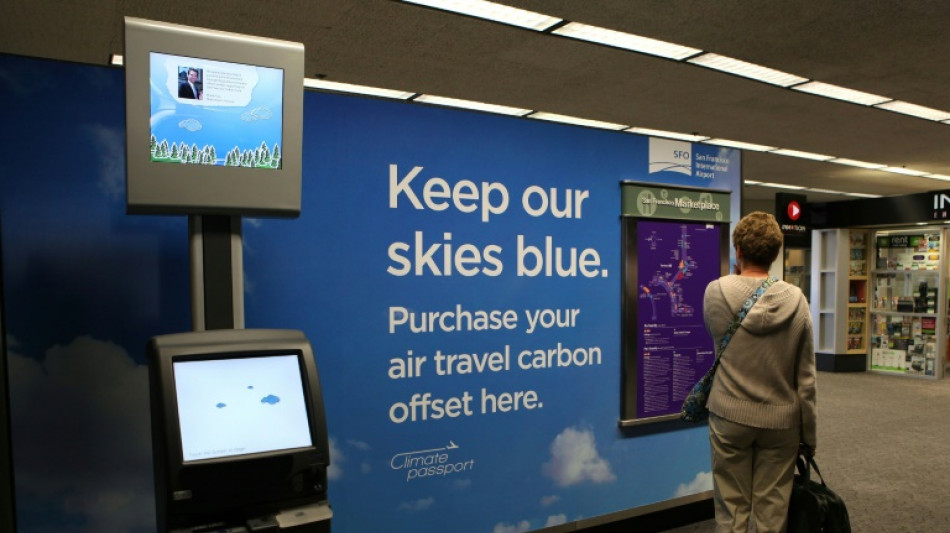
Corporate climate pledge weakened by carbon offsets move / Photo: JUSTIN SULLIVAN - GETTY IMAGES NORTH AMERICA/AFP/File

 Kenya's economy faces climate change risks: World Bank
 British oil giant BP aims to sell North Sea business

 China factory activity slides as leaders seek spending boost

 Tech rebound fuels record-breaking rally in South Korean stocks

 Cables and cooling bring AI windfall to Indian suppliers

 Anthropic's models gained unauthorized 'real-world' access during testing

 Apple tops estimates in CEO Cook's final quarter, but shares fall

 Milei demands expulsion of foreigners expressing 'hate' against Argentina

 Italy's Po River valley on drought alert

 Prada profits pinched as growth hard to chase

 Stocks climb on earnings and rates, oil retreats

 US economic growth slows in second quarter, missing expectations

 Russia adds Telegram founder Durov to 'terrorist' blacklist

 Stocks diverge on earnings, as oil steadies

 Eurozone economy grows despite Middle East war

 Singapore group will develop 'most promising' Ebola vaccine

 Shell profit surges as Mideast war fuels oil prices

 Car maker Stellantis says back in profit in second quarter

 Samsung quarterly operating profit up 1,800% on AI boom

 South Korean stocks bounce after rout, oil holds gains on Mideast woes

 South Korea's women web sleuths fight AI deepfake porn

 Anything but programmable: New cost-efficient EC-power-supply-series for the DIN rail by CAMTEC PS

 Meta misses profit expectations, sticks to massive AI spending

 Campari - king of the spritz - hopes to conquer American heartland

 Air France-KLM and Lufthansa bid for Portugal's TAP airline

The world's main benchmark for vetting corporate climate action has been accused by its own staff of "greenwashing" after allowing businesses to use carbon credits to offset pollution from their value chains.
The ruling by the Science-Based Targets Initiative (SBTi) was slammed as a "coup" on Thursday and has sparked a revolt by staff who want the decision reversed and the non-profit's CEO and board to resign.
Experts say it could irreversibly damage the credibility of the SBTi, which is partnered with the UN Global Compact and WWF, and is the gold standard for assessing the net zero plans of big business.
An internal letter sent to SBTi leadership, and seen by AFP, said the board's decision was taken without adequate consultation, defied science, and "resulted in significant harm to our organisation’s reputation and viability.
"We stand ready to support any efforts aimed at ensuring that the SBTi does not become a greenwashing platform where decisions are unduly influenced by lobbyists, driven by potential conflicts of interest and poor adherence to existing governance procedures," read the letter to SBTi's CEO and Board of Trustees.
"In the event that our concerns are not addressed, SBTi staff will have no choice but to take further action," it added, without elaborating on what that would mean.
It was signed by staff from "the Target Validation Team, Target Operations Team, the Technical Department, Communications, Impact and IT, and multiple department heads."
Comment has been sought from SBTi and the We Mean Business Coalition, one of its main partners.
- 'Extremely serious' -
On April 9, SBTi issued a statement rolling back its previous opposition to the use of carbon credits to offset Scope 3 emissions.
These occur in the value chain, and represents the lion's share of the carbon footprints -- in some cases more than 90 percent -- of most companies.
Carbon credits are generated by projects that reduce or avoid emissions -- like renewable energy, tree planting and forest protection -- and sold to companies wanting to offset pollution from their activities.
But critics say offsets give corporations a free pass to keep polluting without cleaning-up their act, and their usage to make claims of "carbon neutrality" has become increasingly contentious.
Gilles Dufrasne from Carbon Market Watch, who sits on the technical advisory group to SBTi, said allowing their usage by companies represented a "fundamental U-turn on SBTi policy so far".
"It is pretty much a coup from the board," he told AFP, adding at least one member of the advisory group had resigned in protest.
"It's extremely serious, I've never seen anything like it."
Verification by SBTi allows companies to say their climate plans align with science and the goals of the Paris agreement to limit global warming.
More than 4,000 companies and financial institutions have sought to have their net zero claims verified by SBTi, the nonprofit said.
Dufrasne said the decision was "extremely damaging" to corporate climate responsibility because it sent a signal that companies could just pay someone else if they can't meet their own targets.
"I'm not sure if SBTi's credibility can survive this," he said.
T.Morelli--CPN