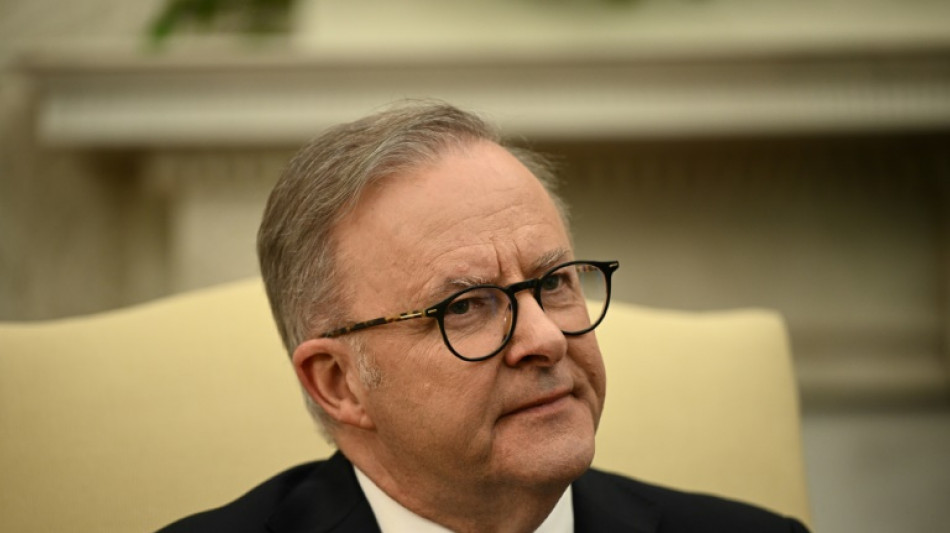
Australia PM unveils plan to overhaul economy, invest in green energy / Photo: Brendan SMIALOWSKI - AFP/File

 Kenya's economy faces climate change risks: World Bank
 British oil giant BP aims to sell North Sea business
 China factory activity slides as leaders seek spending boost

 Tech rebound fuels record-breaking rally in South Korean stocks

 Cables and cooling bring AI windfall to Indian suppliers

 Anthropic's models gained unauthorized 'real-world' access during testing

 Apple tops estimates in CEO Cook's final quarter, but shares fall

 Milei demands expulsion of foreigners expressing 'hate' against Argentina

 Italy's Po River valley on drought alert

 Prada profits pinched as growth hard to chase

 Stocks climb on earnings and rates, oil retreats

 US economic growth slows in second quarter, missing expectations

 Russia adds Telegram founder Durov to 'terrorist' blacklist

 Stocks diverge on earnings, as oil steadies

 Eurozone economy grows despite Middle East war

 Singapore group will develop 'most promising' Ebola vaccine

 Shell profit surges as Mideast war fuels oil prices

 Car maker Stellantis says back in profit in second quarter

 Samsung quarterly operating profit up 1,800% on AI boom

 South Korean stocks bounce after rout, oil holds gains on Mideast woes

 South Korea's women web sleuths fight AI deepfake porn

 Anything but programmable: New cost-efficient EC-power-supply-series for the DIN rail by CAMTEC PS

 Meta misses profit expectations, sticks to massive AI spending

 Campari - king of the spritz - hopes to conquer American heartland

 Air France-KLM and Lufthansa bid for Portugal's TAP airline

Mining superpower Australia will on Thursday announce a US-style scheme to pour public money into manufacturing and clean energy industries, joining the global race to build a cleaner and more resilient economy.
Prime Minister Anthony Albanese will unveil the "Future Made in Australia Act" to help compete with global partners who are providing massive subsidies to new industries, according to an advance copy of his speech.
The act, to be passed this year, would mark a departure from Australia's decades-old free market policies on trade and investment.
"We need to be willing to break with old orthodoxies and pull new levers to advance the national interest," the centre-left Labor Party prime minister will say.
Though no figures are given, the taxpayer-funded incentive scheme aims to compete with other nations' efforts, such as US President Joe Biden's massive investments through the US Inflation Reduction Act.
Other trading partners, including China, the European Union, Canada and Japan have also invested in their industrial base and manufacturing capabilities.
"Australia can't afford to sit on the sidelines. Being in the race does not guarantee our success – but sitting it out guarantees failure," Albanese will say, according to the advance copy of his speech.
Albanese will describe the climatic and economic changes underway as "every bit as significant as the industrial revolution or the information revolution – and more rapid and wide-ranging than both".
"We have to think differently about what government can -- and must -- do to work alongside the private sector to grow the economy, boost productivity, improve competition and secure our future prosperity."
Albanese will deliver the speech in the northeast state of Queensland, a key electoral battleground and the heartland of the country's gas and coal industries.
- 'Sharper elbows' -
Australia could not match the United States' investment dollar for dollar, he will say, but the country would be able to compete for international investment.
A world-leading exporter of minerals such as iron ore and coal, resource-rich Australia will not just play to its "traditional strengths", he said, but also offer new products and services to new markets.
"We need this change in thinking and approach because the global economic circumstances are changing in ways far more profound than the consequences of the pandemic or conflict alone," Albanese will say.
"We need sharper elbows when it comes to marking out our national interest."
The act would boost investment in Australia's renewable energy resources, including battery production, like green hydrogen, green metals, create more jobs and ensure a competitive economy, he will say.
Tim Buckley, director of independent public interest think tank Climate Energy Finance, said the act would lay the foundations to make Australia a zero-emissions trade and investment leader and global clean energy "superpower".
About 27 percent of the Australian economic output came from exports to international partners and this new act would have flow-on effects and help them decarbonise as well, Buckley told AFP.
"State intervention is the new competition. We can't afford to 'sit it out'. The Future Made In Australia Act puts Australia into the global race. It is the investment signal and de-risking private capital needs," he said.
But he said greater details were needed to ensure that local, state and federal governments worked together on ensuring the act was rolled out smoothly.
C.Smith--CPN