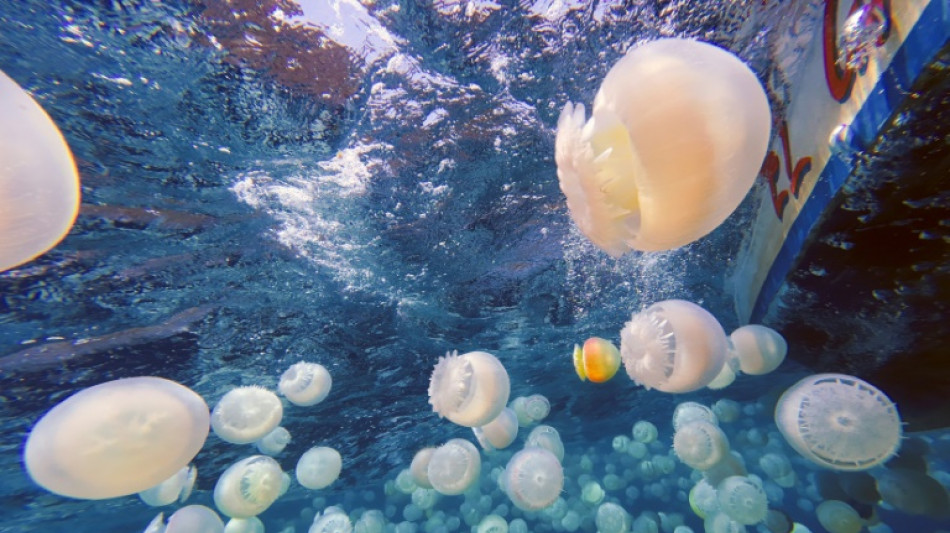
Jellyfish invade Venezuelan waters, worrying fishermen / Photo: Juan BARRETO - AFP

 Kenya's economy faces climate change risks: World Bank
 British oil giant BP aims to sell North Sea business

 China factory activity slides as leaders seek spending boost

 Tech rebound fuels record-breaking rally in South Korean stocks
 Cables and cooling bring AI windfall to Indian suppliers

 Anthropic's models gained unauthorized 'real-world' access during testing

 Apple tops estimates in CEO Cook's final quarter, but shares fall

 Milei demands expulsion of foreigners expressing 'hate' against Argentina

 Italy's Po River valley on drought alert

 Prada profits pinched as growth hard to chase

 Stocks climb on earnings and rates, oil retreats

 US economic growth slows in second quarter, missing expectations

 Russia adds Telegram founder Durov to 'terrorist' blacklist

 Stocks diverge on earnings, as oil steadies

 Eurozone economy grows despite Middle East war

 Singapore group will develop 'most promising' Ebola vaccine

 Shell profit surges as Mideast war fuels oil prices

 Car maker Stellantis says back in profit in second quarter

 Samsung quarterly operating profit up 1,800% on AI boom

 South Korean stocks bounce after rout, oil holds gains on Mideast woes

 South Korea's women web sleuths fight AI deepfake porn

 Anything but programmable: New cost-efficient EC-power-supply-series for the DIN rail by CAMTEC PS

 Meta misses profit expectations, sticks to massive AI spending

 Campari - king of the spritz - hopes to conquer American heartland

 Air France-KLM and Lufthansa bid for Portugal's TAP airline

A thick bloom of varying hues drifts in the turquoise waters of Aragua in Venezuela, a surreal vision attributed to climate change that has decimated fishing stocks.
"It is like there are flowers in the sea. This has never happened before," said Elvis Morillo, 59, a fisherman in the northern village of Chuao, where verdant mountains hug the Caribbean coast.
The invasive cannonball jellyfish is filling fishermen's nets, in a surge the environment ministry attributes to warming waters from climate change and a decline in jellyfish predators such as sharks and sea turtles.
At the same time, "sardines and other species that serve as fishing bait have disappeared. Fishing is at its lowest level in years," said Gustavo Carrasquel, of the NGO Azul Ambientalistas, who lives in Choroni, a town neighboring Chuao.
Globally, jellyfish populations have soared. Researchers have warned of a tipping point in which the oceans could go from being dominated by fish populations, to jellyfish -- mostly as a result of overfishing.
The gelatinous creatures, which do not have a heart, brain or complex organs, thrive in harsh conditions and need little oxygen.
This is an "atypical event, completely abnormal," said Joxmer Scott-Frias, a researcher at the Institute of Zoology and Tropical Ecology at the Central University of Venezuela.
"A few individuals had been observed in recent years, but the increase in the population this year exceeded previous estimates," he said while collecting samples of the jellyfish for study.
Scott-Frias said the reasons for the surge were not yet clear.
The jellyfish bloom and the presence of the invasive coral Unomia stolonifera, which smothers native corals, have become a headache for local fishermen.
"It has been almost nine months without fish production," said Fernando Mayora, head of the fishermen's council in Choroni.
"With the problem of jellyfish and invasive corals, we don't know what to do. The fish have disappeared," he said.
In Chuao, fishermen who would bring in between 3,000 and 5,000 kilograms a week have seen their yields drop to between 500 and 1,000 kilograms, said Douglas Martinez, 44, a fisherman.
Mayora said that Venezuela should draw inspiration from countries such as Mexico, which exploits jellyfish commercially, exporting it to Asian countries where it is used in gastronomy or the pharmaceutical industry.
"We need to know if we can take advantage of this in Venezuela," he said.
J.Bondarev--CPN