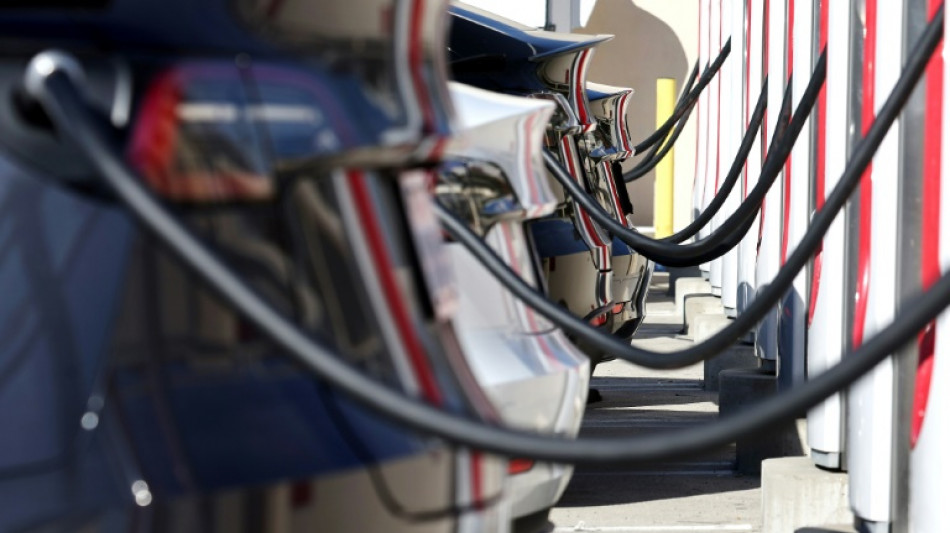
Electric cars credited with lower CO2 emissions in US neighborhoods / Photo: MARIO TAMA - GETTY IMAGES NORTH AMERICA/AFP

 Kenya's economy faces climate change risks: World Bank
 British oil giant BP aims to sell North Sea business

 China factory activity slides as leaders seek spending boost

 Tech rebound fuels record-breaking rally in South Korean stocks

 Cables and cooling bring AI windfall to Indian suppliers

 Anthropic's models gained unauthorized 'real-world' access during testing

 Apple tops estimates in CEO Cook's final quarter, but shares fall

 Milei demands expulsion of foreigners expressing 'hate' against Argentina

 Italy's Po River valley on drought alert

 Prada profits pinched as growth hard to chase

 Stocks climb on earnings and rates, oil retreats

 US economic growth slows in second quarter, missing expectations

 Russia adds Telegram founder Durov to 'terrorist' blacklist

 Stocks diverge on earnings, as oil steadies

 Eurozone economy grows despite Middle East war

 Singapore group will develop 'most promising' Ebola vaccine

 Shell profit surges as Mideast war fuels oil prices

 Car maker Stellantis says back in profit in second quarter

 Samsung quarterly operating profit up 1,800% on AI boom

 South Korean stocks bounce after rout, oil holds gains on Mideast woes

 South Korea's women web sleuths fight AI deepfake porn

 Anything but programmable: New cost-efficient EC-power-supply-series for the DIN rail by CAMTEC PS

 Meta misses profit expectations, sticks to massive AI spending

 Campari - king of the spritz - hopes to conquer American heartland

 Air France-KLM and Lufthansa bid for Portugal's TAP airline

The booming use of electric vehicles in parts of California is reducing CO2 emissions in those areas, a study showed Thursday, bolstering a key pillar of the state's drive towards net zero.
Scientists at the University of California, Berkeley, say a network of sensors set up around the San Francisco Bay Area -- where Teslas and other EVs are a common sight -- has logged a small but steady drop in the volume of planet-warming carbon dioxide being pumped out every year.
"We show from atmospheric measurements that adoption of electric vehicles is working, that it's having the intended effect on CO2 emissions," said chemistry professor Ronald Cohen, the study's lead author.
Carbon dioxide is one of the main contributors to global warming, the human-caused phenomenon of rising temperatures that is increasingly playing havoc with global weather patterns.
Scientists agree that nations have to rapidly shift away from burning fossil fuels in order to keep global temperature rises to a manageable level and avoid the worst environmental calamities.
More than two-thirds of CO2 emissions come from cities, but granular information about those emissions is scant -- leaving policymakers guessing at how best to tamp them down.
Cohen's network of dozens of sensors, which he started installing in 2012, has started to change that. It logged a 1.8 percent drop in emissions every year over a five-year period.
Cross-referencing this data with vehicle registration information in the Bay Area -- where almost one in every 20 vehicles is electric or hybrid -- led Cohen and his team to conclude electrification was having a measurable effect.
"The state of California has an ambition to be net zero in 2045 and that requires a decrease (in emissions) of a little more than three and a half percent per year for the next 20 plus years," Cohen told AFP.
"1.8 percent per year is half the rate that we need to decrease. But I think it's an amazing down payment on our way to the right future."
- 'Good news' -
California's ambitious plan for net zero -- where CO2 production is vastly reduced and any remaining emissions are offset -- puts it ahead of the 2050 target of the United States as a whole.
The state, which if it were a country would have the fifth-biggest economy in the world, has some of the strictest environmental standards in the United States, including a plan to ban the sale of new gas-powered cars by 2035.
Cohen, who plans to roll out his sensor network in Los Angeles, in Providence, Rhode Island and in the Scottish city of Glasgow, acknowledges that the Bay Area's enthusiastic adoption of EVs in a state sympathetic to the cause makes it an atypical case study.
"This is what a good news story looks like in the place that's most aggressive," he said.
"But it shows it's possible. It shows both how we can make measurements that allow us to report on how cities are doing with their policies, and it shows us those policies can make changes that are observable at scale," he said.
Y.Uduike--CPN