Rising temperatures upend migratory bird habitats in Albania
/ Photo: Adnan Beci - AFP

 Kenya's economy faces climate change risks: World Bank

 British oil giant BP aims to sell North Sea business

 China factory activity slides as leaders seek spending boost

 Tech rebound fuels record-breaking rally in South Korean stocks
 Cables and cooling bring AI windfall to Indian suppliers

 Anthropic's models gained unauthorized 'real-world' access during testing

 Apple tops estimates in CEO Cook's final quarter, but shares fall

 Milei demands expulsion of foreigners expressing 'hate' against Argentina

 Italy's Po River valley on drought alert

 Prada profits pinched as growth hard to chase

 Stocks climb on earnings and rates, oil retreats

 US economic growth slows in second quarter, missing expectations

 Russia adds Telegram founder Durov to 'terrorist' blacklist

 Stocks diverge on earnings, as oil steadies

 Eurozone economy grows despite Middle East war

 Singapore group will develop 'most promising' Ebola vaccine

 Shell profit surges as Mideast war fuels oil prices

 Car maker Stellantis says back in profit in second quarter

 Samsung quarterly operating profit up 1,800% on AI boom

 South Korean stocks bounce after rout, oil holds gains on Mideast woes

 South Korea's women web sleuths fight AI deepfake porn

 Anything but programmable: New cost-efficient EC-power-supply-series for the DIN rail by CAMTEC PS

 Meta misses profit expectations, sticks to massive AI spending

 Campari - king of the spritz - hopes to conquer American heartland

 Air France-KLM and Lufthansa bid for Portugal's TAP airline

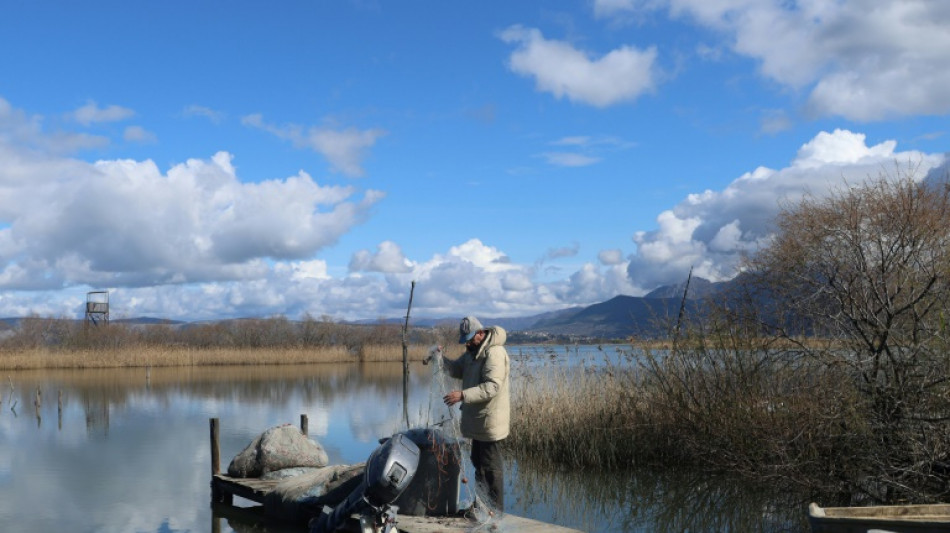
Long considered a Garden of Eden for migratory birds, the Vain Lagoon along the northern Albanian coast has been increasingly abandoned by a range of species as rising temperatures wreak havoc on wetlands across the country.
Millions of birds pass through Albanian lagoons and estuaries during flights north every year, providing critical grounds for migratory species travelling between northern Europe and Africa.
The Vain Lagoon covers more than 3,000 hectares (7,400 acres) stretched along the Adriatic Sea and is home to 196 species of migratory birds.
Long-legged flamingos with bright pink plumage, black-headed gulls, slender egrets, whistling ducks and teals with their raspy birdsong are among the species that frequent the area.
But their numbers are in steep decline, according to experts.
At least 40 percent of the total migratory bird populations were missing in January, the latest survey reported. For several years, the mallard duck has all but disappeared.
Scientists say that poaching, poisoning, collision with power lines and loss of habitat kills migratory birds by the thousands every year. But spiking temperatures across the globe may prove even more disruptive.
"There are many reasons, but above all it is global warming which has affected migration and breeding seasons," said Kreshnik Toni, who oversees the protected nature reserves in Lezhe, which includes the Vain Lagoon.
Local fishermen have also blamed warming waters for the overall decline in fish populations in the area, depriving the birds of vital food supplies.
"Water temperatures, rising sea levels and other factors have led to a decline in fish stocks," said Nikolle Lucaj, who has been fishing commercially in the area for 35 years.
Once abundant, the population of eels -- a favoured prey for many bird species -- in the area has dropped by as much as 80 percent, said Cel Arifi, who oversees fishing operations at the Vain Lagoon.
Invasive species like blue crab, which are native to the waters of the West Atlantic, have also threatened the biodiversity of wetlands in Albania.
"They attack birds and they are very aggressive even towards flamingos," Lucaj told AFP.
Pollution along with the degradation and destruction of the birds' habitat by humans also poses a significant risk, warned Mirjan Topi, the author of the first field guide of birds in Albania.
A young stork carrying a GPS device that tracked its migration in real time died last year in Greece after hitting an electricity pole.
- 'Global problem' -
Some birds, like white storks -- an endangered species -- spent less time in Africa this year only to return much earlier than expected to Albania, according to conservationists.
Scientists have also been closely watching a pair of mated storks for the past seven years, with the couple nesting at the same spot in Albania.
"But another pair of storks preferred to spend the winter in Albania rather than take the risk of a long and perilous migration to Africa," said Taulant Bino, who chairs the Albanian Ornithological Association (ASO).
Worried Albanian ornithologists are also impatiently awaiting the return of an Egyptian vulture from Chad, which is equipped with a GPS device.
The sacred bird of the pharaohs, which is now endangered, "is exposed to a lot of danger during this journey of more than 5,000 kilometres (3,100 miles) across three continents" said Ledi Selgjekaj, a biologist working with the Protection and Preservation of Natural Environment in Albania group.
The European population of the Egyptian vulture alone has fallen by 50 percent since the 1970s. In the Balkans, it has declined by 80 percent over the past 30 years alone, according to Topi, who wrote the field guide on Albanian birds.
In Albania there are only five couples left, Topi added.
To preserve the dwindling population, ornithologists groups from Albania and Greece have built secure sites aimed at eliminating threats during breeding.
"No country can fight the battle alone," said Bino from ASO. "Climate change and the risks that migratory birds face during their journeys are a global problem."
L.Peeters--CPN