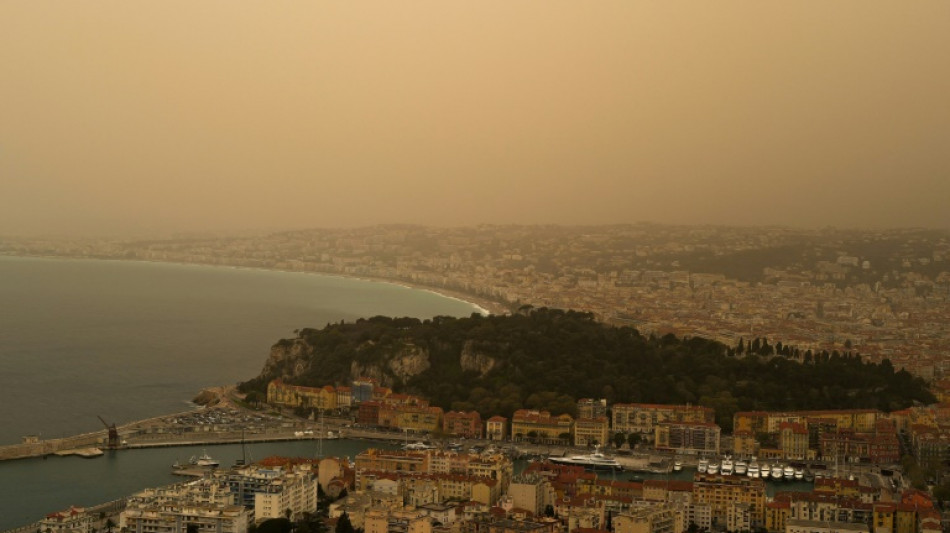
Saharan dust smothers Switzerland, southeast France / Photo: Valery HACHE - AFP

 Kenya's economy faces climate change risks: World Bank
 British oil giant BP aims to sell North Sea business
 China factory activity slides as leaders seek spending boost
 Tech rebound fuels record-breaking rally in South Korean stocks
 Cables and cooling bring AI windfall to Indian suppliers
 Anthropic's models gained unauthorized 'real-world' access during testing

 Apple tops estimates in CEO Cook's final quarter, but shares fall

 Milei demands expulsion of foreigners expressing 'hate' against Argentina

 Italy's Po River valley on drought alert

 Prada profits pinched as growth hard to chase

 Stocks climb on earnings and rates, oil retreats

 US economic growth slows in second quarter, missing expectations

 Russia adds Telegram founder Durov to 'terrorist' blacklist

 Stocks diverge on earnings, as oil steadies

 Eurozone economy grows despite Middle East war

 Singapore group will develop 'most promising' Ebola vaccine

 Shell profit surges as Mideast war fuels oil prices

 Car maker Stellantis says back in profit in second quarter

 Samsung quarterly operating profit up 1,800% on AI boom

 South Korean stocks bounce after rout, oil holds gains on Mideast woes

 South Korea's women web sleuths fight AI deepfake porn

 Anything but programmable: New cost-efficient EC-power-supply-series for the DIN rail by CAMTEC PS
 Meta misses profit expectations, sticks to massive AI spending

 Campari - king of the spritz - hopes to conquer American heartland
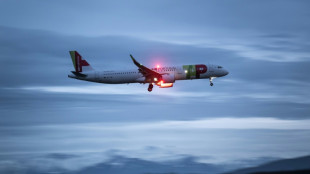 Air France-KLM and Lufthansa bid for Portugal's TAP airline

An exceptionally rare haze of Saharan dust cloaked Switzerland and southeastern France on Saturday, sparking health warnings as a yellow hue tinged the sky.
The phenomenon, which began in Switzerland on Friday, brings with it "a very clear worsening of sunlight and visibility. Added to that is an increase in concentrations of fine particles", the MeteoSuisse weather service posted on X.
With the dust concentrated at lower than 3,000 metres (around 9,800 feet), air quality was especially affected, with Switzerland's airCHeck monitoring application flagging high levels of pollution in a corridor stretching from the southwest to the northeast.
Calculations estimate that the amount of dust reached around 180,000 tonnes, double the levels recorded during recent similar events, SRF Meteo forecaster Roman Brogli told public radio.
In neighbouring France, local authorities in the southeast and south announced that the air pollution threshold was breached on Saturday, with the Herault department asking residents to avoid intense physical effort, particularly those with heart or respiratory problems.
The Sahara desert releases 60 to 200 million tonnes of mineral dust per year. While the largest particles come rapidly back down to earth, the smallest can travel thousands of kilometres.
The sand gives an orange tint to snow and can impact melting processes, notably for glaciers, which are shrinking as average temperatures rise, by reducing the ice's ability to reflect sunlight.
The situation is due to improve in France and Switzerland on Sunday.
A.Samuel--CPN