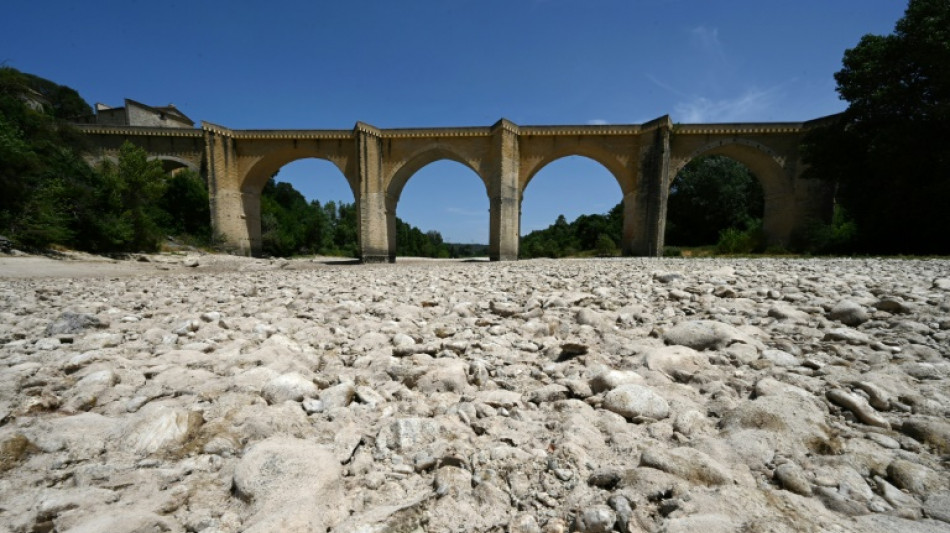
Climate change is slowing heat waves, prolonging misery / Photo: Pascal GUYOT - AFP/File

 Kenya's economy faces climate change risks: World Bank
 British oil giant BP aims to sell North Sea business

 China factory activity slides as leaders seek spending boost

 Tech rebound fuels record-breaking rally in South Korean stocks

 Cables and cooling bring AI windfall to Indian suppliers

 Anthropic's models gained unauthorized 'real-world' access during testing

 Apple tops estimates in CEO Cook's final quarter, but shares fall

 Milei demands expulsion of foreigners expressing 'hate' against Argentina

 Italy's Po River valley on drought alert

 Prada profits pinched as growth hard to chase

 Stocks climb on earnings and rates, oil retreats

 US economic growth slows in second quarter, missing expectations

 Russia adds Telegram founder Durov to 'terrorist' blacklist

 Stocks diverge on earnings, as oil steadies

 Eurozone economy grows despite Middle East war

 Singapore group will develop 'most promising' Ebola vaccine

 Shell profit surges as Mideast war fuels oil prices

 Car maker Stellantis says back in profit in second quarter

 Samsung quarterly operating profit up 1,800% on AI boom

 South Korean stocks bounce after rout, oil holds gains on Mideast woes

 South Korea's women web sleuths fight AI deepfake porn

 Anything but programmable: New cost-efficient EC-power-supply-series for the DIN rail by CAMTEC PS

 Meta misses profit expectations, sticks to massive AI spending

 Campari - king of the spritz - hopes to conquer American heartland

 Air France-KLM and Lufthansa bid for Portugal's TAP airline

Climate change is causing heat waves to slow to a crawl, exposing humans to extreme temperatures for longer than ever before, a study published in Science Advances said Friday.
While previous research has found climate change is causing heat waves to become longer, more frequent and more intense, the new paper differed by treating heat waves as distinct weather patterns that move along air currents, just as storms do.
For every decade between 1979 to 2020, researchers found heat waves slowed down by an average of five miles (eight kilometers) an hour per day.
"If a heatwave is moving slower, that means heat can stay in a region longer, so that has effects on communities," senior author Wei Zhang of Utah State University told AFP.
The researchers divided the world into three dimensional-grid cells and defined heat waves as a million square kilometer zones where temperatures reached at least the 95th percentile of the local historical maximum temperature. They then measured their movement over time in order to determine how fast the hot air was moving.
They also used climate models to determine what the results would have looked like absent human-caused climate change, and found manmade factors loomed large.
"It's pretty clear to us that a dominant factor here to explain this trend is anthropogenic forcing, the greenhouse gas," said Zhang.
The changes have accelerated in particular since 1997 and in addition to human causes, weakening upper atmospheric air circulation may play a part, the paper said.
The duration of heat waves also increased, from an average of eight days at the start, to 12 days during the last five years of the study period.
"The results suggest that longer-traveling and slower-moving large contiguous heat waves will cause more devastating impacts on natural and societal systems in the future if GHG keep rising, and no effective mitigation measures are taken," the authors wrote.
Zhang said he was worried by the disproportionate impacts on less-developed regions.
"In particular, cities that don't have enough green infrastructure or not many cooling centers for some folks, in particular for the disadvantaged population, will be very dangerous," he warned.
la-ia/mdl
C.Peyronnet--CPN