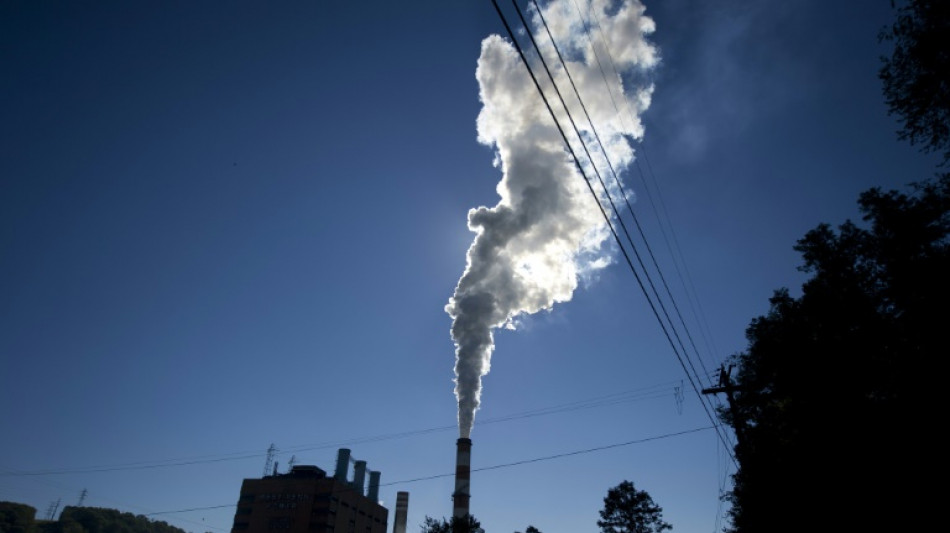
UK greenhouse gas emissions fell 5.4% in 2023: data / Photo: JEFF SWENSEN - GETTY IMAGES NORTH AMERICA/AFP/File

 Nintendo producer 'all nervous' as Zelda classic remake hits shelves

 Three killed by storm in southern India

 Two hundred 'Cruise for life' passengers stranded in Cambodia

 Billionaire Ambani's Jio jumps 21% in market debut after record India IPO

 Sri Lanka's Tamil farmers fight to reclaim land after civil war

 'They don't care about us': Trump food aid cuts leave Americans struggling and angry

 Palestinian activist Khalil returns to Columbia after US detention

 Youths testify about 'despair' in unprecedented Canadian climate trial

 Storied Paris department store seeks bankruptcy protection

 Boeing shares tumble after it releases cautious growth forecast

UK greenhouse gas emissions fell by 5.4 percent in 2023, largely due to a reduction in the amount of gas used in power stations, according to official data published on Thursday.
Net emissions of all greenhouse gases were estimated to have been 384.2 million tonnes of carbon dioxide equivalent in 2023, compared to 406.2 million tonnes in 2022, the government's provisional figures showed.
Carbon dioxide emissions decreased by 6.6 percent annually to 302.8 million tonnes, part of a 52.7-percent decrease in total greenhouse gas emissions since 1990.
Gas use for electricity generation fell 21.1 percent in 2023, "primarily due to higher electricity imports from France, as well as UK electricity demand continuing to decline", said the report.
The reduced demand is mainly due to "greater efficiency resulting from improvements in technology and a decline in the relative importance of energy-intensive industries", it added.
High energy prices are also likely to have been a factor, with less fuel being used to heat buildings and by industry, said the report.
Nuclear and renewables accounted for 56.7 percent of fuel used for electricity generation in 2023, up from 22.2 percent in 1990.
Domestic transport remained the largest source of UK emissions, accounting for 29.1 percent in 2023, almost all of which are from carbon dioxide, the main source being the use of petrol and diesel in road vehicles.
However, the sector's emissions decreased by 1.4 percent in 2023, the first fall since 2020 when travel was heavily restricted due to the Covid-19 pandemic.
Germany in January reported a 9.8 percent fall in carbon dioxide emissions in 2023 due to the sharp decline in coal consumption and crisis in its industrial sector.
And France last week said its domestic greenhouse gas emissions had fallen by 4.8 percent over the same period.
Y.Tengku--CPN