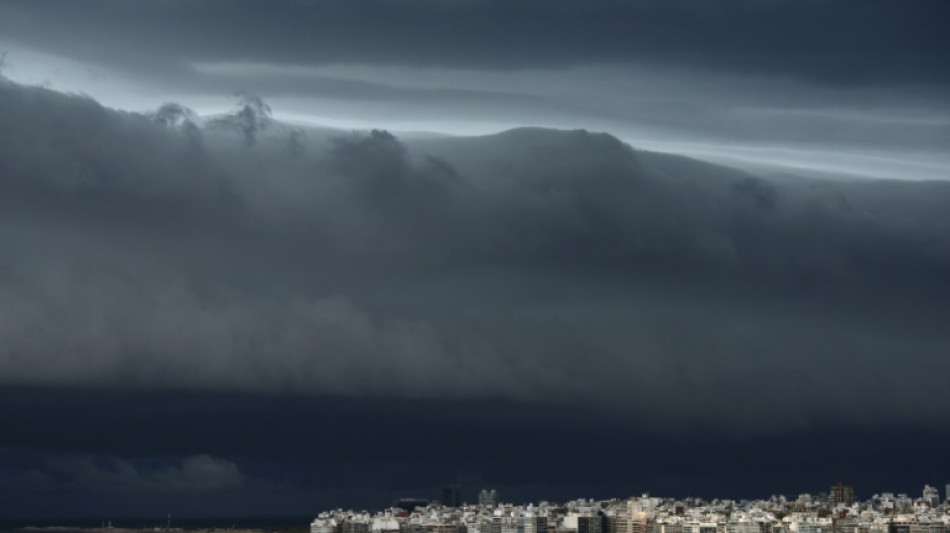
Swiss Re warns insured disaster losses could double in a decade / Photo: Mariana SUAREZ - AFP/File

 Kenya's economy faces climate change risks: World Bank
 British oil giant BP aims to sell North Sea business

 China factory activity slides as leaders seek spending boost

 Tech rebound fuels record-breaking rally in South Korean stocks

 Cables and cooling bring AI windfall to Indian suppliers

 Anthropic's models gained unauthorized 'real-world' access during testing

 Apple tops estimates in CEO Cook's final quarter, but shares fall

 Milei demands expulsion of foreigners expressing 'hate' against Argentina

 Italy's Po River valley on drought alert

 Prada profits pinched as growth hard to chase

 Stocks climb on earnings and rates, oil retreats

 US economic growth slows in second quarter, missing expectations

 Russia adds Telegram founder Durov to 'terrorist' blacklist

 Stocks diverge on earnings, as oil steadies

 Eurozone economy grows despite Middle East war

 Singapore group will develop 'most promising' Ebola vaccine

 Shell profit surges as Mideast war fuels oil prices

 Car maker Stellantis says back in profit in second quarter

 Samsung quarterly operating profit up 1,800% on AI boom

 South Korean stocks bounce after rout, oil holds gains on Mideast woes

 South Korea's women web sleuths fight AI deepfake porn

 Anything but programmable: New cost-efficient EC-power-supply-series for the DIN rail by CAMTEC PS

 Meta misses profit expectations, sticks to massive AI spending

 Campari - king of the spritz - hopes to conquer American heartland

 Air France-KLM and Lufthansa bid for Portugal's TAP airline

Insured property losses could double in the coming decade due to climate change and more frequent and more intense severe weather events, reinsurance giant Swiss Re warned Tuesday.
The Zurich-based group -- which acts as an insurer for insurers -- also highlighted the rising costs from hailstorms.
Natural disasters caused $280 billion in damage worldwide in 2023, including $108 billion covered by insurance companies, Swiss Re said in its annual overview of the cost of disasters and natural catastrophes.
The total amount of damage, and the share covered by insurers, both fell compared to 2022, which saw Hurricane Ian -- one of the deadliest storms to hit the United States this century -- send costs soaring.
In 2022, the damage caused by natural disasters amounted to $286 billion, while the bill for insurers reached $133 billion.
Despite the drop from the previous year, the bill for insurers in 2023 nonetheless exceeded the $100-billion mark for the fourth year in a row.
"Even without a historic storm on the scale of Hurricane Ian, which hit Florida the year before, global natural catastrophe losses in 2023 were severe," said Swiss Re chief economist Jerome Jean Haegeli.
"This reconfirms the 30-year loss trend that's been driven by the accumulation of assets in regions vulnerable to natural catastrophes."
But the study also found that there were more natural catastrophes causing insured losses in 2023, at a record 142.
"The frequency of events was the main driver of the full-year insured loss total," said the report.
- Turkey quake costliest disaster -
Haegeli warned that the intensity of storms would be a problem going forward.
"Fiercer storms and bigger floods fuelled by a warming planet are due to contribute more to losses," he said.
"This demonstrates how urgent the need for action is, especially when taking into account structurally higher inflation that has caused post-disaster costs to soar."
Swiss Re estimates that insured losses "could double within the next 10 years as temperatures rise and extreme weather events become more frequent and intense".
"Therefore, mitigation and adaptation measures are key to reduce natural catastrophe risk," it said.
The earthquake in Turkey and Syria was the costliest natural disaster of 2023.
Estimated insured losses totalled $6.2 billion, with the earthquake dramatically illustrating coverage gaps around the world, said the report.
Economic losses reached $58 billion but the earthquake hit poorly insured areas, with around 90 percent of losses not covered, the report said.
Last year, severe convective storms alone caused a record $64 billion in insured losses, the study said, noting that such storms are now the second-largest source of losses for insurers after tropical cyclones.
Hailstorms are by far the main contributor to insured losses from severe storms.
The United States accounts for 85 percent of insured losses for storms but the bill is increasing in Europe, exceeding $5 billion per year over the last three years.
The risk of hail in particular is increasing in Germany, Italy and France.
P.Petrenko--CPN