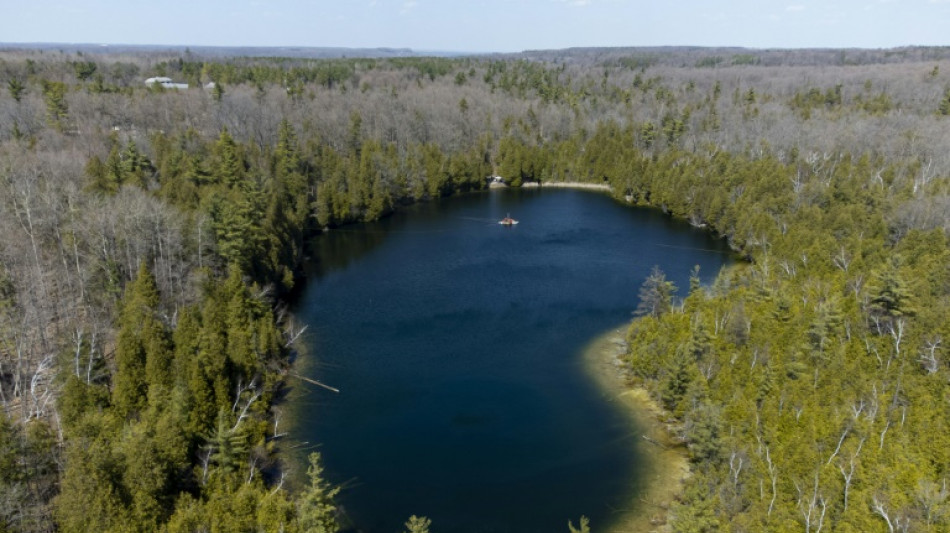
No 'human era' in Earth's geological history, scientists say / Photo: Peter POWER - AFP

 Kenya's economy faces climate change risks: World Bank

 Fornaro Legal Releases Guidance to Help Businesses Maintain Clear Ownership Records During Growth

 Japan probe made closest-ever asteroid flyby: space agency
 British oil giant BP aims to sell North Sea business

 China factory activity slides as leaders seek spending boost

 Tech rebound fuels record-breaking rally in South Korean stocks
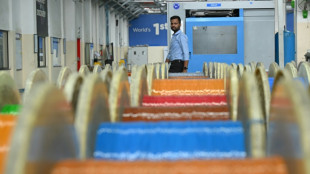 Cables and cooling bring AI windfall to Indian suppliers

 Anthropic's models gained unauthorized 'real-world' access during testing

 Apple tops estimates in CEO Cook's final quarter, but shares fall

 Milei demands expulsion of foreigners expressing 'hate' against Argentina

 Italy's Po River valley on drought alert

 Prada profits pinched as growth hard to chase

 Stocks climb on earnings and rates, oil retreats

 US economic growth slows in second quarter, missing expectations

 Russia adds Telegram founder Durov to 'terrorist' blacklist

 Stocks diverge on earnings, as oil steadies

 Eurozone economy grows despite Middle East war

 Singapore group will develop 'most promising' Ebola vaccine

 Shell profit surges as Mideast war fuels oil prices

 Car maker Stellantis says back in profit in second quarter

 Samsung quarterly operating profit up 1,800% on AI boom

 South Korean stocks bounce after rout, oil holds gains on Mideast woes

 South Korea's women web sleuths fight AI deepfake porn

 Anything but programmable: New cost-efficient EC-power-supply-series for the DIN rail by CAMTEC PS

 Meta misses profit expectations, sticks to massive AI spending

A top panel of geologists has decided not to grant the 'human age' its own distinct place in Earth's geological timeline after disagreeing over when exactly our era might have begun.
After 15 years of deliberation, a team of scientists made the case that humankind has so fundamentally altered the natural world that a new phase of Earth's existence -- a new epoch -- has already begun.
Soaring greenhouse gases, the spread of microplastics, decimation of other species, and fallout from nuclear tests -- all were submitted as evidence that the world entered the Anthropocene, or era of humans, in the mid-20th century.
But the proposal was rejected in a contentious vote that has been upheld by the International Union of Geological Sciences, the field's governing body said in a statement published on its website on Thursday.
The decision "to reject the proposal for an Anthropocene Epoch as a formal unit of the Geologic Time Scale is approved", it said.
There is no avenue for appeal, though some involved in the voting committee have raised allegations over the conduct of the ballot and a perceived lack of due process.
The union denied these assertions and called the outcome "a decisive rejection of the Anthropocene proposal" by the field's pre-eminent experts.
There were four votes in favour, 12 against and three abstentions, it added.
Despite this, the Anthropocene would endure as a widely used term: "It will remain an invaluable descriptor of human impact on the Earth system," the union said.
- 'Missed opportunity' -
In 2009 scientists began an enquiry that ultimately concluded that the Holocene epoch -- which began 11,700 years ago as the last ice age ended -- gave way to the Anthropocene around 1950.
They gathered a trove of evidence to show this, including traces of radioactive material found in the layered sediment of lakes, the global upheaval of plants and animals, and omnipresent "forever chemicals".
But opponents argued mankind had been reshaping the planet long before the 1950s, pointing to defining moments like the advent of farming and the industrial revolution.
Martin Head, who was part of the team that advocated for the Anthropocene, said there was "a myriad of geological signals" and lamented the way the process was handled.
"I feel this has been a missed opportunity to recognise and endorse a simple reality, that our planet left its natural functioning state in the mid-20th century," Head, a professor of earth sciences at Brock University in Canada, told AFP.
There was no disagreement that 'the age of man' had resulted in profound planetary changes, said Erle Ellis, an environmental scientist critical of the Anthropocene proposal.
But scientists weren't convinced this impact represented an epoch, no less one that definitively began only seven decades ago, said Ellis, professor of geography and environmental systems at the University of Maryland.
"The truth is, there was never a need for a firm boundary. It just wasn't the critical thing," he told AFP earlier this month after the proposal was first voted down.
L.Peeters--CPN