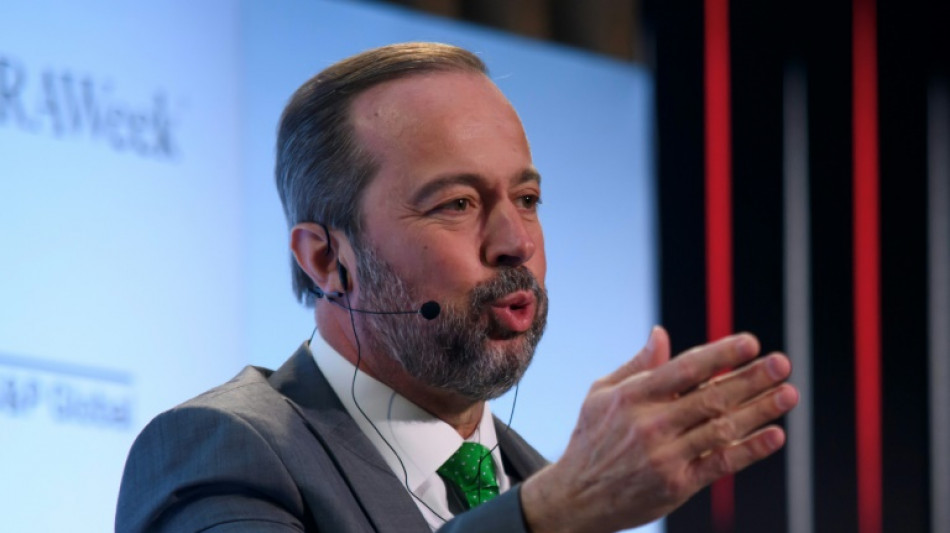
Fossil fuels to become as unpopular as cigarettes: Brazil energy minister / Photo: Mark Felix - AFP

 Nintendo producer 'all nervous' as Zelda classic remake hits shelves

 Three killed by storm in southern India

 Two hundred 'Cruise for life' passengers stranded in Cambodia

 Billionaire Ambani's Jio jumps 21% in market debut after record India IPO

 Sri Lanka's Tamil farmers fight to reclaim land after civil war

 'They don't care about us': Trump food aid cuts leave Americans struggling and angry

 Palestinian activist Khalil returns to Columbia after US detention

 Youths testify about 'despair' in unprecedented Canadian climate trial

 Storied Paris department store seeks bankruptcy protection
 Boeing shares tumble after it releases cautious growth forecast

Fossil fuels will eventually be seen as just as unhealthy as cigarettes, according to Brazil Energy Minister Alexandre Silveira, who oversees the South American country's balancing act a giant of both renewables and oil.
"The energy transition will happen one way or the other, but it will also happen because of another factor, which is the cultural issue," Silveira told AFP, speaking at an energy conference in Houston, Texas.
"The new generations are going to begin to repudiate fossil fuels as they repudiated the cigarette industry in the last 20 years," he said, drawing a comparison with awareness around tobacco's harms that helped drive down its usage.
"This is going to happen with oil," he said.
Silveira's comments Wednesday come as Brazil, a member of the oil-producing OPEC+ countries, also advocates for a transition toward clean energy.
Since returning to office for a third term in January 2023, Brazil's leftist President Luiz Inacio Lula da Silva has made solid progress on his pledge to end illegal deforestation in the Amazon, which fell by half last year compared to 2022.
At the same time, Brazil -- Latin America's top oil producer -- also racked up several monthly crude output records last year, including in November when it produced nearly 3.7 million barrels a day.
Oil is "a source of funding both for education and health," Silveira said, as well as "a very important source of funding for the energy transition" itself.
Noting that much of Brazil’s oil is exported -- more than 1.3 million barrels per day, in 2022 -- he argued that such demand comes from the global market more than the domestic market.
"The demand for increased oil production is not national," he said -- noting that such demand indicates "transition is slower than it should be."
The energy transition needs "global governance that can make a fairer and more equitable dialogue between the countries of the Global South and the developed countries," Silveira said.
Earlier this month, a report from the think tank Carbon Tracker found the world's major oil and gas companies, including Brazilian state oil company Petrobras, were planning fossil fuel expansion incompatible with limiting warming to the Paris climate agreement goal of 1.5 degrees Celsius.
In total, renewables account for 47 percent of Brazil's energy mix, more than triple the world average of 15 percent, according to government figures.
Y.Jeong--CPN