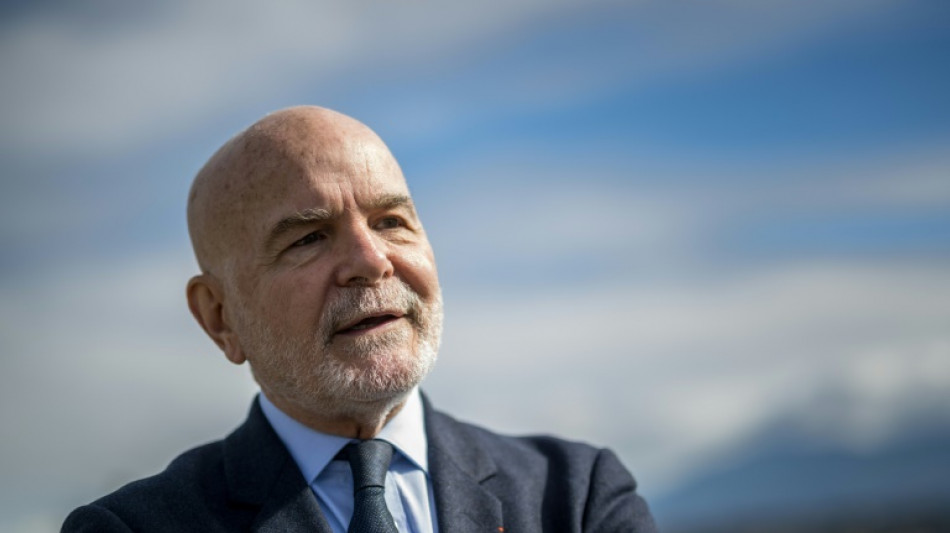
Climate protesters under fire in Europe: UN expert / Photo: Fabrice COFFRINI - AFP

 Kenya's economy faces climate change risks: World Bank
 Japan probe made closest-ever asteroid flyby: space agency
 British oil giant BP aims to sell North Sea business

 China factory activity slides as leaders seek spending boost

 Tech rebound fuels record-breaking rally in South Korean stocks

 Cables and cooling bring AI windfall to Indian suppliers

 Anthropic's models gained unauthorized 'real-world' access during testing

 Apple tops estimates in CEO Cook's final quarter, but shares fall

 Milei demands expulsion of foreigners expressing 'hate' against Argentina

 Italy's Po River valley on drought alert

 Prada profits pinched as growth hard to chase

 Stocks climb on earnings and rates, oil retreats

 US economic growth slows in second quarter, missing expectations

 Russia adds Telegram founder Durov to 'terrorist' blacklist

 Stocks diverge on earnings, as oil steadies

 Eurozone economy grows despite Middle East war

 Singapore group will develop 'most promising' Ebola vaccine

 Shell profit surges as Mideast war fuels oil prices

 Car maker Stellantis says back in profit in second quarter

 Samsung quarterly operating profit up 1,800% on AI boom

 South Korean stocks bounce after rout, oil holds gains on Mideast woes

 South Korea's women web sleuths fight AI deepfake porn

 Anything but programmable: New cost-efficient EC-power-supply-series for the DIN rail by CAMTEC PS

 Meta misses profit expectations, sticks to massive AI spending

 Campari - king of the spritz - hopes to conquer American heartland

Environmental activists are increasingly facing hostility across Europe, a UN expert said, warning that the very right to protest was "at risk" in countries usually considered beacons of democracy.
Michel Forst, the UN special rapporteur on environmental defenders, told AFP in an interview this week that he was deeply troubled by the hardening tone against climate activists in countries including France, Austria, Germany and Britain.
Government ministers have been throwing about terms like "eco terrorists" and "Green Talibans" to describe non-violent activists, he claimed, also blaming some media reporting for contributing to an increasingly hostile public attitude.
"It creates a sort of chilling effect," warned Forst, an independent expert appointed under the UN's Aarhus Convention -- a legally-binding text that provides for justice in environmental matters.
"Currently, the right to protest is at risk in Europe."
Forst said he had recently visited several European countries after receiving complaints that activists faced treatment that allegedly violated the convention and international human rights law.
Following a visit to Britain, he publicly voiced alarm at the "toxic discourse" and "increasingly severe crackdown" on environmental defenders.
- 'Regressive laws' -
Forst charged that "regressive laws" in Britain were being used to slap climate activists with harsh penalties, with one activist sent to prison for six months for a 30-minute slow march disrupting traffic.
Another activist had been sentenced to 27 months behind bars in the UK, he said.
He also decried harsh sentences in other countries, including Germany.
Forst travelled to France last month following complaints about a crackdown on a drawn-out anti-motorway protest near the southwestern city of Toulouse.
Activists, called "squirrels", who have been squatting in trees destined to be chopped down to make way for the A69 motorway, have accused law enforcement of denying them access to food and water and using floodlights to deprive them of sleep.
Forst said he had been blocked from bringing food to the activists, and was "shocked" by what he found.
"Obviously, deprivation of food, of drinking water, of sleep is clearly against international law," said Forst, a French national.
They are "considered acts of torture in international texts", he added.
- 'Dangerous' -
Forst said that European media coverage often focuses exclusively on the drama around demonstrations and not on the climate crisis prompting the protests.
The world is in a very "dangerous time", he said, but the general public often do not understand why young people are "blocking access to airports, or gluing their hands on the floor".
As a result, states have felt justified in developing new policies and laws, paving the way for police crackdowns, and increasingly harsh sentences.
In Britain, he said that some judges were even barring environmental defenders from using the word "climate" to explain their motivation to the jury.
Forst said that he was investigating whether big companies, especially in the oil and energy sector, might be lobbying to increase the pressure on climate activists.
"The most dangerous" companies were even "using security forces, connections with the mafia... to target and sometimes to kill defenders," he said.
Forst said he was currently organising consultations in Latin America and Africa with environmental activists there who are facing attacks by companies.
He is also investigating whether companies based in Europe are, through local subsidiaries, contributing to attacks on activists.
And the expert blasted European countries for "a double standard" by supporting environmental defenders in other parts of the world but "not protecting their defenders inside Europe".
H.Müller--CPN