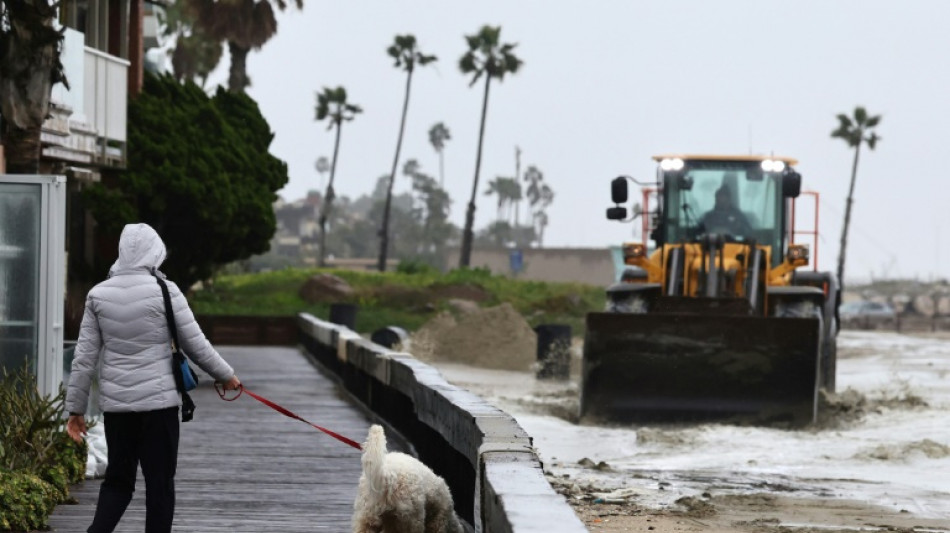
Sinking US cities more exposed to rising seas: study / Photo: MARIO TAMA - GETTY IMAGES NORTH AMERICA/AFP/File

 Kenya's economy faces climate change risks: World Bank

 Japan probe made closest-ever asteroid flyby: space agency
 British oil giant BP aims to sell North Sea business

 China factory activity slides as leaders seek spending boost

 Tech rebound fuels record-breaking rally in South Korean stocks

 Cables and cooling bring AI windfall to Indian suppliers

 Anthropic's models gained unauthorized 'real-world' access during testing

 Apple tops estimates in CEO Cook's final quarter, but shares fall

 Milei demands expulsion of foreigners expressing 'hate' against Argentina

 Italy's Po River valley on drought alert

 Prada profits pinched as growth hard to chase

 Stocks climb on earnings and rates, oil retreats

 US economic growth slows in second quarter, missing expectations

 Russia adds Telegram founder Durov to 'terrorist' blacklist

 Stocks diverge on earnings, as oil steadies

 Eurozone economy grows despite Middle East war

 Singapore group will develop 'most promising' Ebola vaccine

 Shell profit surges as Mideast war fuels oil prices

 Car maker Stellantis says back in profit in second quarter

 Samsung quarterly operating profit up 1,800% on AI boom

 South Korean stocks bounce after rout, oil holds gains on Mideast woes

 South Korea's women web sleuths fight AI deepfake porn

 Anything but programmable: New cost-efficient EC-power-supply-series for the DIN rail by CAMTEC PS

 Meta misses profit expectations, sticks to massive AI spending

 Campari - king of the spritz - hopes to conquer American heartland

Sea level rise could hit major US cities like New Orleans and San Francisco harder than expected by mid-century because coastal land is sinking, researchers said Wednesday, warning current flood defences leave people and property at risk.
Global warming is melting ice sheets and glaciers and raising ocean water levels across the world, with predictions that the United States will see some of the fastest increases, threatening coastal regions that are home to some 30 percent of the country's population.
Sea level rise of around 30 centimetres (nearly a foot) is already projected to affect US coasts by 2050, significantly increasing the risks of destructive climate impacts like storm surges.
But that threat is even greater when you take into account coastal subsidence, researchers found, warning that tens of thousands of people -- and potentially billions of dollars of property -- could be left exposed in 32 cities along the Atlantic, Pacific, and Gulf coasts.
Poorer and minority communities are at greatest risk, according to the study published in the Journal Nature.
That "really multiplies the potential impact to those areas and their abilities to recover from significant flooding," lead author Leonard Ohenhen, of Virginia Tech, told AFP.
Ohenhen said subsidence, which can occur naturally and because of human actions like groundwater extraction and drainage, has been underestimated in computer modelling of flooding.
That has left more people at risk, according to the study.
Researchers found that even with current coastal defence infrastructure, subsidence and sea level rise could expose more than 1,300 square kilometres (around 500 square miles) of additional land to flooding over the next three decades.
This could threaten between 55,000 to 273,000 people and up to 171,000 properties.
Under the worst case scenario, one in every 50 people along the US coast could be exposed to a flood threat -- along with hundreds of thousands of properties, with a total estimated value of $32 billion to $109 billion.
To slow the rate of subsidence, researchers recommended reducing groundwater extraction, regulating industrial activities and reducing emissions to reduce long-term climate risks.
Sea walls, levees and barriers offer flood protection, while nature-based solutions like restoring marshes and mangroves can also help.
"Ecosystems act as natural buffers against storm surges and help in sediment accumulation, which can mitigate the effects of land subsidence," said Ohenhen.
X.Cheung--CPN