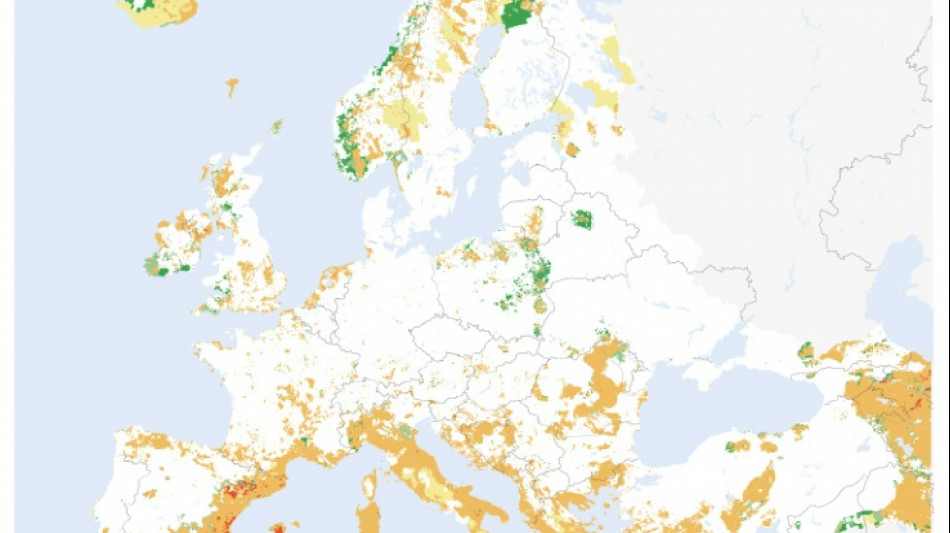
Winter drought grips southern Europe, northern Africa / Photo: Sophie RAMIS, Nalini LEPETIT-CHELLA, Sabrina BLANCHARD - AFP

 Kenya's economy faces climate change risks: World Bank
 Fornaro Legal Releases Guidance to Help Businesses Maintain Clear Ownership Records During Growth

 Japan probe made closest-ever asteroid flyby: space agency
 British oil giant BP aims to sell North Sea business
 China factory activity slides as leaders seek spending boost
 Tech rebound fuels record-breaking rally in South Korean stocks
 Cables and cooling bring AI windfall to Indian suppliers

 Anthropic's models gained unauthorized 'real-world' access during testing

 Apple tops estimates in CEO Cook's final quarter, but shares fall

 Milei demands expulsion of foreigners expressing 'hate' against Argentina

 Italy's Po River valley on drought alert

 Prada profits pinched as growth hard to chase

 Stocks climb on earnings and rates, oil retreats

 US economic growth slows in second quarter, missing expectations

 Russia adds Telegram founder Durov to 'terrorist' blacklist

 Stocks diverge on earnings, as oil steadies

 Eurozone economy grows despite Middle East war

 Singapore group will develop 'most promising' Ebola vaccine

 Shell profit surges as Mideast war fuels oil prices

 Car maker Stellantis says back in profit in second quarter

 Samsung quarterly operating profit up 1,800% on AI boom

 South Korean stocks bounce after rout, oil holds gains on Mideast woes

 South Korea's women web sleuths fight AI deepfake porn

 Anything but programmable: New cost-efficient EC-power-supply-series for the DIN rail by CAMTEC PS

 Meta misses profit expectations, sticks to massive AI spending

Drought plaguing the Mediterranean has failed to recede over winter months that brought below-average rainfall, the EU's Copernicus Climate Change Service has reported, prompting water restrictions and state of emergency declarations.
Just over 45 percent of southern Europe suffered from soil drought, with 2.8 percent reaching the highest "alert" level, over the first 10 days of February, according to the latest data from the European Drought Observatory (EDO) analysed by AFP.
Meanwhile a quarter of all Europe and northern Africa is under drought conditions, according to Copernicus, with 19.3 percent of the region's soil at a "warning" level, meaning a moisture deficit is underway.
An alert level is impacting 2.5 percent of the region, meaning vegetation is growing abnormally due to the advanced stage of the drought, according to calculations by AFP.
The situation has worsened since the end of January, but has slightly improved compared with the same period last year that saw 31.3 percent of the territory under drought.
The western Mediterranean region has been particularly hard-hit, including southern Italy, Spain, northern Morocco, Algeria and Tunisia.
Warmer than usual seasonal temperatures are the culprit.
Last month was the warmest January on record globally, according to Copernicus, combined with a lack of precipitation that in some regions has lasted months, and even years.
Faced with "its worst drought in a century", according to Catalonia regional president Pere Aragones, a state of emergency was issued including new restrictions on water.
The regions reservoirs had fallen below the level of 16 percent.
Figures by Copernicus relate to soil dryness, visible by satellites, and not groundwater.
In France, the southern Pyrenees-Orientales region to the south faced "very worrying" levels of groundwater, its main reserve for drinking water, according to the organisation that monitors it.
The Italian island of Sicily declared a drought emergency at the beginning of February, while in Sardinia, farmers were slapped with restrictions on water use.
Morocco, where temperatures recently approached 37 degrees Celsius (98 degrees Fahrenheit), is experiencing its sixth consecutive year of drought.
The climate situation may not get any better.
The EDO has forecasted spring 2024 to be warmer than usual for Europe and the Mediterranean, which will compound a shortfall in snow over several mountain ranges that are responsible for recharging rivers over the coming months.
T.Morelli--CPN
