Quiet revolution? UK sees new breed of 'green' narrowboats / Photo: Daniel LEAL - AFP

 Kenya's economy faces climate change risks: World Bank

 Profits surge at US oil giant amid Iran war supply shock

 Stock markets rally on tech rebound

 France, Spain assess scorched terrain as new wildfires threaten other regions
 Chipmaker Kioxia reports AI-driven 45-fold surge in quarterly net profit

 Far right and far left battle for power in polarised Berlin

 The last trio: S.Africa's zoo elephants await their fate

 Oil industry sees war windfall but girds for political blowback

 Amazon beats expectations with cloud and AI growth

 Blowout Microsoft results lift US stocks as oil retreats

 'Beginning of the end': Relief but no party as French wildfire winds down

 Southern Europe 'becoming more flammable' in hotter climate, experts say

 Mammoth bones found on parched bed of Danube in Bulgaria

 MEXC Lists Grvt (GRVT) with $60,000 Worth of GRVT and 10,000 USDT in Airdrop+ Rewards

 George and Amal Clooney flee French home due to wildfire

 MEXC Ventures Supports Alpha Arena's APAC Debut at Coinfest Bali

 AI data centre supplier Zhongji InnoLight slips on Hong Kong debut

 May, June heatwaves caused 2,877 extra deaths in England: govt

 BMW profit down a third as carmaker plans job cuts

 Seoul extends losses as most Asian markets drop, oil rises again

 Gambling.com Group Is Now Grandstand

 Meet the astronomer digging into the Milky Way's 'fossils'

 AI data centre supplier Zhongji InnoLight falls on Hong Kong debut

 Samsung operating profit up 1,800% in second quarter on AI boom

 Japanese population below 120 million for first time in decades

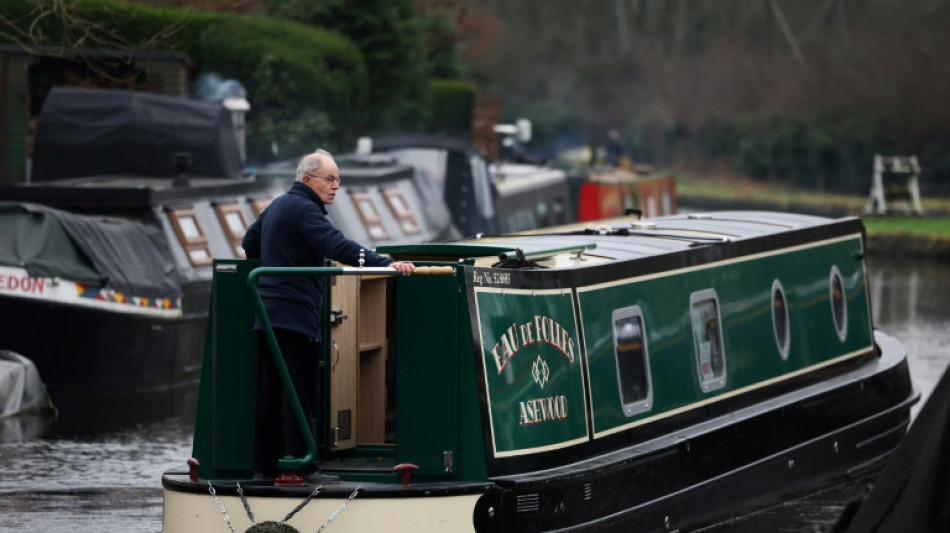
Motoring down the Staffordshire & Worcestershire Canal in England's West Midlands, Neil Cocksedge's narrowboat at first sight looks like most other vessels plying the country's famous network of scenic inland waterways.
But one feature, in particular, gives away that this is no ordinary narrowboat: its stealthy near-silence.
"The thing people notice about the electric boat is it's so much quieter -- we sneak up on fishermen!" Cocksedge told AFP proudly as he piloted it on a recent morning.
Named "Eau de Folles" -- after a now-shuttered Toulouse restaurant where he proposed to his wife decades ago -- the 20-month-old vessel is among a small but growing number propelled to varying degrees by electricity.
Batteries powering the engine and on-board appliances -- including an oven, fridge and kettle -- are recharged by solar panels on the roof, canalside charging points or a fuel-fed generator.
It can manage a day's cruising on primarily solar-generated power and, overall, uses a quarter of the diesel that traditional narrowboats guzzle, according to Cocksedge.
The 70-year-old retired steel industry executive is among those pioneering a switch to environmentally-friendly narrowboats, after more than a century of diesel-powered boats on Britain's pleasure cruising-dominated canals.
The slow shift is being driven by increasingly eco-conscious owners, financial incentives, increased exposure of canal lifestyles online -- and the added bonus of less noisy engines.
"We wanted to try and be as green as possible and also we like the quietness," explained Cocksedge, who bought the bespoke boat in May 2022 for leisure trips during warmer months.
"There's very few electric narrowboats around at the moment. They are gaining popularity though," he added.
- Environmental incentives -
Britain experienced its canal-building boom in the late 1700s when they were used to haul cargo, spurring the industrial revolution. But over the next century, they were largely supplanted by railways.
England and Wales still boast around 2,000 miles (3,219 kilometres) of navigable canals and linked rivers, with the West Midlands the epicentre.
Birmingham, its biggest city, proclaims to have more miles of canals than Venice.
Much of the network is often just seven feet (2.1 metres) wide, giving rise to Britain's so-called narrowboats.
Crossing idyllic countryside as well as urban areas, they have enjoyed a resurgence in recent decades as a place to live as well as for leisure.
But as the UK bids to decarbonise its transport and other sectors, attention has turned to the vast majority of narrowboats belching out diesel fumes.
"Because they last for so long... they tend to put out quite a lot of smutty smoke," said Cocksedge, noting the vessels typically host "old agricultural-type engines that have been marinised", converted for use in boats.
The government wants all maritime vessels to show from next year how they could be altered to meet the country's 2050 zero emissions target.
The Canal & River Trust (CRT), a charity which cares for the inland waterways, is encouraging uptake of electric-powered narrowboats.
It offers "greener" boat owners 25 percent discounts on mandatory annual licenses, and is also partnering in pilot schemes to install charging points at inner-city moorings.
It currently licences around 35,000 boats in England and Wales, but only around one percent claim the discount, underlining what it calls the "massive undertaking" ahead.
- Vlogging impact -
"Less polluting solutions need to be found for boating power generation, heating and propulsion," a CRT spokeswoman said, noting more charging points in particular were needed across the canal network.
"The government and marine industry, as well as local councils and waterside developments and businesses, will have to play their part too."
Ortomarine, the narrowboat-maker behind "Eau de Folles", is one such partner.
Founded in 2015, it decided three years ago to focus exclusively on electric-propelled narrowboats.
"We could see a real niche in the market," explained financial director Caroline Badger from the firm's small workshop on a former military site southwest of Birmingham.
Its boats typically cost at least £150,000 ($190,000), around £25,000 more than many new diesel-powered vessels -- but then offering significantly lower running costs.
Badger noted narrowboats are "ideal" for electric propulsion because they have ample space for solar panels and bulky batteries, which can replace ballast, while they travel at consistent low speeds.
Ortomarine, which turns out up to six made-to-order boats a year, has a full order book until 2027.
"We could basically sell as many electric boats as we can build," Badger said, as staff worked busily on the latest vessel.
She noted video bloggers posting footage of the country's distinctive canal culture had boosted interest, especially post-pandemic.
"It's getting a worldwide audience... so it's a big promotional thing," she said, noting customers hail from Australia, South Africa and north America.
"Nowhere has the extent of canals that the UK has... going through some of the most beautiful countryside."
D.Philippon--CPN
