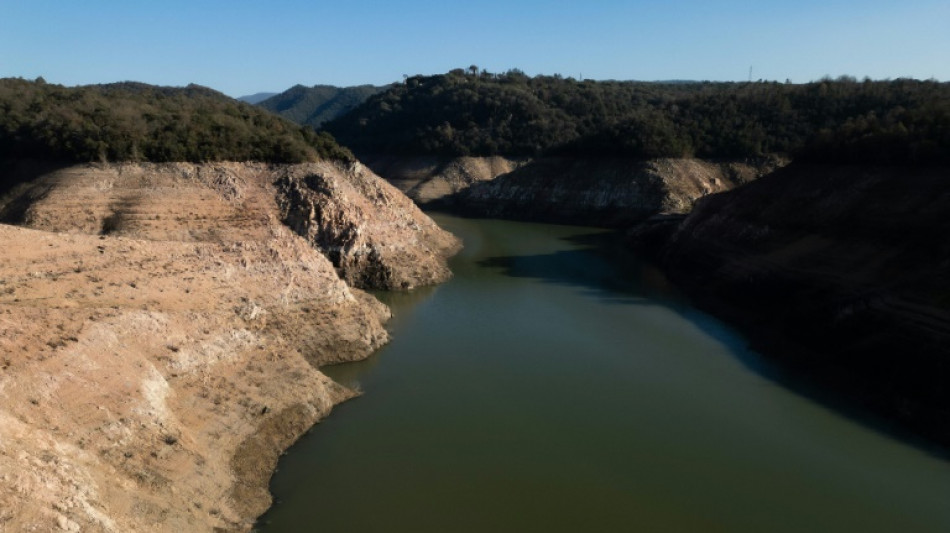
Spain sees warmest January on record / Photo: PAU BARRENA - AFP

 Kenya's economy faces climate change risks: World Bank

 Profits surge at US oil giant amid Iran war supply shock

 Stock markets rally on tech rebound

 France, Spain assess scorched terrain as new wildfires threaten other regions

 Chipmaker Kioxia reports AI-driven 45-fold surge in quarterly net profit

 Far right and far left battle for power in polarised Berlin

 The last trio: S.Africa's zoo elephants await their fate

 Oil industry sees war windfall but girds for political blowback

 Amazon beats expectations with cloud and AI growth

 Blowout Microsoft results lift US stocks as oil retreats

 'Beginning of the end': Relief but no party as French wildfire winds down

 Southern Europe 'becoming more flammable' in hotter climate, experts say

 Mammoth bones found on parched bed of Danube in Bulgaria

 MEXC Lists Grvt (GRVT) with $60,000 Worth of GRVT and 10,000 USDT in Airdrop+ Rewards

 George and Amal Clooney flee French home due to wildfire

 MEXC Ventures Supports Alpha Arena's APAC Debut at Coinfest Bali

 AI data centre supplier Zhongji InnoLight slips on Hong Kong debut

 May, June heatwaves caused 2,877 extra deaths in England: govt

 BMW profit down a third as carmaker plans job cuts

 Seoul extends losses as most Asian markets drop, oil rises again

 Gambling.com Group Is Now Grandstand

 Meet the astronomer digging into the Milky Way's 'fossils'

 AI data centre supplier Zhongji InnoLight falls on Hong Kong debut

 Samsung operating profit up 1,800% in second quarter on AI boom

 Japanese population below 120 million for first time in decades

Spain has just experienced its warmest January since current records began in 1961, national weather office Aemet said Wednesday, after temperatures neared 30 degrees Celsius (86 degrees Fahrenheit) in some regions.
The average temperature in mainland Spain for January 2024 was 8.4 Celsius, or 2.4 degrees higher than average for the period and 0.4 degrees above the previous record set in 2016, Aemet said.
Temperatures reached or exceeded 20 Celsius last month at nearly 400 meteorological stations, or nearly half the country's total.
Temperatures rose to 29.5C in the eastern region of Valencia, 28.5C in Murcia in the southeast and 27.8C near Malaga in the south -- levels usually seen in June.
The unseasonable winter weather, which drew people to beaches and outdoor cafes across Spain, delayed the start of the ski season and worsened a years-long drought in Catalonia in the northeast and in the southern region of Andalusia.
While January "was a rainy month overall, the distribution of rainfall was very uneven: at least it rained where rainfall was needed the most", Aemet spokesman Ruben del Campo said in a post on X.
Spain had already in 2022 experienced its hottest year since Aemet's annual records began, with an average annual temperature of nearly 15.5 Celsius.
It was the first time that the average yearly temperature surpassed 15 degrees Celsius.
Catalonia's regional government declared last week a drought emergency for Spain's second-largest city of Barcelona and much of the surrounding region, paving the way for tighter water use restrictions after three years without significant rainfall.
It took the measure after water levels at reservoirs in the Mediterranean region fell below 16 percent of full capacity, the benchmark set by the authorities for applying a new round of water-saving measures that will affect around six million people.
Water levels in some reservoirs in Catalonia are so low that old bridges and even a church bell tower have resurfaced in some areas.
Measures to curb water use include a ban on using fresh water for swimming pools, with some exceptions for recognised use in sports. Cars can also now be washed only with recycled water and public gardens irrigated with groundwater.
The measures aim to cut the amount of water used to irrigate crops by 80 percent, doubling the 40 percent reduction introduced last November.
Industries must cut water use by 25 percent, whereas previously it was 15 percent.
- 'Complicated situation' -
Catalonia is facing its worst drought since records began in 1916, with rainfall lower than average in the region for the past three years.
The drought has lasted more than twice as long as the previous dry spell in 2008, the regional government said.
Andalusia is also struggling with severe drought, with regional authorities warning that water-use restrictions will be needed in Seville and Malaga this summer if there is not sufficient rain before then.
Andalusia and Catalonia, Spain's two most populous regions, are both preparing to import fresh water by boat if needed.
"We are facing a very complicated situation," Agriculture Minister Luis Planas told reporters in Madrid after the report of January temperature record.
"Spaniards know very well that climate change is here," he added.
Experts say climate change driven by human activity is boosting the intensity and frequency of extreme weather events such as heatwaves, droughts and wildfires.
O.Ignatyev--CPN