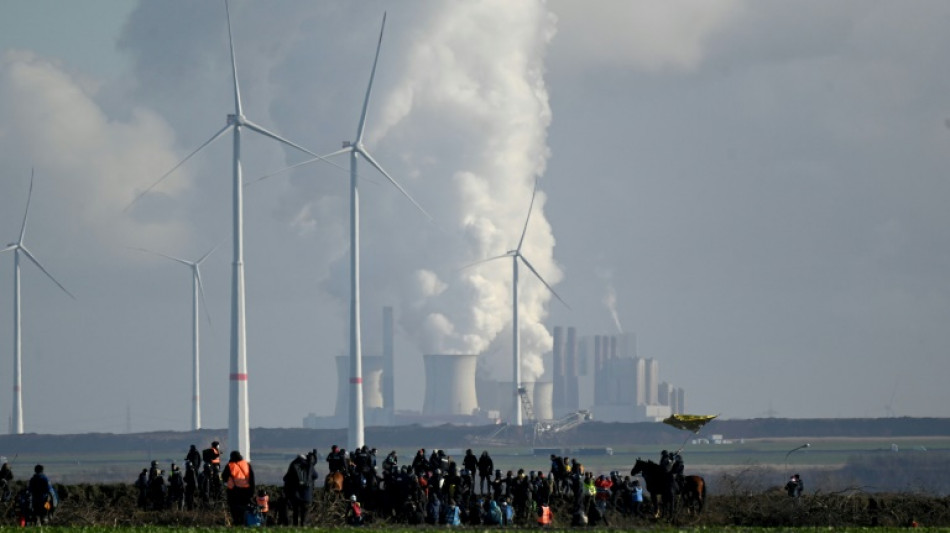
King coal set to lose crown for electricity production: IEA / Photo: INA FASSBENDER - AFP

 Kenya's economy faces climate change risks: World Bank

 Commerzbank agrees to talks with UniCredit after two-year standoff

 Fornaro Legal Releases Guidance to Help Businesses Maintain Clear Ownership Records During Growth

 Japan probe made closest-ever asteroid flyby: space agency

 British oil giant BP aims to sell North Sea business

 China factory activity slides as leaders seek spending boost

 Tech rebound fuels record-breaking rally in South Korean stocks

 Cables and cooling bring AI windfall to Indian suppliers

 Anthropic's models gained unauthorized 'real-world' access during testing

 Apple tops estimates in CEO Cook's final quarter, but shares fall

 Milei demands expulsion of foreigners expressing 'hate' against Argentina

 Italy's Po River valley on drought alert

 Prada profits pinched as growth hard to chase

 Stocks climb on earnings and rates, oil retreats

 US economic growth slows in second quarter, missing expectations

 Russia adds Telegram founder Durov to 'terrorist' blacklist

 Stocks diverge on earnings, as oil steadies

 Eurozone economy grows despite Middle East war

 Singapore group will develop 'most promising' Ebola vaccine

 Shell profit surges as Mideast war fuels oil prices

 Car maker Stellantis says back in profit in second quarter

 Samsung quarterly operating profit up 1,800% on AI boom

 South Korean stocks bounce after rout, oil holds gains on Mideast woes

 South Korea's women web sleuths fight AI deepfake porn

 Anything but programmable: New cost-efficient EC-power-supply-series for the DIN rail by CAMTEC PS

Renewables are set to displace coal as the top source of energy for electricity production globally in 2025, the International Energy Agency said Wednesday.
In its annual report on the electricity market, the IEA said that renewables -- in particular from solar panels -- should see their share of total electricity production surpass a third of the total, passing from 30 percent last year to 37 percent in 2026.
If nuclear power, which the IEA sees hitting a record next year, is included, almost half of the world’s electricity will be generated by low-emissions sources by 2026, up from a share of just under 40 percent in 2023.
The strong growth in renewables will outpace the increased demand for electricity in industrialised countries as part of efforts to reach carbon neutrality, said the IEA.
"The power sector currently produces more CO2 emissions than any other in the world economy, so it’s encouraging that the rapid growth of renewables and a steady expansion of nuclear power are together on course to match all the increase in global electricity demand over the next three years," said IEA Executive Director Fatih Birol.
That may also turn out to be the case in China, where coal produces more than half of electricity, but much depends on hydroelectric production and the pace of the economic recovery.
Nevertheless, the IEA sees a slow structural decline in coal use, even if developing nations will account for most of the increase in electricity demand in coming years.
It expects electricity produced from coal to drop by 1.7 percent per year on average through 2026, after a 1.6 percent increase last year due to low levels of hydroelectric power produced in China and India.
Electricity produced from natural gas should increase by around 1 percent per year during the period.
The IEA expects electricity produced from nuclear power plants to hit next year the record level it set in 2021 as France finishes repairing a number of reactors and new ones are brought on line in China, India, Japan and South Korea.
P.Kolisnyk--CPN
