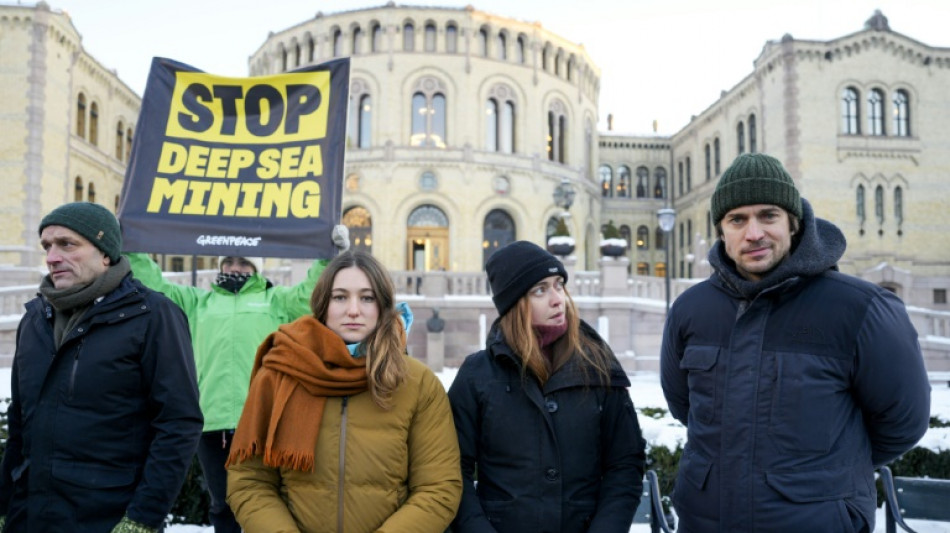
Norway greenlights deep-sea mining exploration / Photo: Javad Parsa - NTB/AFP

 Kenya's economy faces climate change risks: World Bank

 Commerzbank agrees to talks with UniCredit after two-year standoff

 Fornaro Legal Releases Guidance to Help Businesses Maintain Clear Ownership Records During Growth

 Japan probe made closest-ever asteroid flyby: space agency
 British oil giant BP aims to sell North Sea business
 China factory activity slides as leaders seek spending boost

 Tech rebound fuels record-breaking rally in South Korean stocks

 Cables and cooling bring AI windfall to Indian suppliers

 Anthropic's models gained unauthorized 'real-world' access during testing

 Apple tops estimates in CEO Cook's final quarter, but shares fall

 Milei demands expulsion of foreigners expressing 'hate' against Argentina

 Italy's Po River valley on drought alert

 Prada profits pinched as growth hard to chase

 Stocks climb on earnings and rates, oil retreats

 US economic growth slows in second quarter, missing expectations

 Russia adds Telegram founder Durov to 'terrorist' blacklist

 Stocks diverge on earnings, as oil steadies

 Eurozone economy grows despite Middle East war

 Singapore group will develop 'most promising' Ebola vaccine

 Shell profit surges as Mideast war fuels oil prices

 Car maker Stellantis says back in profit in second quarter

 Samsung quarterly operating profit up 1,800% on AI boom

 South Korean stocks bounce after rout, oil holds gains on Mideast woes

 South Korea's women web sleuths fight AI deepfake porn

 Anything but programmable: New cost-efficient EC-power-supply-series for the DIN rail by CAMTEC PS

Norway's parliament on Tuesday adopted a government plan to open up parts of its seabed to mining exploration, despite protests from activists and scientists' warnings about the uncertain environmental impact.
The proposal to gradually open up a 280,000-square-kilometre (108,100 square mile) area, mostly in the Arctic, was approved by the Storting, with 80 votes in favour and 20 against.
A small group of protesters had gathered outside the parliament in Oslo, displaying banners reading "Stop deep sea mining" and "Norway protect our oceans".
"They are opening a very new, vulnerable and enormous area that has been under-explored by scientists," Haldis Tjeldflaat Helle of Greenpeace Norway told AFP.
Already Western Europe's largest oil and gas producer, the Scandinavian nation is now set to become one of the first countries to explore the ocean floor for minerals crucial for renewable energy technology, potentially making it a major mineral producer.
At the same time, deep-sea mining is controversial due to its potential impact on vulnerable marine ecosystems.
In early 2023, the Norwegian Offshore Directorate published a report concluding that "substantial resources are in place on the seabed" including minerals such as copper, zinc and cobalt.
The Labour-led coalition minority government then in June proposed allowing mining of the country's seabed in the Arctic region.
In December it announced that it had reached a deal with opposition parties to secure parliamentary support to move forward.
"We need minerals because we want to lead a green transition in the form of fuel cells and solar panels, of electric cars and mobile phones," Labour member of parliament Marianne Sivertsen Naess told a press conference at the time.
- Knowledge gaps -
NGOs and scientists have meanwhile warned that deep-sea mining could damage habitats and harm species that are little understood, but are potentially important to the food chain.
In addition, they point to the risk of disrupting the ocean's capacity to absorb carbon emitted by human activities, and the noise that could disturb species such as whales.
"We are very worried about what this will mean for both ecosystems in the Arctic. What it will mean for the fisheries of both Norway and other countries, and also Norwegians and Norway's international reputation as a country that is supposed to take climate and nature seriously," Tjeldflaat Helle said.
The environmental activist added that they were also worried that Norway "chooses this time to send the signal that they will push forward on deep sea mining when the rest of the world is discussing a moratorium or a precautionary pause on this industry."
Several countries, including France and the UK, have called for a moratorium on deep-sea mining.
The Norwegian plan stresses that "environmental considerations" will be taken into account in all stages of the process and "extraction will only be authorised if the licensee's extraction plan demonstrates that extraction can take place in a sustainable and responsible manner."
Among others, Norway's Institute of Marine Research and the Norwegian Polar Institute have warned that there is a severe lack of knowledge necessary to assess what the environmental impact of deep-sea mining would be.
Currently there is no time schedule for when exploration and later potential mining could begin.
In the proposal, the government stressed that "the fact that the state opens an area for mineral extraction does not mean that extraction activities are initiated immediately."
Instead it means that licensing authorities can began the process of granting licenses, while the state can "continue the mapping of Norwegian seabed minerals."
Y.Uduike--CPN
