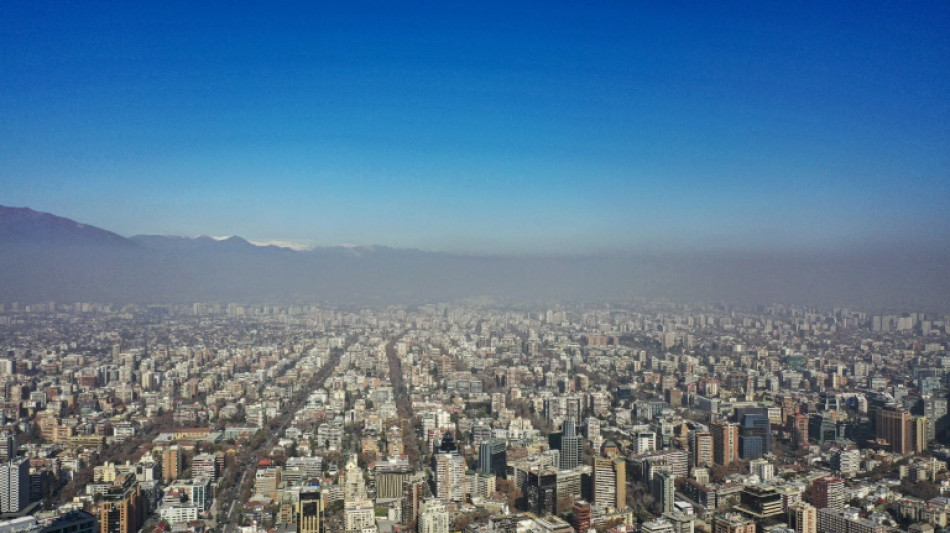
South America sweats under high temps -- in the middle of winter / Photo: MARTIN BERNETTI - AFP

 iPhone 18預購後出現可疑扣款 四間銀行調查未授權交易

 Galaxy Tab S12系列效果圖曝光 Ultra擬配雙鏡頭及瀏海螢幕

 Altman tells Fortune OpenAI will not go public in 2026
 ستاندرد آند بورز تثبت تصنيف السعودية عند A+

 Steven Strogatz weighs AI mathematics advances and their consequences for researchers

 Venezuelans outside Caracas say capital not sharing blackout burden

 Anthropic boss calls for slowing pace of AI development

 BRICS nations urge 'maximum restraint' in Middle East war

 Europe eyes battle over 'pervert' AI glasses

 Children in flood-hit Nepal grapple with loss, cling to hope

 Venice Film Festival: A look back on the highlights

 DR Congo school fire stampede death toll rises to 26: UNICEF

 Dance Fitness Tempe Announces Expansion of Accessible Digital Movement Programs

 Europe saw record summer air traffic despite Mideast war: Eurocontrol

 Relatives of 9/11 victims hit out at Saudi Arabia -- and US leaders

 Relative of 9/11 victim unleashes searing attack on Saudi Arabia

 Czech antitrust office lets Turkey's Pegasus Airlines buy Smartwings

 Investors on edge as energy costs, surging bond yields roil markets

 UK lawmakers to vote again on failed assisted dying bill

 Yemen's Houthis complete takeover of Bab al-Mandab area: govt official to AFP

 Fast-pace dance takes I.Coast's working-class streets by storm

 Fans celebrate Celine Dion's Paris return with giant karaoke

 Appreciation, anger await as Trump heads to Irish golf resort

 Putin arrives in India for BRICS summit coloured by wars

 Carney says in touch with Trump, Canada ready for 'fair' trade deal

Far away from the extreme summer temperatures of the northern hemisphere, Southern Cone countries such as Chile and Argentina are also experiencing record heat, but in the middle of what is supposed to be their winter.
On Tuesday, the mountain town of Vicuna in central Chile hit 37 degrees Celsius (almost 99 degrees Fahrenheit).
"It's been more than 70 years since a temperature like this was recorded" in Vicuna, Chilean meteorologist Cristobal Torres told AFP.
Unusually high temperatures were also recorded 450 kilometers (280 miles) south in the capital Santiago: 24C (75F) on Wednesday, with similar levels forecast for Thursday and Friday.
Meanwhile in Buenos Aires, the temperature exceeded 30C (86F) on Tuesday, making it the highest August 1 temperature since record-keeping began, according to Argentina's National Meteorological Service. The average August temperature in Buenos Aires is usually between 18C (64F) and 9C (48F).
Several cities across Uruguay also recorded temperatures of 30C (86F) on Wednesday.
"What we are experiencing is the combination of two phenomena: a global warming trend due to climate change plus the El Nino phenomenon," said Chile's Environment Minister Maisa Rojas, a climatologist.
"When El Nino ends, the global weather situation should stop being so extreme," she said.
An El Nino event is characterized by increased Pacific Ocean temperatures, causing rainfall, floods and avalanches in western South America, as well as heat waves.
Santiago, Buenos Aires and Montevideo are expected to return to normal temperatures in the coming days, but it is believed that similar heat waves will occur with increasing frequency.
"It is very likely that the heat record will be broken this year (in Santiago), and that is extraordinarily abnormal. Ten years ago we had two heat waves a year and now we are talking about nine," explained University of Santiago climatologist Raul Cordero.
One of the most significant impacts of the warm weather is on snowpacks in the mountains, which are vital for the water supply in Chile's capital.
"Winter heat waves have devastating effects on glaciers and snow," Cordero said.
Rojas also warned about the effects of heat at the poles.
"The ice around the polar areas is at minimum levels," she said on X, formerly known as Twitter.
"Especially around Antarctica, where at this time of year sea ice grows to reach a maximum in September, it is at a historic minimum."
Y.Ponomarenko--CPN