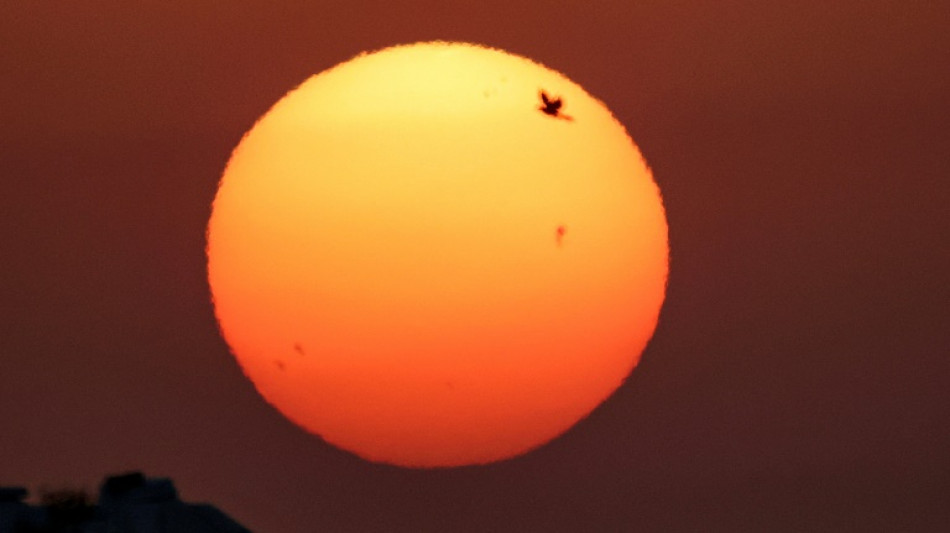
Kuwait's scorching summers a warning for heating planet / Photo: YASSER AL-ZAYYAT - AFP/File

 iPhone 18預購後出現可疑扣款 四間銀行調查未授權交易

 Galaxy Tab S12系列效果圖曝光 Ultra擬配雙鏡頭及瀏海螢幕

 Altman tells Fortune OpenAI will not go public in 2026
 ستاندرد آند بورز تثبت تصنيف السعودية عند A+

 Steven Strogatz weighs AI mathematics advances and their consequences for researchers

 Venezuelans outside Caracas say capital not sharing blackout burden

 Anthropic boss calls for slowing pace of AI development

 BRICS nations urge 'maximum restraint' in Middle East war

 Europe eyes battle over 'pervert' AI glasses

 Children in flood-hit Nepal grapple with loss, cling to hope

 Venice Film Festival: A look back on the highlights

 DR Congo school fire stampede death toll rises to 26: UNICEF

 Dance Fitness Tempe Announces Expansion of Accessible Digital Movement Programs

 Europe saw record summer air traffic despite Mideast war: Eurocontrol

 Relatives of 9/11 victims hit out at Saudi Arabia -- and US leaders

 Relative of 9/11 victim unleashes searing attack on Saudi Arabia

 Czech antitrust office lets Turkey's Pegasus Airlines buy Smartwings

 Investors on edge as energy costs, surging bond yields roil markets

 UK lawmakers to vote again on failed assisted dying bill

 Yemen's Houthis complete takeover of Bab al-Mandab area: govt official to AFP

 Fast-pace dance takes I.Coast's working-class streets by storm

 Fans celebrate Celine Dion's Paris return with giant karaoke

 Appreciation, anger await as Trump heads to Irish golf resort

 Putin arrives in India for BRICS summit coloured by wars

 Carney says in touch with Trump, Canada ready for 'fair' trade deal

As the blazing summer sun beats down on Kuwait, shoppers stroll down a promenade lined with palm trees and European-style boutiques, all without breaking a sweat.
In one of the world's hottest desert countries, it's all made possible by architecture and technology: the entire street is located inside the heavily air-conditioned Kuwait City shopping mall.
Outside, where temperatures now often soar around 50 degrees Celsius (120 degrees Fahrenheit), barely anyone is moving around on foot, leaving the historic market largely deserted.
"Only a few people stay in Kuwait at this time of year," said date merchant Abdullah Ashkanani, 53, as large fans sprayed cooling mist onto the few customers braving the blistering heat.
Ashkanani, who hails from Iran, said he keeps his shop open largely "for appearances" during the hottest months when most of Kuwait's four million residents flee abroad.
For those who stay behind in the tiny oil-rich country, life is made bearable by the ever-present Arctic blast of air-con systems.
"We can put up with it because the house, the car, everything is air-conditioned," said pensioner Abou Mohammad, dressed in a white robe and keffiyeh and sitting in a comfortably cooled cafe.
The irony is not lost on him that such energy-guzzling systems produce the carbon emissions that are heating up the planet -- especially the sweltering Gulf region, a climate hotspot.
Such excessive energy consumption, said Mohammad, has "brought this heat to Kuwait".
- Heating up -
Kuwait is home to seven percent of the world's crude reserves -- energy wealth that has long afforded many of its people a luxury lifestyle.
An extremely water-scarce country, it also relies heavily on fossil fuels to power seawater desalination plants.
Like Saudi Arabia and Qatar, Kuwait is one of the world's leading emitters per capita of CO2, a key driver of global warming.
Kuwait has always been hot, its dry summers fanned by the northwesterly shamal wind that also blows over Iraq and Saudi Arabia.
Temperatures in Mitribah, a remote area in northwest Kuwait, often soar past 50 degrees Celsius, making it one of the hottest places on Earth after Death Valley in eastern California.
But in recent years, climate change has made summer peaks hotter and longer, said meteorologist Essa Ramadan, as periods of extreme heat have gone "from two weeks to about a month".
The number of days per year that see temperatures rise above 50C have more than tripled since the turn of the century, noted the meteorologist.
As the world records ever more heat records, "what is happening to us will happen elsewhere", he warned.
- Grassroots -
Kuwait -- where glass towers soar into the sky and cars choke the highways -- has only recently invested in public transport and green energy to help counter climate change.
Its environment protection authority, which falls under the oil ministry, recognises "a rise in temperatures in recent years", its director Samira Al-Kandari said.
To help change course, Kuwait has started building its first commercial solar power park, the Shagaya project.
With the first phase complete, and other projects planned, Kandari said Kuwait's goal is that "renewable energy constitutes 15 percent of our energy production by 2035".
"We will increase this percentage in the future," she said.
Outside of the state institutions, some Kuwaiti citizens have launched grassroot initiatives, including tree-planting to help cool sun-baked urban environments.
Essa Al-Essa, a 46-year-old dentist, started planting trees as a "hobby" in a vacant, sandy lot near his home on the outskirts of the capital, he told AFP.
In 2020, at the height of the Covid pandemic, he developed it into the Kuwait Forest project, starting a green space that also helps scrub the air and captures carbon.
"Trees are particularly useful in polluted places such as industrial and residential areas," said Essa.
But he also hopes the natural shade and cooling they provide will help break the dominance of energy-intensive air-conditioning.
"The more we cool our houses," Essa said, "the more we warm our surroundings."
A.Agostinelli--CPN