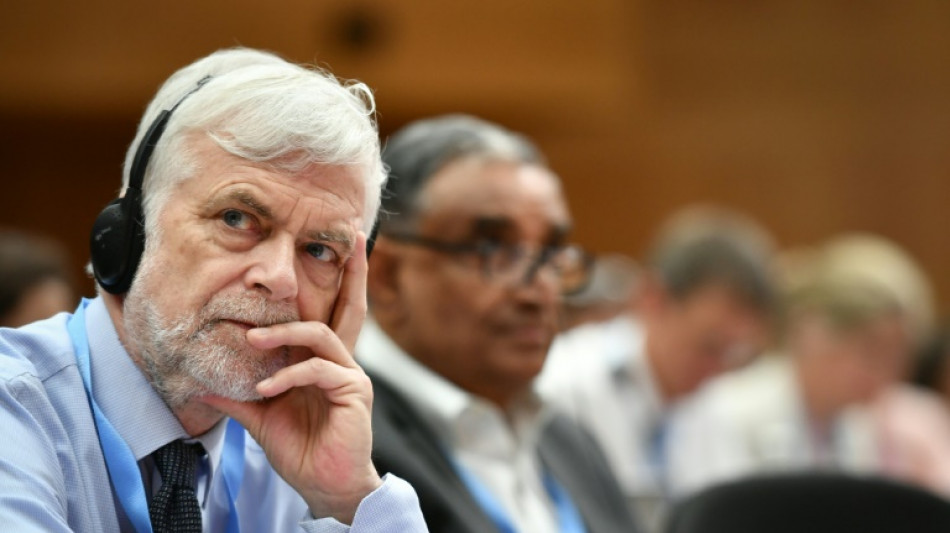
Humanity 'has agency over future': new head of UN climate panel / Photo: FABRICE COFFRINI - AFP

 iPhone 18預購後出現可疑扣款 四間銀行調查未授權交易

 Galaxy Tab S12系列效果圖曝光 Ultra擬配雙鏡頭及瀏海螢幕

 Altman tells Fortune OpenAI will not go public in 2026

 ستاندرد آند بورز تثبت تصنيف السعودية عند A+

 Steven Strogatz weighs AI mathematics advances and their consequences for researchers

 Venezuelans outside Caracas say capital not sharing blackout burden

 Anthropic boss calls for slowing pace of AI development

 BRICS nations urge 'maximum restraint' in Middle East war

 Europe eyes battle over 'pervert' AI glasses

 Children in flood-hit Nepal grapple with loss, cling to hope

 Venice Film Festival: A look back on the highlights

 DR Congo school fire stampede death toll rises to 26: UNICEF

 Dance Fitness Tempe Announces Expansion of Accessible Digital Movement Programs

 Europe saw record summer air traffic despite Mideast war: Eurocontrol

 Relatives of 9/11 victims hit out at Saudi Arabia -- and US leaders

 Relative of 9/11 victim unleashes searing attack on Saudi Arabia

 Czech antitrust office lets Turkey's Pegasus Airlines buy Smartwings

 Investors on edge as energy costs, surging bond yields roil markets

 UK lawmakers to vote again on failed assisted dying bill

 Yemen's Houthis complete takeover of Bab al-Mandab area: govt official to AFP

 Fast-pace dance takes I.Coast's working-class streets by storm

 Fans celebrate Celine Dion's Paris return with giant karaoke

 Appreciation, anger await as Trump heads to Irish golf resort

 Putin arrives in India for BRICS summit coloured by wars

 Carney says in touch with Trump, Canada ready for 'fair' trade deal

British professor Jim Skea told AFP on Thursday he will bring "a judicious blend of realism and optimism" to his leadership of the UN's climate expert panel, including a firm belief that humanity is not powerless to confront global warming.
Skea takes charge of the Intergovernmental Panel on Climate Change (IPCC) in a crucial decade which will determine the extent of warming and its impact on the planet for decades or even centuries to come.
The 195-nation organisation informs global policymakers on the latest science on climate change, and Skea will oversee hundreds of experts and the defining reports they produce on the best course of action.
Skea, a Professor of Sustainable Energy at Imperial College London, said extreme temperatures being felt across the globe this month were "a salutary lesson" for the task ahead as he assumes his new role.
But it was critical to offer "positive" ways for humanity to address these challenges, he said, and not just "messages of gloom that can induce a sense of existential dread about the future of the planet".
"We need to make the point that human beings do have choices they can make, and agency over their own future," Skea told AFP in Nairobi, where the elections for other IPCC leadership positions are also underway.
He said more than ever, governments wanted advice on steps they could take in the near term and there would be a "twin emphasis" on climate adaptation and mitigation under his stewardship.
Skea, 69, has decades of experience building consensus around climate change and was not "naive about the difficulty of getting the science messages across."
"I think it will be a judicious blend of realism and optimism... I am genetically optimistic," he said of his approach to the job.
- Daunting task -
The task ahead is enormous.
Under the 2015 Paris treaty, nations promised to collectively cap the rise in the planet's average temperature at "well below" 2C, and at 1.5C if possible.
To get to that more ambitious target, the IPCC says emissions need to drop 43 percent by 2030 -- and 84 percent by mid-century -- to stay within the threshold.
Yet they continue to rise, and there are concerns the next IPCC reports -- due in five to seven years -- come too near the end of this critical decade to rally a sufficient global response.
Skea said rushing out reports would risk "that gold standard credibility that has been so influential for the IPCC in the past".
Skea had a leading role in publishing a landmark 2018 IPCC report that concluded only a 1.5C cap on warming could ensure a climate-safe world that did not risk ecosystem collapse.
Experts have said it might fall on Skea to finally say the world cannot limit temperature rises to 1.5C in time -- but the new chief said this was premature.
"If it appears that 1.5 cannot be reached on a more permanent basis, we will have to say so," Skea said.
"But we are not at that point yet, and we do not have the evidence for it".
He said he would strongly resist pressure to turn out more so-called special reports like the 2018 study, saying they dragged on the IPCC's core work and resources.
"I'll say something very strongly -- over my dead body will we see lots and lots of special reports," he said.
He succeeds South Korean economist Hoesung Lee, who led the IPCC for eight years, and was elected over four other candidates including two hoping to be the first woman chair of the organisation.
Skea said the IPCC had "big issues" around gender and diversity, and said a priority of his tenure would be increasing the number of women in their ranks.
Ng.A.Adebayo--CPN