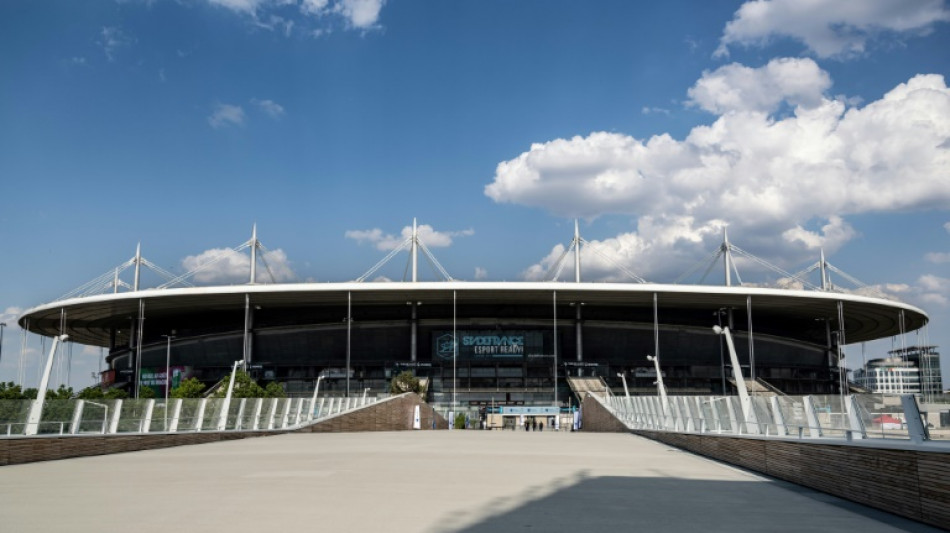
The Paris Olympics have bold climate plans, but few specifics / Photo: BERTRAND GUAY - AFP

 iPhone 18預購後出現可疑扣款 四間銀行調查未授權交易

 Galaxy Tab S12系列效果圖曝光 Ultra擬配雙鏡頭及瀏海螢幕

 Altman tells Fortune OpenAI will not go public in 2026
 ستاندرد آند بورز تثبت تصنيف السعودية عند A+

 Steven Strogatz weighs AI mathematics advances and their consequences for researchers

 Venezuelans outside Caracas say capital not sharing blackout burden

 Anthropic boss calls for slowing pace of AI development

 BRICS nations urge 'maximum restraint' in Middle East war

 Europe eyes battle over 'pervert' AI glasses

 Children in flood-hit Nepal grapple with loss, cling to hope

 Venice Film Festival: A look back on the highlights

 DR Congo school fire stampede death toll rises to 26: UNICEF

 Dance Fitness Tempe Announces Expansion of Accessible Digital Movement Programs

 Europe saw record summer air traffic despite Mideast war: Eurocontrol

 Relatives of 9/11 victims hit out at Saudi Arabia -- and US leaders

 Relative of 9/11 victim unleashes searing attack on Saudi Arabia

 Czech antitrust office lets Turkey's Pegasus Airlines buy Smartwings

 Investors on edge as energy costs, surging bond yields roil markets

 UK lawmakers to vote again on failed assisted dying bill

 Yemen's Houthis complete takeover of Bab al-Mandab area: govt official to AFP

 Fast-pace dance takes I.Coast's working-class streets by storm

 Fans celebrate Celine Dion's Paris return with giant karaoke

 Appreciation, anger await as Trump heads to Irish golf resort

 Putin arrives in India for BRICS summit coloured by wars

 Carney says in touch with Trump, Canada ready for 'fair' trade deal

Organisers of next year's Paris Olympics say they want its carbon footprint to be half that of previous summer Games, but with a year to go observers say they still do not have enough detail to verify the plans.
Citing climate change as "the greatest challenge humanity has ever known", organisers have said they can reduce greenhouse gases from the Games with a variety of measures, including renewable energy and using existing venues rather than building new ones.
That would, they say, allow them to halve CO2 emissions from the estimated 3.5 million tonnes generated during the 2012 London and 2016 Rio Games.
"It's a fine promise," said Martin Muller, Professor of Geography and Sustainability at the University of Lausanne, adding the target itself is a first.
But "I don't have the figures to believe it," he told AFP.
Muller would like open access to precise data. Otherwise, he said, "I can't understand on what basis this has been calculated".
- Planes, stadiums and snacks -
For the time being, the organisers have sketched out forecasts.
Expected emissions break down into three areas -- travel, buildings and other activities like accommodation, security and catering -- which each account for roughly a third of emissions.
With the venues themselves, the organisers say they have limited the construction footprint with a 95 percent reliance on existing or temporary arenas, unlike the much-criticised football World Cup in Qatar.
This decision to use as much existing infrastructure as possible was praised by Gilles Dufrasne, of Carbon Market Watch, as a "thoughtful approach".
Other ideas include using renewable energy or serving "low carbon" meals with less meat.
"The other big item is emissions from spectators arriving by plane," said Muller.
Even if venues have to be accessed by public transport, organisers will have little control over how people arrive into the country.
Around a quarter of the total emissions is expected to be from spectator travel alone.
- Offsetting -
For these types of emissions, the organisers say they are supporting projects to “offset” the carbon pollution.
"All emissions that cannot be avoided will be offset by projects designed to bring both environmental and social benefits on all five continents,” they said.
This involves, for example, financing the planting of trees to absorb CO2 or clean cookstove projects.
The organisers promise to be rigorous in their selection of projects, but offsetting in general is often subject to criticism for variable accounting methods and difficulties in verifying the amount of carbon removed.
"Offsetting is a measure of last resort," said Muller.
- What next? -
Paris 2024 organisers hope to set a "new standard" for future Olympics.
But experts argue the Games should be thinking much bigger -- by thinking smaller.
A study published in 2021 in Nature Sustainability, and led by Muller, looked at 16 Summer and Winter Olympic Games between 1992 and 2020, representing a total cost of more $70 billion.
They found that overall sustainability has declined over time and made three main recommendations.
"First, greatly reducing the size of the event," the researchers said.
"Second, rotating the Olympics among the same cities; third, enforcing independent sustainability standards."
Key is the reduction of spectators arriving by plane, with Dufrasne imagining ultimately an "all-TV" event, with broadcasts to local stadiums around the world.
A.Mykhailo--CPN