Heat-struck Mediterranean is climate change 'hot spot' / Photo: Anibal MAIZ CACERES, Guillermo RIVAS PACHECO - AFP

 iPhone 18預購後出現可疑扣款 四間銀行調查未授權交易

 Galaxy Tab S12系列效果圖曝光 Ultra擬配雙鏡頭及瀏海螢幕

 Altman tells Fortune OpenAI will not go public in 2026
 ستاندرد آند بورز تثبت تصنيف السعودية عند A+

 Steven Strogatz weighs AI mathematics advances and their consequences for researchers

 Venezuelans outside Caracas say capital not sharing blackout burden

 Anthropic boss calls for slowing pace of AI development

 BRICS nations urge 'maximum restraint' in Middle East war

 Europe eyes battle over 'pervert' AI glasses

 Children in flood-hit Nepal grapple with loss, cling to hope

 Venice Film Festival: A look back on the highlights

 DR Congo school fire stampede death toll rises to 26: UNICEF

 Dance Fitness Tempe Announces Expansion of Accessible Digital Movement Programs

 Europe saw record summer air traffic despite Mideast war: Eurocontrol

 Relatives of 9/11 victims hit out at Saudi Arabia -- and US leaders

 Relative of 9/11 victim unleashes searing attack on Saudi Arabia

 Czech antitrust office lets Turkey's Pegasus Airlines buy Smartwings

 Investors on edge as energy costs, surging bond yields roil markets

 UK lawmakers to vote again on failed assisted dying bill

 Yemen's Houthis complete takeover of Bab al-Mandab area: govt official to AFP

 Fast-pace dance takes I.Coast's working-class streets by storm

 Fans celebrate Celine Dion's Paris return with giant karaoke

 Appreciation, anger await as Trump heads to Irish golf resort

 Putin arrives in India for BRICS summit coloured by wars

 Carney says in touch with Trump, Canada ready for 'fair' trade deal

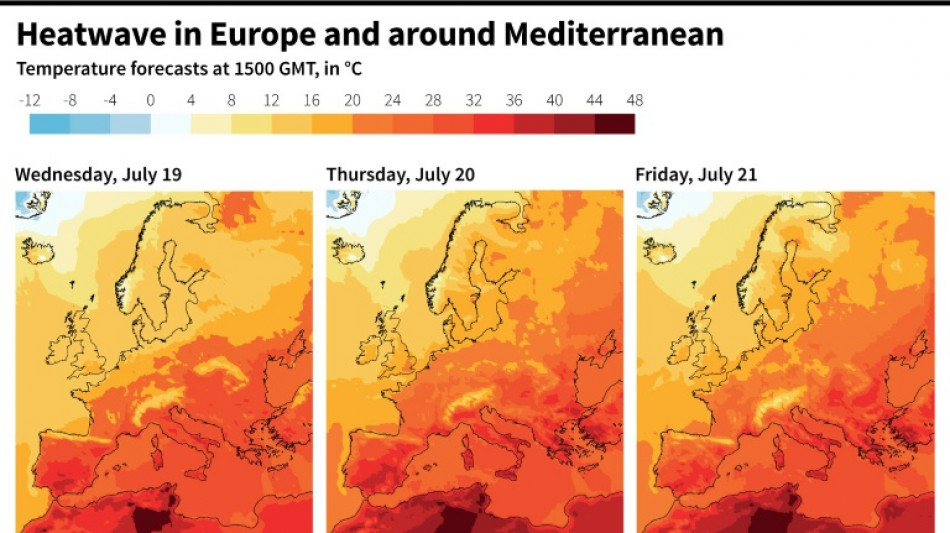
Struck by near-record temperatures and wildfires during this week's heatwave, the Mediterranean region is ranked as a climate-change "hot spot" by scientists.
The beaches, seafood and heritage sites in the region spanning parts of southern Europe, northern Africa and western Asia are under threat.
Here are five key threats to the region flagged by the United Nations' Intergovernmental Panel on Climate Change (IPCC). Its reports are the most comprehensive summary of scientific knowledge on global warming.
- Deadly heatwaves -
Like parts of the United States and Asia, the Med has been hit by extreme heat in recent weeks. The Italian islands of Sardinia and Sicily are forecast to possibly top a continent-wide record of 48.8C (119.8F).
"Heatwaves are increasing due to climate change in the Mediterranean, and are amplified in cities due to urbanisation practices," causing illness and death, the IPCC said in its 2022 report on impacts of climate change and how to adapt to them.
One study published in 2010 led by scientists at the University of Bern calculated that the intensity, length and number of heatwaves in the eastern Mediterranean had increased by about six or seven times since the 1960s.
- Wheat and olives -
A drought in North Africa has left farmers bracing for a terrible harvest. "We've never seen a drought this bad," Tunisian wheat farmer Tahar Chaouachi told AFP. "It's been dry for the last four years but we expected some rain this season. Instead, it's become worse."
With hotter weather drying up groundwater for irrigating farms, the IPCC said that with global warming of more than 1.5C olive yields could fall by a fifth in the northern Mediterranean. The world has warmed more than 1.1C since the 19th century.
Researchers at Stanford University found "the Mediterranean experiencing significant adverse impacts on most crops".
- Water and politics -
A drought in Spain has raised political tensions over water management ahead of a general election on July 23. The European Drought Observatory said groundwater tables across half the Mediterranean region were running low already in June.
The IPCC report warned climate change will worsen water shortages "in most locations" in the region. Lakes and reservoirs are expected to decline by up to 45 percent this century, and surface water availability by up to 55 percent in North Africa.
Meanwhile "terrestrial and freshwater ecosystems are impacted by climate change in the Mediterranean, resulting in loss of habitats and biodiversity," it added.
- Rising seas -
The sea level in the Mediterranean basin has risen 2.8mm a year over recent decades, threatening shorelines and cities such as Venice, which regularly suffers tidal floods.
"Sea level rise already impacts extreme coastal waters around the Mediterranean and it is projected to increase coastal flooding, erosion and salinisation risks," said the IPCC.
"These impacts would affect agriculture, fisheries and aquaculture, urban development, port operations, tourism, cultural sites and many coastal ecosystems."
- Invasive species -
As well as its cherished beaches, climate change threatens the Mediterranean sea and the food produced by its fisheries.
"A shift in Mediterranean marine ecosystems, characterised by biodiversity decline and invasive species, has occurred since the 1980s" due to climate change and other human impacts, the IPCC said.
With global warming of more than 1.5C, more than 20 percent of exploited fish and invertebrates in the Eastern Mediterranean could become locally extinct by 2060 and fishing revenues could decrease up to 30 percent by 2050, it said.
L.K.Baumgartner--CPN