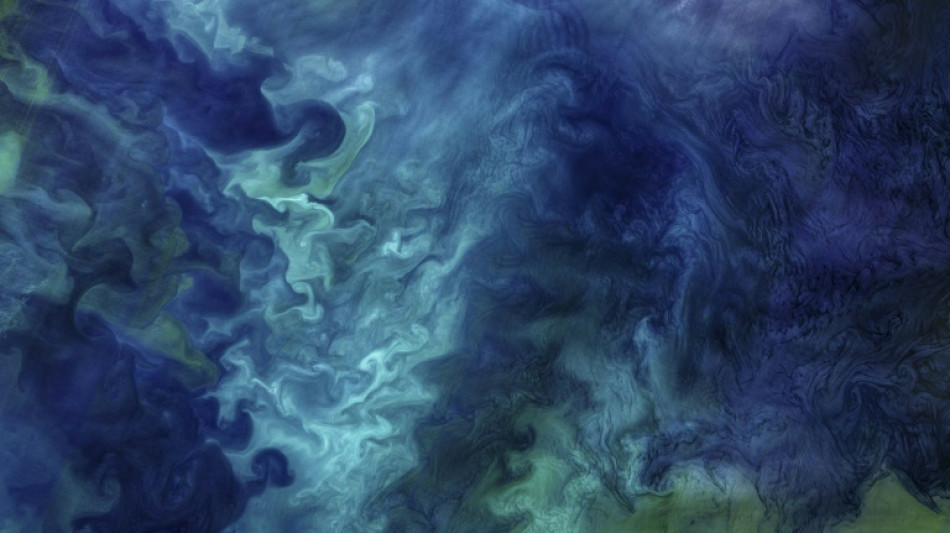
Oceans are changing colour and climate change may be to blame / Photo: HO - NASA/AFP/File

 iPhone 18預購後出現可疑扣款 四間銀行調查未授權交易

 Galaxy Tab S12系列效果圖曝光 Ultra擬配雙鏡頭及瀏海螢幕

 Altman tells Fortune OpenAI will not go public in 2026
 ستاندرد آند بورز تثبت تصنيف السعودية عند A+

 Steven Strogatz weighs AI mathematics advances and their consequences for researchers

 Venezuelans outside Caracas say capital not sharing blackout burden

 Anthropic boss calls for slowing pace of AI development

 BRICS nations urge 'maximum restraint' in Middle East war

 Europe eyes battle over 'pervert' AI glasses

 Children in flood-hit Nepal grapple with loss, cling to hope

 Venice Film Festival: A look back on the highlights

 DR Congo school fire stampede death toll rises to 26: UNICEF

 Dance Fitness Tempe Announces Expansion of Accessible Digital Movement Programs

 Europe saw record summer air traffic despite Mideast war: Eurocontrol

 Relatives of 9/11 victims hit out at Saudi Arabia -- and US leaders

 Relative of 9/11 victim unleashes searing attack on Saudi Arabia

 Czech antitrust office lets Turkey's Pegasus Airlines buy Smartwings

 Investors on edge as energy costs, surging bond yields roil markets

 UK lawmakers to vote again on failed assisted dying bill

 Yemen's Houthis complete takeover of Bab al-Mandab area: govt official to AFP

 Fast-pace dance takes I.Coast's working-class streets by storm

 Fans celebrate Celine Dion's Paris return with giant karaoke

 Appreciation, anger await as Trump heads to Irish golf resort

 Putin arrives in India for BRICS summit coloured by wars

 Carney says in touch with Trump, Canada ready for 'fair' trade deal

Over the past 20 years huge swathes of the world's oceans have changed colour, displaying a subtle greening towards the tropics that researchers say points to the effect of climate change on life in the world's seas.
In the new research published on Wednesday, scientists said they had detected shifts in colours across more than half of the world's oceans -- an expanse bigger than Earth's total land area.
Authors of the study in Nature think that is down to changes in ecosystems, and particularly in tiny plankton, which are the centrepiece of the marine food web and play a crucial part in stabilising our atmosphere.
"The reason we care about the colour changes is because the colour reflects the state of the ecosystem, so colour changes mean ecosystem changes," lead author B.B. Cael, of Britain's National Oceanography Centre, told AFP.
The colour of the seas when seen from space can paint a picture of what is going on in the upper layers of the water.
A deep blue would tell you that there is not much life, while if the water is greener it is likely to have more activity, specifically from the photosynthesising phytoplankton, which like plants contain the green pigment chlorophyll.
These produce a significant amount of the oxygen we breathe, are a crucial part of the global carbon cycle and are a foundational part of the ocean food web.
- Life colours -
Researchers are keen to develop ways of monitoring changes in ecosystems in order to track climate changes and enshrine protected areas.
But previous studies have suggested you would need three decades of ocean chlorophyll monitoring to detect a trend because of annual variations.
In the latest study, researchers broadened the colour spectrum, looking at seven hues of ocean colour monitored by the MODIS-Aqua satellite from 2002 to 2022.
These are too subtle for humans to see and would look largely blue to the naked eye.
The authors analysed the observational data to detect a trend above the year-to-year variability and then compared it to computer models of what would be expected with climate change.
They found that the real-world observations tallied closely with the changes predicted.
While the researchers said more work would be needed to find out what exactly those colour changes might mean, they said climate change was very likely to be the cause.
"I've been running simulations that have been telling me for years that these changes in ocean colour are going to happen," said co-author Stephanie Dutkiewicz, of MIT's Department of Earth, Atmospheric and Planetary Sciences at the Center for Global Change Science.
"To actually see it happening for real is not surprising, but frightening. And these changes are consistent with man-induced changes to our climate."
D.Avraham--CPN