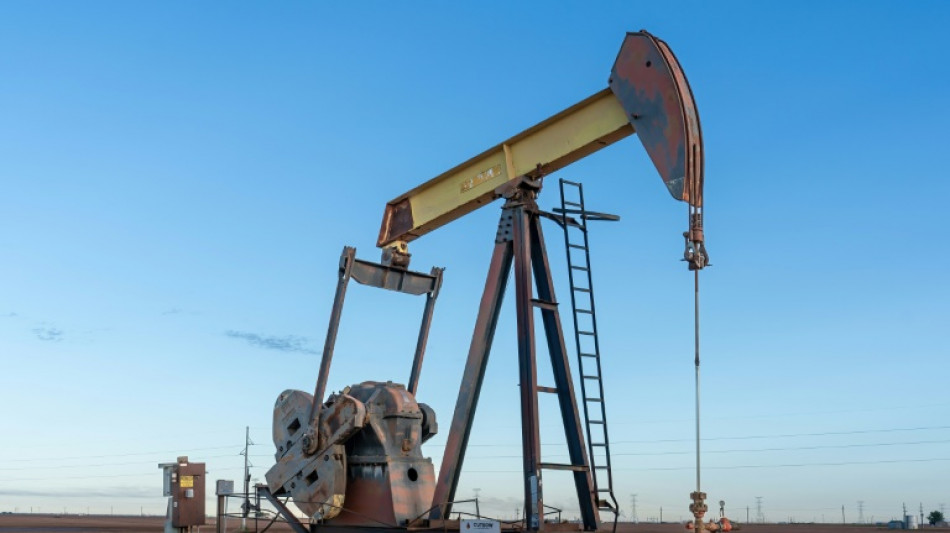
Peak in oil demand 'in sight' before end of decade: IEA / Photo: SUZANNE CORDEIRO - AFP/File

 اليورو يستقر في البنوك المصرية وأعلى سعر للبيع 59.85 جنيه

 الأرصاد السعودية تتوقع سيولاً وأمطاراً رعدية في خمس مناطق

 Lights out in Laos as electricity exports surge

 Steven Strogatz weighs AI mathematics advances and their consequences for researchers

 Anthropic boss calls for AI slowdown, Altman and Musk agree

 French IT giant Capgemini sells subsidiary after row over ICE links

 Quebec Brokerage Qubit Insurance Announces New Data on Coverage Shortfalls as Rebuilding Costs Rise

 Lady Gaga welcomes first child with fiance: US media

 Bhutan business bets on hazelnuts for farming future

 'Widow's Bay' and 'The Pitt' are favorites for Emmys night

 Coastal erosion forces cancellation of California music festival

 Argentina's Dirty War rears its head in Venice film

 UK lawmakers throw out bill to legalise assisted dying

 US inflation steady in August, fueling Fed rate hike expectations

 New York marks 25th anniversary of 9/11 attacks

 Nepal flood reconstruction bill to be $4.78 bn: foreign ministry

 JUMO and Standard Bank launch Social Finance Framework to scale inclusive finance in Africa

 Doomsday tech: could AI really kill us all?

 French comedy show 'Call my agent' makes film comeback

 It's all coming back: Celine Dion fans gear up for Paris return

 Researchers eye AI revolution in natural disaster forecasts

 US braces for inflation report that may push Fed to hike rates

 Musk threatens legal action over documentary

 Latin America fact-check group asks Meta not to replace verification practice

 AI Risks to Enter 60–80% of Liability and Cyber Insurance Underwriting by 2028, ScienceSoft Predicts

Global oil demand could peak before the end of this decade as the energy crisis has accelerated the transition to cleaner technologies, the International Energy Agency said Wednesday.
The Paris-based agency, which advises developed nations, forecast in its Oil 2023 medium-term market report that annual demand growth would slow sharply over the next five years.
"The shift to a clean energy economy is picking up pace, with a peak in global oil demand in sight before the end of this decade as electric vehicles, energy efficiency and other technologies advance," IEA Executive Director Fatih Birol said in a statement.
"Oil producers need to pay careful attention to the gathering pace of change and calibrate their investment decisions to ensure an orderly transition," Birol said.
Energy prices soared last year after Russia, a major exporter of fossil fuels, invaded Ukraine and cut deliveries of natural gas to Europe.
Western powers imposed bans and price caps on Russian oil exports in efforts to drain a major source of cash for Moscow's war effort.
Oil and gas prices have fallen in the past several months.
World demand for oil will rise by six percent between 2022 and 2028 to reach 105.7 million barrels per day due to the needs of the petrochemical and aviation sectors, the IEA said.
But annual growth will slow significantly, from 2.4 million bpd day this year to just 400,000 bpd in 2028.
"Growth in the world's demand for oil is set to slow almost to a halt in the coming years," the IEA said.
- China demand to slow -
In its 2022 World Energy Outlook, the IEA had forecast world demand peaking and stabilising after 2035.
But the energy crisis is "hastening the shift towards cleaner energy technologies", the organisation said.
The use of oil for the transport sector should decline after 2026 as more and more electric vehicles hit the road, it said.
The need for oil will decline from 2024 in the 38 nations that are part of the Organisation for Economic Co-operation and Development, whose members range from Australia to European countries, Japan, Mexico and the United States.
"Nevertheless, burgeoning petrochemical demand and strong consumption growth in emerging economies will more than offset a contraction in advanced economies," the IEA said.
Demand growth in China, the world's second biggest economy, will slow "markedly from 2024 onwards" following a post-Covid rebound this year.
- Oil investments rise -
"Global oil markets are still slowly recalibrating after three turbulent years in which they were upended first by the Covid-19 pandemic and then by Russia's invasion of Ukraine," the agency said.
"Global oil markets could tighten significantly in the coming months," it added, noting production cuts by the OPEC+ alliance of major producers led by Saudi Arabia and Russia.
"However, the multifaceted strains on markets look set to ease in the following years."
While demand is set to slow, global investments in oil and gas exploration, extraction and production are "on course to reach their highest levels since 2015" with a 15-percent annual rise to $528 billion in 2023.
Earlier on Wednesday, British oil giant Shell said it would keep its oil production steady into 2030, angering environmental activists who saw the announcement as a "climate-wrecking U-turn".
Another British oil major, BP, announced in February that it expected to boost its profits between now and 2030 by investing more in both renewable energy and hydrocarbons, slowing the pace of its transition.
Y.Tengku--CPN