Quebec the new epicenter of Canada's raging wildfires / Photo: ANDREJ IVANOV - AFP

 اليورو يستقر في البنوك المصرية وأعلى سعر للبيع 59.85 جنيه

 الأرصاد السعودية تتوقع سيولاً وأمطاراً رعدية في خمس مناطق

 Lights out in Laos as electricity exports surge

 Steven Strogatz weighs AI mathematics advances and their consequences for researchers

 Anthropic boss calls for AI slowdown, Altman and Musk agree

 French IT giant Capgemini sells subsidiary after row over ICE links

 Quebec Brokerage Qubit Insurance Announces New Data on Coverage Shortfalls as Rebuilding Costs Rise

 Lady Gaga welcomes first child with fiance: US media

 Bhutan business bets on hazelnuts for farming future

 'Widow's Bay' and 'The Pitt' are favorites for Emmys night

 Coastal erosion forces cancellation of California music festival

 Argentina's Dirty War rears its head in Venice film

 UK lawmakers throw out bill to legalise assisted dying

 US inflation steady in August, fueling Fed rate hike expectations

 New York marks 25th anniversary of 9/11 attacks

 Nepal flood reconstruction bill to be $4.78 bn: foreign ministry

 JUMO and Standard Bank launch Social Finance Framework to scale inclusive finance in Africa

 Doomsday tech: could AI really kill us all?

 French comedy show 'Call my agent' makes film comeback

 It's all coming back: Celine Dion fans gear up for Paris return

 Researchers eye AI revolution in natural disaster forecasts

 US braces for inflation report that may push Fed to hike rates

 Musk threatens legal action over documentary

 Latin America fact-check group asks Meta not to replace verification practice

 AI Risks to Enter 60–80% of Liability and Cyber Insurance Underwriting by 2028, ScienceSoft Predicts

Canada's Quebec province, not used to the huge number, scale and strength of wildfires ravaging the rest of the country, has become the latest hotspot with about 160 fires burning on Tuesday, most of those out of control.
In the hardest-hit Abitibi-Temiscamingue region of the province, more than 650 kilometers (400 miles) north of Montreal, fires that have disrupted mining and forestry operations are "worrying," said Quebec Premier François Legault.
"We are experiencing a situation never seen... everywhere in Quebec," warned Francois Bonnardel, Quebec's public safety minister, stressing that a large number of these fires were sparked by human carelessness.
"Western Canada usually sees a lot of wildfire activity. Quebec doesn't," he noted. "But right now everything is on fire."
Some 4,400 evacuees were permitted to return to their homes in the northern city of Sept-Iles on the shores of the St. Lawrence River as rains arrived to help stall advancing blazes.
"We are very, very happy to see rain," Legault told a news conference.
But further north, he added, there's "a huge fire which will take weeks to extinguish completely, so we must remain cautious."
- Smoke and ash -
Canada has been hit repeatedly by extreme weather in recent years, the intensity and frequency of which have increased due to global warming.
After major flare-ups in the west of the country in May, notably in the prairie provinces of Alberta and Saskatchewan, firefighting shifted in recent weeks to Nova Scotia on the Atlantic coast, before turning to Quebec.
Dozens of fires are still burning in the west of the country: 62 in Alberta, 76 in westernmost British Columbia and 24 in Saskatchewan.
Quebec, meanwhile, has recorded 424 wildfires since the spring thaw -- more than double the average annual count over the past decade.
About 100 firefighters from France were scheduled to arrive by Friday to help fight the Quebec wildfires. This is on top of nearly 1,000 firefighters from Australia, Mexico, New Zealand, South Africa and the United States who have arrived or were en route to bolster firefighting efforts across Canada.
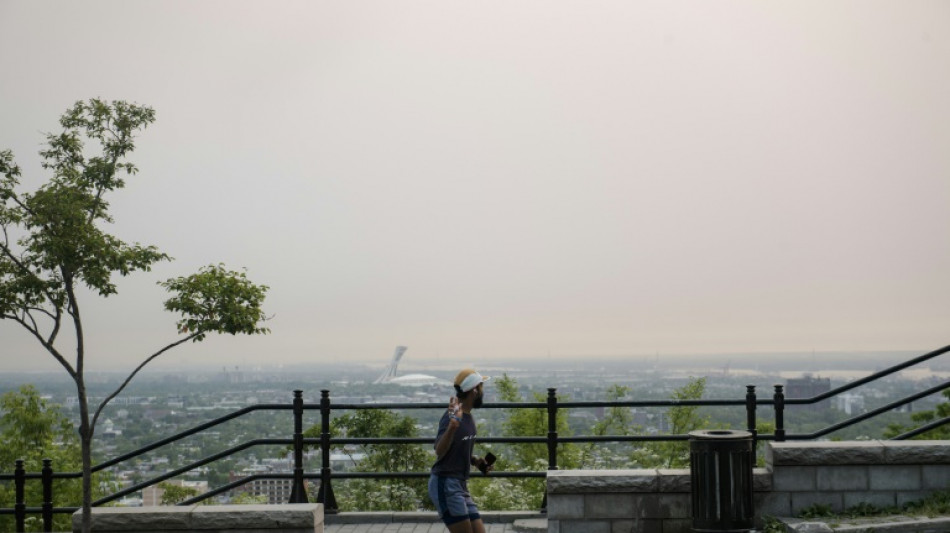
Wildfire smoke on Tuesday strangled the capital, Ottawa, prompting severe air quality alerts, and darkened skies above Montreal and Toronto. Officials urged residents to limit outdoor activities and said the smoke would not likely clear for another few days.
In Parliament, lawmakers complained about the smell of smoke and ash coating surfaces.
Ottawa resident Abe Bourgi told AFP he woke up to a yellowish haze over the city, and the sun a deep orange color.
"The smell of smoke is very strong," he said. "Many people are wearing masks in the streets and you have to close the doors and windows otherwise your apartment will smell like an ashtray."
Similar smoke conditions -- stemming from the Canadian fires -- were reported down the US Atlantic seaboard, triggering air quality alerts. In New York, the Manhattan skyline was barely visible from other boroughs.
A.Agostinelli--CPN