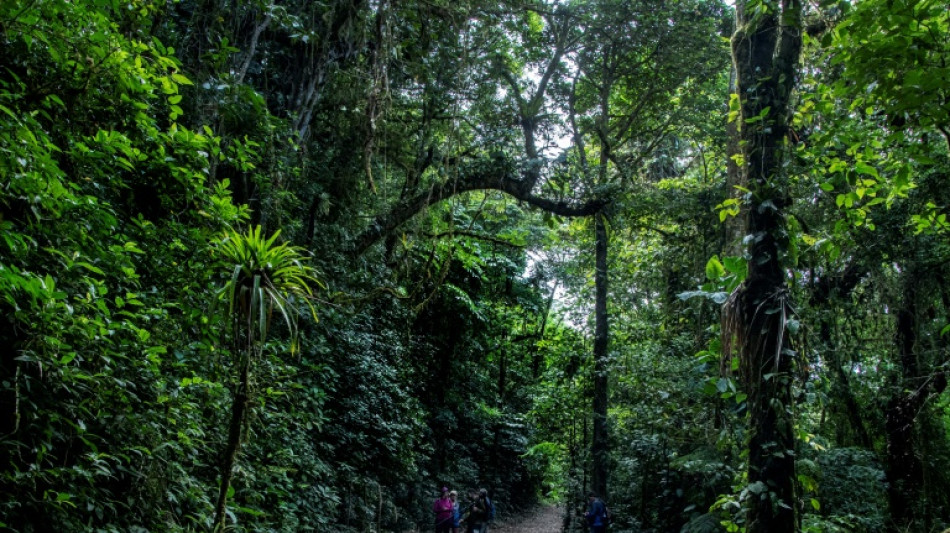
In Costa Rica, climate change threatens 'cloud forest' / Photo: Ezequiel BECERRA - AFP

 اليورو يستقر في البنوك المصرية وأعلى سعر للبيع 59.85 جنيه

 الأرصاد السعودية تتوقع سيولاً وأمطاراً رعدية في خمس مناطق

 Lights out in Laos as electricity exports surge

 Steven Strogatz weighs AI mathematics advances and their consequences for researchers

 Anthropic boss calls for AI slowdown, Altman and Musk agree

 French IT giant Capgemini sells subsidiary after row over ICE links

 Quebec Brokerage Qubit Insurance Announces New Data on Coverage Shortfalls as Rebuilding Costs Rise

 Lady Gaga welcomes first child with fiance: US media

 Bhutan business bets on hazelnuts for farming future

 'Widow's Bay' and 'The Pitt' are favorites for Emmys night

 Coastal erosion forces cancellation of California music festival

 Argentina's Dirty War rears its head in Venice film

 UK lawmakers throw out bill to legalise assisted dying

 US inflation steady in August, fueling Fed rate hike expectations

 New York marks 25th anniversary of 9/11 attacks

 Nepal flood reconstruction bill to be $4.78 bn: foreign ministry

 JUMO and Standard Bank launch Social Finance Framework to scale inclusive finance in Africa

 Doomsday tech: could AI really kill us all?

 French comedy show 'Call my agent' makes film comeback

 It's all coming back: Celine Dion fans gear up for Paris return

 Researchers eye AI revolution in natural disaster forecasts

 US braces for inflation report that may push Fed to hike rates

 Musk threatens legal action over documentary

 Latin America fact-check group asks Meta not to replace verification practice

 AI Risks to Enter 60–80% of Liability and Cyber Insurance Underwriting by 2028, ScienceSoft Predicts

The "cloud forest" of Monteverde, in the center of Costa Rica, will soon no longer be worthy of the name: climate change threatens this unique ecosystem, and its fauna and flora face an unclear future under a brilliant blue sky.
In the forest, what a visitor should hear is the constant drip of moisture falling from the trees. Instead, it is the sound of dead branches snapping underfoot that breaks the silence on the dry trails.
The high-altitude forest is still clinging to life, and it delights walkers with an infinite variety of greens under an uncomfortably bright sun: the fog which reigned supreme here only a short time ago dissipates as the temperature rises, explained 24-year-old forest guide Andrey Castrillo.
"The forest should be cool," he said. "You should hear the drops falling all over the forest, but that only happens during the wettest and windiest days of the rainy season."
"Here there was no sun... We had about 30 days of sunshine a year. Now we have more than 130," he said.
At 1,400 meters (4,600 feet) above sea level and 140 kilometers (86 miles) northwest of the capital San Jose, the private nature reserve extends over 14,200 hectares (35,000 acres) and is home to a hundred species of mammals, 440 bird species and 1,200 types of amphibians.
- 'Walking in the clouds' -
This exceptional type of altitude forest represents only one percent of the world's tropical and subtropical areas.
"Near-ground cloud cover forms when the humidity saturation is above 90 percent with temperatures between 14 and 18 degrees Celsius (57 to 64 degrees Fahrenheit)," researcher Ana Maria Duran, of the University of Costa Rica, told AFP.
The researcher said she had been coming here regularly for more than twenty years.
Normally, the "almost permanent" fog gives the impression of "practically walking in the middle of the clouds," with visibility down to barely a meter (three feet).
As she spoke, she stared into the forest where the temperature had risen to more than 25 degrees Celsius, under a blue sky where only a few clouds crowned the peaks.
"Coming to Monteverde to find such dry conditions and not being in the clouds like it was 20 years ago when I started coming is obviously very sad," said Duran.
Rising temperatures mean lower humidity and more sun. The mosses have dried on the tree trunks, the rivers are no more than streams, and the amphibians here have been the first victims of climate change.
"The decline of amphibians in cloud forests may serve as a wake-up call," warned biologist Andrea Vincent, who teaches at the University of Costa Rica.
Already, the species Incilius periglenes, known as the golden frog, has been considered extinct since 2019 by the International Union for Conservation of Nature (IUCN).
"A cloudless cloud forest, it will disappear, it has to," said Vincent, warning that "there will be a lot of extinctions" of various species.
But this "dispiriting scenario" can still be avoided, she said.
"Ecosystems are resilient. If we make efforts to stop climate change it is possible that cloud forests will recover... not during our lifetime but perhaps for the next generations".
O.Hansen--CPN