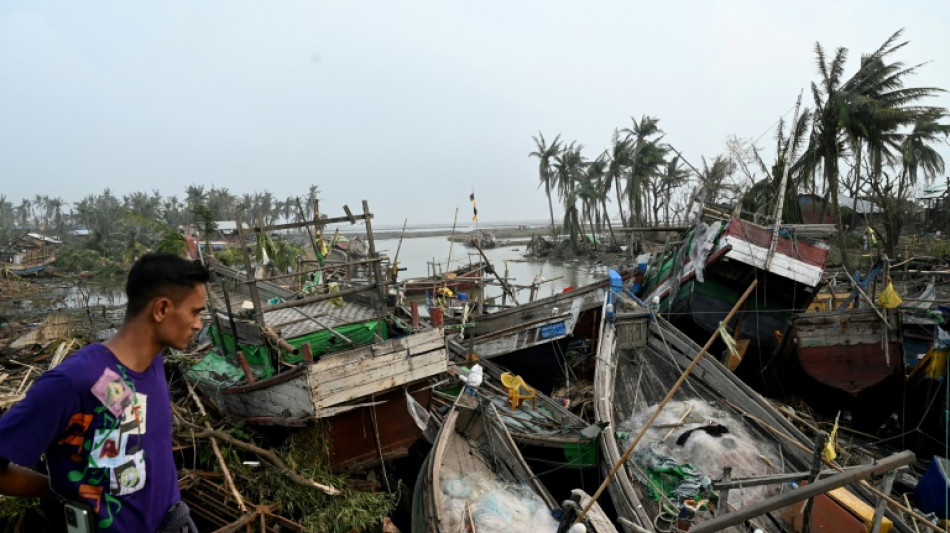
Early warning systems send disaster deaths plunging: UN / Photo: Sai Aung MAIN - AFP

 اليورو يستقر في البنوك المصرية وأعلى سعر للبيع 59.85 جنيه

 الأرصاد السعودية تتوقع سيولاً وأمطاراً رعدية في خمس مناطق

 Lights out in Laos as electricity exports surge

 Steven Strogatz weighs AI mathematics advances and their consequences for researchers

 Anthropic boss calls for AI slowdown, Altman and Musk agree

 French IT giant Capgemini sells subsidiary after row over ICE links

 Quebec Brokerage Qubit Insurance Announces New Data on Coverage Shortfalls as Rebuilding Costs Rise

 Lady Gaga welcomes first child with fiance: US media

 Bhutan business bets on hazelnuts for farming future

 'Widow's Bay' and 'The Pitt' are favorites for Emmys night

 Coastal erosion forces cancellation of California music festival

 Argentina's Dirty War rears its head in Venice film

 UK lawmakers throw out bill to legalise assisted dying

 US inflation steady in August, fueling Fed rate hike expectations

 New York marks 25th anniversary of 9/11 attacks

 Nepal flood reconstruction bill to be $4.78 bn: foreign ministry

 JUMO and Standard Bank launch Social Finance Framework to scale inclusive finance in Africa

 Doomsday tech: could AI really kill us all?

 French comedy show 'Call my agent' makes film comeback

 It's all coming back: Celine Dion fans gear up for Paris return

 Researchers eye AI revolution in natural disaster forecasts

 US braces for inflation report that may push Fed to hike rates

 Musk threatens legal action over documentary

 Latin America fact-check group asks Meta not to replace verification practice

 AI Risks to Enter 60–80% of Liability and Cyber Insurance Underwriting by 2028, ScienceSoft Predicts

Weather-related disasters have surged over the past 50 years, causing swelling economic damage even as early warning systems have meant dramatically fewer deaths, the United Nations said Monday.
Extreme weather, climate and water-related events caused 11,778 reported disasters between 1970 and 2021, new figures from the UN's World Meteorological Organization (WMO) show.
Those disasters killed just over two million people and caused $4.3 trillion in economic losses.
"The most vulnerable communities unfortunately bear the brunt of weather, climate and water-related hazards," WMO chief Petteri Taalas said in a statement.
The report found that over 90 percent of reported deaths worldwide due to disasters over the 51-year-period occurred in developing countries.
But the agency also said improved early warning systems and coordinated disaster management had significantly reduced the human casualty toll.
WMO pointed out in a report issued two years ago covering disaster-linked deaths and losses between 1970 and 2019, that at the beginning of the period the world was seeing more than 50,000 such deaths each year.
By the 2010s, the disaster death toll had dropped to below 20,000 annually.
And in its update of that report, WMO said Monday that 22,608 disaster deaths were recorded globally in 2020 and 2021 combined.
- 'Early warnings save lives' -
Cyclone Mocha, which wreaked havoc in Myanmar and Bangladesh last week, exemplifies this, Taalas said.
Mocha "caused widespread devastation... impacting the poorest of the poor," he said.
But while Myanmar's junta has put the death toll from the cyclone at 145, Taalas pointed out that during similar disasters in the past, "both Myanmar and Bangladesh suffered death tolls of tens and even hundreds of thousands of people".
"Thanks to early warnings and disaster management these catastrophic mortality rates are now thankfully history. Early warnings save lives."
The UN has launched a plan to ensure all nations are covered by disaster early warning systems by the end of 2027.
Endorsing that plan figures among the top strategic priorities during a meeting of WMO's decision-making body, the World Meteorological Congress, which opens Monday.
To date, only half of countries have such systems in place.
- Surging economic losses -
WMO meanwhile warned that while deaths have plunged, the economic losses incurred when weather, climate and water extremes hit have soared.
The agency previously recorded economic losses increased sevenfold between 1970 and 2019, rising from $49 million per day during the first decade to $383 million per day in the final one.
Wealthy countries have been hardest hit by far in monetary terms.
The United States alone incurred $1.7 trillion in losses, or 39 percent of economic losses globally due to disasters since 1970.
But while the dollar figures on losses suffered in poorer nations were not particularly high, they were far higher in relation to the size of their economies, WMO noted.
Developed nations accounted for over 60 percent of losses due to weather, climate and water disasters, but in more than four-fifths of cases, the economic losses were equivalent to less than 0.1 percent of gross domestic product (GDP).
And no disasters saw reported economic losses greater than 3.5 percent of the respective GDPs.
By comparison, in seven percent of the disasters to hit the world's least developed countries, losses equivalent to more than five percent of their GDP were reported, with several disasters causing losses equivalent to nearly a third of GDP.
And for small island developing states, one fifth of disasters saw economic losses of over five percent of GDP, with some causing economic losses above 100 percent.
J.Bondarev--CPN