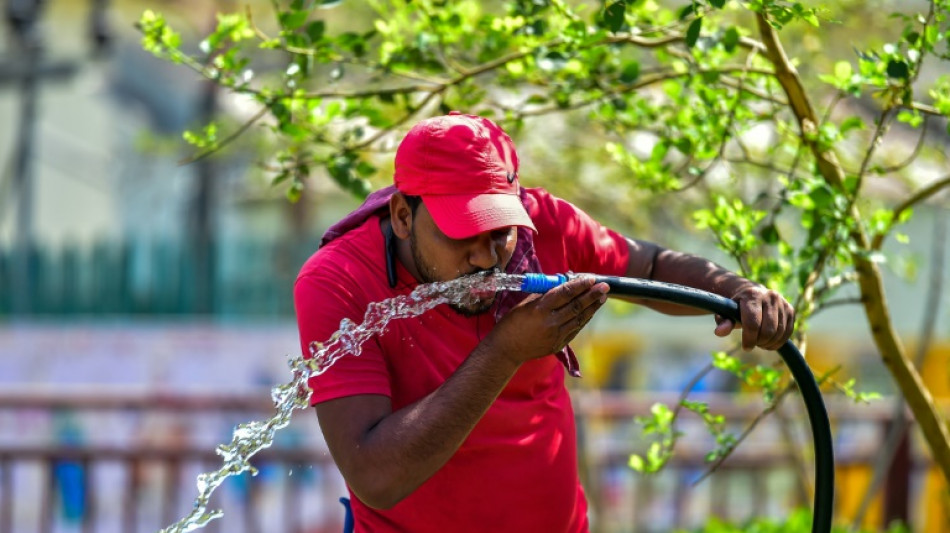
Asia heatwaves made 30 times more likely by climate change: study / Photo: SANJAY KANOJIA - AFP/File

 اليورو يستقر في البنوك المصرية وأعلى سعر للبيع 59.85 جنيه

 الأرصاد السعودية تتوقع سيولاً وأمطاراً رعدية في خمس مناطق

 Lights out in Laos as electricity exports surge

 Steven Strogatz weighs AI mathematics advances and their consequences for researchers

 Anthropic boss calls for AI slowdown, Altman and Musk agree

 French IT giant Capgemini sells subsidiary after row over ICE links

 Quebec Brokerage Qubit Insurance Announces New Data on Coverage Shortfalls as Rebuilding Costs Rise

 Lady Gaga welcomes first child with fiance: US media

 Bhutan business bets on hazelnuts for farming future

 'Widow's Bay' and 'The Pitt' are favorites for Emmys night

 Coastal erosion forces cancellation of California music festival

 Argentina's Dirty War rears its head in Venice film

 UK lawmakers throw out bill to legalise assisted dying

 US inflation steady in August, fueling Fed rate hike expectations

 New York marks 25th anniversary of 9/11 attacks

 Nepal flood reconstruction bill to be $4.78 bn: foreign ministry

 JUMO and Standard Bank launch Social Finance Framework to scale inclusive finance in Africa

 Doomsday tech: could AI really kill us all?

 French comedy show 'Call my agent' makes film comeback

 It's all coming back: Celine Dion fans gear up for Paris return

 Researchers eye AI revolution in natural disaster forecasts

 US braces for inflation report that may push Fed to hike rates

 Musk threatens legal action over documentary

 Latin America fact-check group asks Meta not to replace verification practice

 AI Risks to Enter 60–80% of Liability and Cyber Insurance Underwriting by 2028, ScienceSoft Predicts

Climate change made record-breaking deadly heatwaves in Bangladesh, India, Laos and Thailand last month at least 30 times more likely, according to a study published Wednesday.
Parts of India saw temperatures above 44 degrees Celsius (111 Fahrenheit) in mid-April, with at least 11 deaths near Mumbai attributed to heat stroke on a single day. In Bangladesh, Dhaka suffered its hottest day in almost 60 years.
The city of Tak in Thailand saw its highest-ever temperature of 45.4 Celsius, while Sainyabuli province in Laos hit 42.9 Celsius, an all-time national temperature record, the study by the World Weather Attribution group said.
Two deaths were reported in Thailand, but the real toll was likely higher as the extreme heat caused widespread hospitalisations, with the poor and vulnerable the worst affected.
The new study by international climate scientists looked at the average maximum temperature and the maximum heat index, which includes humidity.
"In both regions, the researchers found that climate change made the humid heatwave at least 30 times more likely, with temperatures at least 2 degrees Celsius hotter than they would have been without climate change," WWA said in a statement.
"Until overall greenhouse gas emissions are halted, global temperatures will continue to increase and events like this will become more frequent and severe," it added.
The analysis also found that such events in India and Bangladesh, previously once-a-century, can now be expected around once every five years because of human-caused climate change.
For Laos and Thailand, if global temperatures rise by two degrees Celsius -- as will happen within around 30 years if emissions are not cut rapidly -- such extreme events could happen every 20 years, compared to every two centuries now, the study said.
"We see again and again that climate change dramatically increases the frequency and intensity of heatwaves, one of the deadliest weather events there are," said Friederike Otto of the Grantham Institute for Climate Change and the Environment, who was involved in the study.
"Still, heat action plans are only being introduced very slowly across the globe. They need to be an absolute priority adaptation action everywhere, but in particular in places where high humidity enhances the impacts of heatwaves," she added.
Scientists were previously reluctant to directly link a particular event to climate change, but in recent years a new field of "attribution science", like that done by the WWA, has emerged.
Some weather events have a more complicated relationship to global warming than others, with the relationship to heatwaves and increased rainfall relatively easy to study.
Other phenomena such as droughts, snowstorms, tropical storms and wildfires are more complicated however, according to the WWA.
A.Leibowitz--CPN