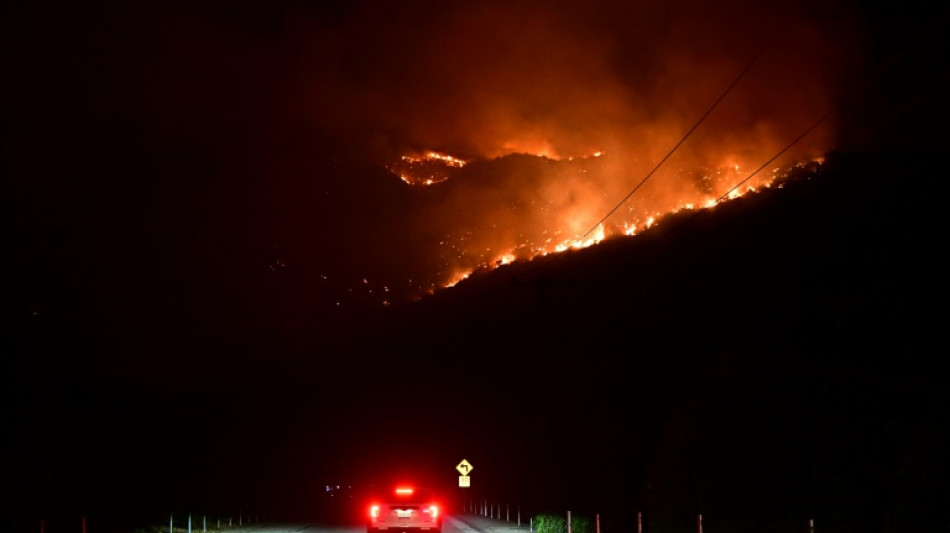
New study quantifies link between climate crisis, wildfires / Photo: Frederic J. BROWN - AFP/File

 اليورو يستقر في البنوك المصرية وأعلى سعر للبيع 59.85 جنيه

 الأرصاد السعودية تتوقع سيولاً وأمطاراً رعدية في خمس مناطق

 Lights out in Laos as electricity exports surge

 Steven Strogatz weighs AI mathematics advances and their consequences for researchers

 Anthropic boss calls for AI slowdown, Altman and Musk agree

 French IT giant Capgemini sells subsidiary after row over ICE links

 Quebec Brokerage Qubit Insurance Announces New Data on Coverage Shortfalls as Rebuilding Costs Rise

 Lady Gaga welcomes first child with fiance: US media

 Bhutan business bets on hazelnuts for farming future

 'Widow's Bay' and 'The Pitt' are favorites for Emmys night

 Coastal erosion forces cancellation of California music festival

 Argentina's Dirty War rears its head in Venice film

 UK lawmakers throw out bill to legalise assisted dying

 US inflation steady in August, fueling Fed rate hike expectations

 New York marks 25th anniversary of 9/11 attacks

 Nepal flood reconstruction bill to be $4.78 bn: foreign ministry

 JUMO and Standard Bank launch Social Finance Framework to scale inclusive finance in Africa

 Doomsday tech: could AI really kill us all?

 French comedy show 'Call my agent' makes film comeback

 It's all coming back: Celine Dion fans gear up for Paris return

 Researchers eye AI revolution in natural disaster forecasts

 US braces for inflation report that may push Fed to hike rates

 Musk threatens legal action over documentary

 Latin America fact-check group asks Meta not to replace verification practice

 AI Risks to Enter 60–80% of Liability and Cyber Insurance Underwriting by 2028, ScienceSoft Predicts

In a first, US climate scientists have quantified the extent to which greenhouse gasses from the world's top fossil fuel companies have contributed to wildfires.
Their analysis, published Tuesday in Environmental Research Letters, found that carbon dioxide and methane emissions from the so-called "Big 88" firms were responsible for more than a third of the area scorched by forest blazes in western North America over the past 40 years.
First author Kristina Dahl, of the Union of Concerned Scientists (UCS), told AFP wildfires in the western United States and southwestern Canada have been worsening for decades: they are burning more intensely, over longer seasons, covering larger areas and reaching higher elevations.
To date, the cost of rebuilding and increasing resilience has largely been footed by the general public, "so we wanted to better understand the role that fossil fuel industry emissions have had in altering the wildfire landscape," she said.
"We really wanted to put a spotlight on their role in that, so that they can be held accountable for their fair share of the cost."
- 'Atmospheric thirst' -
Using climate modeling, the team determined that emissions from the Big 88 -- which includes ExxonMobil, BP, Chevron and Shell -- were responsible for increasing global average temperatures by 0.9 degrees Fahrenheit (0.5 degrees Celsius) since the start of the 20th century, or roughly half of the observed warming.
For the purposes of this study, the authors included all emissions across the life cycle of fossil fuels -- from extraction and flaring operations to refinement and use inside a vehicle, for example.
The companies' contribution to planet-wide warming was then used to calculate how much they added to a rise in "vapor pressure deficit" or VPD -- a measure of air's ability to draw water out of plants and soils -- within the western North America region.
Because warmer air can hold more water vapor, rising temperatures caused by climate change are causing this measure of atmospheric thirst to increase too.
A higher VPD makes an area more fire prone, and recent research has established a clear exponential relationship between increases in this aridity indicator and the area burned by forest fires.
Combining all these elements, Dahl's research team found that emissions from the Big 88 were responsible for 37 percent of the total area razed by forest fires in western United States and southwestern Canada between 1986, when reliable fire area data became available, and 2021.
That is 19.8 million acres (8 million hectares) -- an area roughly the size of the Czech Republic.
The study also found that emissions from the same companies were responsible for nearly half of the observed increase in VPD since 1901.
Other factors that increased fire danger conditions over the last century include aggressive fire suppression that led to large buildups of vegetation that normally would have burned in smaller regularly occurring fires, often managed by Indigenous communities.
Accidental ignitions have also increased as humans encroached into fire-prone areas.
- Growing area of research -
The research builds on an accumulating body of climate "attribution" studies, which have calculated how much greenhouse gas emissions from burning fossil fuels have contributed to global temperature increases, sea level rise, and ocean acidification.
Such work has paved the way for impacted communities to seek redress through lawsuits, said Dahl, and helps shift the conversation about tackling climate change away from individual responsibility.
"Lowering our individual carbon footprints is a narrative that has been very heavily pushed by the fossil fuel industry," she said.
"While individuals need to make the best choices we can, we also have to acknowledge that we're living in a reality that's been shaped by these companies and our choices have been constrained because of them."
The UCS is pushing for government investigations into past and ongoing disinformation campaigns by industry aimed at denying climate science that was predicted by the companies’ own internal modeling.
P.Kolisnyk--CPN