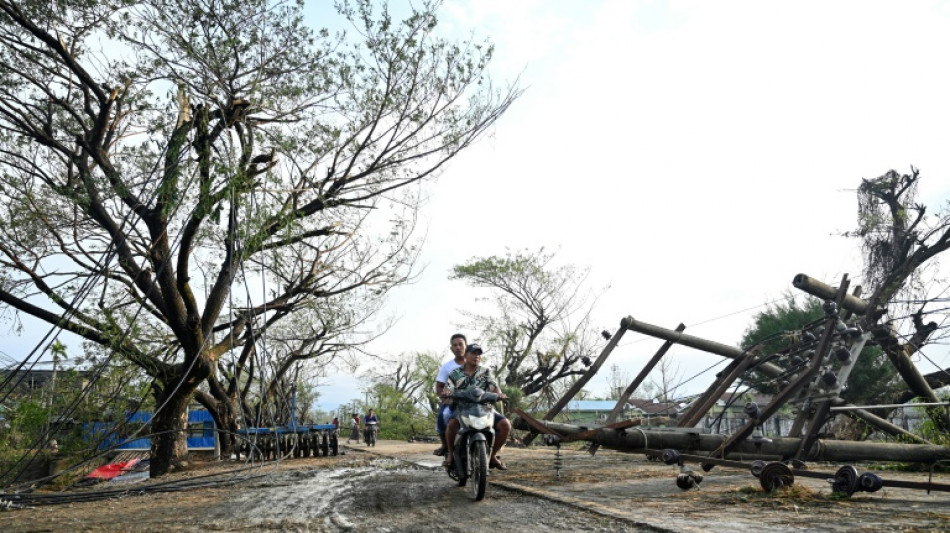
Myanmar port city slowly reopens after deadly Cyclone Mocha / Photo: Sai Aung MAIN - AFP

 اليورو يستقر في البنوك المصرية وأعلى سعر للبيع 59.85 جنيه

 الأرصاد السعودية تتوقع سيولاً وأمطاراً رعدية في خمس مناطق

 Lights out in Laos as electricity exports surge

 Steven Strogatz weighs AI mathematics advances and their consequences for researchers

 Anthropic boss calls for AI slowdown, Altman and Musk agree

 French IT giant Capgemini sells subsidiary after row over ICE links

 Quebec Brokerage Qubit Insurance Announces New Data on Coverage Shortfalls as Rebuilding Costs Rise

 Lady Gaga welcomes first child with fiance: US media

 Bhutan business bets on hazelnuts for farming future

 'Widow's Bay' and 'The Pitt' are favorites for Emmys night

 Coastal erosion forces cancellation of California music festival

 Argentina's Dirty War rears its head in Venice film

 UK lawmakers throw out bill to legalise assisted dying

 US inflation steady in August, fueling Fed rate hike expectations

 New York marks 25th anniversary of 9/11 attacks

 Nepal flood reconstruction bill to be $4.78 bn: foreign ministry

 JUMO and Standard Bank launch Social Finance Framework to scale inclusive finance in Africa

 Doomsday tech: could AI really kill us all?

 French comedy show 'Call my agent' makes film comeback

 It's all coming back: Celine Dion fans gear up for Paris return

 Researchers eye AI revolution in natural disaster forecasts

 US braces for inflation report that may push Fed to hike rates

 Musk threatens legal action over documentary

 Latin America fact-check group asks Meta not to replace verification practice

 AI Risks to Enter 60–80% of Liability and Cyber Insurance Underwriting by 2028, ScienceSoft Predicts

Contact was slowly being restored on Monday with tens of thousands of people cut off in a major Myanmar port city as the death toll from a cyclone that tore through the west of the country and neighbouring Bangladesh rose to at least five.
Cyclone Mocha made landfall between Cox's Bazar in Bangladesh and Myanmar's Sittwe carrying winds of up to 195 kilometres (120 miles) per hour, the biggest storm to hit the Bay of Bengal in more than a decade.
The storm had largely passed by late Sunday, sparing the refugee camps housing almost a million Rohingya in Bangladesh, where officials said there had been no deaths.
At least five people were killed in Myanmar and "some residents" were injured, the military junta said in a statement, without giving details.
More than 860 houses and 14 hospitals or clinics had been damaged across the country, it said.
Communications were still mostly down on Monday with Rakhine state's capital Sittwe, home to around 150,000 people and which bore the brunt of the storm according to cyclone trackers.
Hundreds of people who had sheltered on higher ground were returning to the city along a road littered with trees, pylons and power cables, AFP correspondents said.
A military checkpoint around 10 kilometres (six miles) outside the city barred cars and vans from entering, forcing people to continue their journeys on motorbike or foot.
In Sittwe, power pylons hung low over deserted streets and trees still standing were stripped of leaves.
At least five people had died in the city and around 25 had been injured, local rescue worker Ko Lin Lin told AFP.
It was not clear whether any of them were included in the death toll in the junta's statement.
Mocha made landfall on Sunday, bringing a storm surge and high winds that toppled a communications tower in Sittwe, according to images published on social media.
"I was in a Buddhist monastery when the storm came," one resident told AFP.
"The prayer hall and monk dining hall have collapsed. We had to move from this building and that building. Now roads are blocked as trees and pylons are fallen."
Junta-affiliated media reported that the storm had put hundreds of base stations, which connect mobile phones to networks, out of action in Rakhine.
Junta chief Min Aung Hlaing had "instructed officials to make preparations for Sittwe Airport transport relief", state media reported, without giving details on when relief was expected to arrive.
- 'Extensive damage' -
The United Nations said communications problems meant it had not yet been able to assess the damage in Rakhine, which has been ravaged by ethnic conflict for years.
"Early reports suggest the damage is extensive," the UN Office for the Coordination of Humanitarian Affairs said late on Sunday.
On Bangladesh's Shah Porir Dwip island, residents began repairing damaged homes, searching through debris and retrieving scattered possessions.
Bangladesh officials said they had evacuated 750,000 people.
Secretary of the disaster management ministry, Kamrul Hasan, told AFP on Monday no one had died in the cyclone.
The damage was also minimal in the Rohingya camps, where about a million people live in 190,000 bamboo and tarpaulin shelters, officials said.
"About 300 shelters were destroyed by the cyclone," deputy refugee commissioner Shamsud Douza told AFP.
The chances of landslides in the camps were also low "due to lack of rain".
"The sky has become clear."
Jomila Banu, a 20-year-old Rohingya woman from Nayapara refugee camp at Teknaf, said: "The roof of my home has been blown away by the wind, now I am eating rice under the open sky with my children."
"The sound and force of the wind made it seem like we would not survive," she told AFP.
Better forecasting and more effective evacuation planning have dramatically reduced the death toll from such storms in recent years.
Scientists have warned that storms are becoming more powerful as the world gets warmer because of climate change.
Cyclone Nargis devastated Myanmar's Irrawaddy Delta in 2008, killing at least 138,000 people.
The then-junta faced international criticism for its response to the disaster. It was accused of blocking emergency aid and initially refusing to grant access to humanitarian workers and supplies.
mma-sa-lpk-rma/pbt
A.Mykhailo--CPN