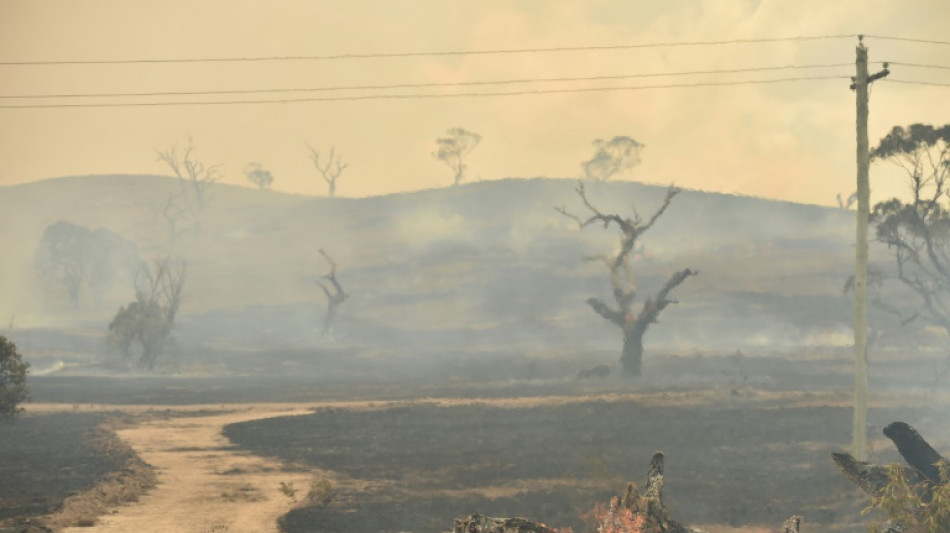
Australian bushfires may have helped trigger La Nina / Photo: PETER PARKS - AFP

 اليورو يستقر في البنوك المصرية وأعلى سعر للبيع 59.85 جنيه

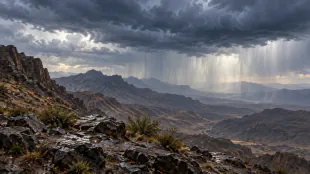 الأرصاد السعودية تتوقع سيولاً وأمطاراً رعدية في خمس مناطق

 Lights out in Laos as electricity exports surge

 Steven Strogatz weighs AI mathematics advances and their consequences for researchers

 Anthropic boss calls for AI slowdown, Altman and Musk agree

 French IT giant Capgemini sells subsidiary after row over ICE links

 Quebec Brokerage Qubit Insurance Announces New Data on Coverage Shortfalls as Rebuilding Costs Rise

 Lady Gaga welcomes first child with fiance: US media

 Bhutan business bets on hazelnuts for farming future

 'Widow's Bay' and 'The Pitt' are favorites for Emmys night

 Coastal erosion forces cancellation of California music festival

 Argentina's Dirty War rears its head in Venice film

 UK lawmakers throw out bill to legalise assisted dying

 US inflation steady in August, fueling Fed rate hike expectations

 New York marks 25th anniversary of 9/11 attacks

 Nepal flood reconstruction bill to be $4.78 bn: foreign ministry

 JUMO and Standard Bank launch Social Finance Framework to scale inclusive finance in Africa

 Doomsday tech: could AI really kill us all?

 French comedy show 'Call my agent' makes film comeback

 It's all coming back: Celine Dion fans gear up for Paris return

 Researchers eye AI revolution in natural disaster forecasts

 US braces for inflation report that may push Fed to hike rates

 Musk threatens legal action over documentary

 Latin America fact-check group asks Meta not to replace verification practice

 AI Risks to Enter 60–80% of Liability and Cyber Insurance Underwriting by 2028, ScienceSoft Predicts

Australia's "Black Summer" bushfire catastrophe coughed up so much smoke it may have fuelled the global onset of La Nina in 2020, according to new research published Thursday.
The report, in peer-reviewed journal Science Advances, said the bushfires were "exceptional" in their severity -- pumping out emissions on a scale similar to major volcanic eruptions.
It suggested this led to the formation of vast banks of cloud over the southeastern Pacific Ocean, which soaked up radiation from the sun and led to the cooling of surface water temperatures.
These disruptions could have helped trigger the start of an unusually long La Nina weather pattern, the researchers found.
The "Black Summer" bushfires raged across Australia's eastern seaboard from late 2019 to early 2020, razing swathes of forest, killing millions of animals, and blanketing cities in noxious smoke.
A rare "triple-dip" La Nina shaped global weather patterns between September 2020 and March 2023, whipping up a series of devastating tropical cyclones while exacerbating droughts in other parts of the planet.
Researchers John Fasullo and Nan Rosenbloom, from the National Center for Atmospheric Research in the United States, used modelling to demonstrate how emissions from the bushfires could shift weather patterns.
Bushfire smoke is laden with particles that act as "condensation nuclei", which attract water molecules in the atmosphere, seeding the formation of clouds.
- Atmospheric impact -
This blanket of cloud could cause "widespread surface cooling" in the tropical Pacific Ocean, the modelling showed, which is one of the key ingredients for the start of La Nina.
"The results here suggest a potential connection between this emergence of cool conditions in the eastern Pacific Ocean and the climate response to the Australian wildfire emissions," the paper stated.
Australian climate scientist Tom Mortlock said the bushfires caused clouds to form in a part of the Pacific that plays a crucial role in global climate regulation.
"The southeast corner of the Pacific is a really sensitive and important area for what goes on with El Nino and La Nina," he told AFP.
"Often we see the first signs of an El Nino or La Nina forming in that part of the ocean."
Pete Strutton, from the Australian Centre of Excellence for Climate Extremes, said it demonstrated the sheer scale of the bushfires.
"We've got an event that happened on the land in southeast Australia, which is having an impact on the atmosphere," he told AFP.
A separate team of British researchers last year found that the "Black Summer" bushfires spewed millions of tonnes of emissions into the atmosphere, likely aggravating the Antarctic ozone hole.
Global weather patterns oscillate between cooling La Nina and warming El Nino cycles -- with neutral conditions in between.
H.Meyer--CPN