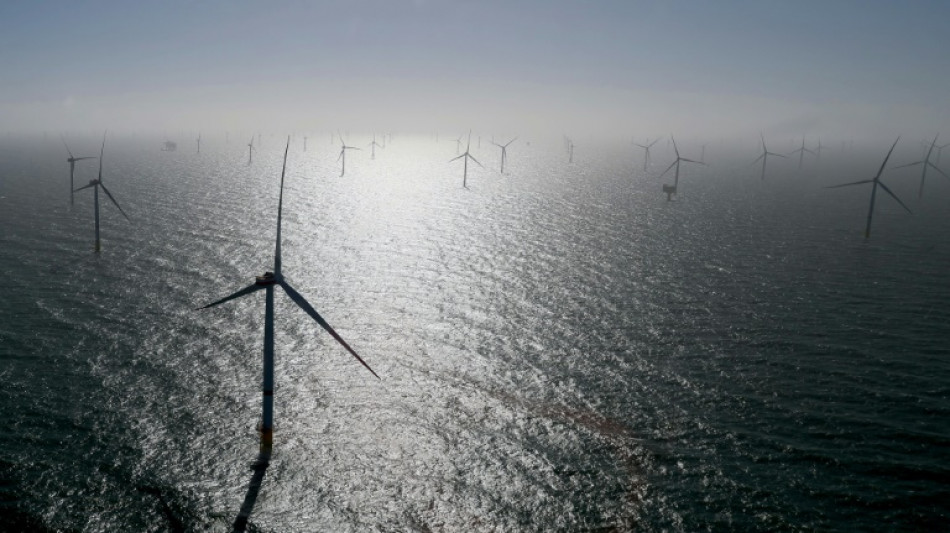
European countries aim to boost wind energy production / Photo: Christian Charisius - POOL/AFP

 اليورو يستقر في البنوك المصرية وأعلى سعر للبيع 59.85 جنيه

 الأرصاد السعودية تتوقع سيولاً وأمطاراً رعدية في خمس مناطق

 Lights out in Laos as electricity exports surge
 Steven Strogatz weighs AI mathematics advances and their consequences for researchers
 Anthropic boss calls for AI slowdown, Altman and Musk agree

 French IT giant Capgemini sells subsidiary after row over ICE links

 Quebec Brokerage Qubit Insurance Announces New Data on Coverage Shortfalls as Rebuilding Costs Rise

 Lady Gaga welcomes first child with fiance: US media

 Bhutan business bets on hazelnuts for farming future

 'Widow's Bay' and 'The Pitt' are favorites for Emmys night

 Coastal erosion forces cancellation of California music festival

 Argentina's Dirty War rears its head in Venice film

 UK lawmakers throw out bill to legalise assisted dying

 US inflation steady in August, fueling Fed rate hike expectations

 New York marks 25th anniversary of 9/11 attacks

 Nepal flood reconstruction bill to be $4.78 bn: foreign ministry

 JUMO and Standard Bank launch Social Finance Framework to scale inclusive finance in Africa

 Doomsday tech: could AI really kill us all?

 French comedy show 'Call my agent' makes film comeback

 It's all coming back: Celine Dion fans gear up for Paris return

 Researchers eye AI revolution in natural disaster forecasts

 US braces for inflation report that may push Fed to hike rates

 Musk threatens legal action over documentary

 Latin America fact-check group asks Meta not to replace verification practice

 AI Risks to Enter 60–80% of Liability and Cyber Insurance Underwriting by 2028, ScienceSoft Predicts

Nine European countries were holding a summit Monday aimed at scaling up wind power generation in the North Sea, spurred by the fallout of the Ukraine war and the push for renewables.
Hosted by Belgium in the coastal town of Ostend, the meeting will gather the leaders of EU members France, Germany, Ireland, Denmark, the Netherlands and Luxembourg, with European Commission chief Ursula von der Leyen also attending.
Norway and Britain will participate, too, though the UK's energy minister was leading his delegation and not Prime Minister Rishi Sunak, who stayed in London on another engagement.
"We need offshore wind turbines -- and we need a lot of them," the leaders of the countries, including French President Emmanuel Macron, German Chancellor Olaf Scholz and Sunak, said in a joint op-ed published in Politico.
"We need them to reach our climate goals, and to rid ourselves of Russian gas, ensuring a more secure and independent Europe."
The collective goal, they said, was to boost offshore wind power generation to 120 gigawatts by 2030 -- from just 30 GW now -- and at least 300 GW by 2050.
The North Sea summit is the second one to be held, after the four countries in the inaugural gathering last year -- Belgium, Denmark, Germany and the Netherlands -- decided it was necessary to broaden cooperation.
They recognised this was "a massive undertaking" requiring "huge investments in infrastructure".
Belgian Prime Minister Alexander De Croo said ahead of the summit that it would be focused on "speed of execution" and standardising equipment to build the offshore wind farms faster and cheaper.
Around 100 bosses of companies in the wind turbine supply chain were also participating in the summit.
The leaders' op-ed emphasised the need to source expertise and parts from Europe rather than elsewhere.
"We need to make space for European value chains when it comes to green tech and diversify our sources of critical raw materials for wind turbines, batteries and the like," they said.
China currently dominates the supply of critical components such as rare earths, and the United States is heavily subsidising industry to onshore that sector.
"We are bolstering our energy security and sending a strong signal to (President Vladimir) Putin's Russia that the days of his dominance over global power markets are well and truly over," British Energy Security Secretary Grant Shapps said as he headed to the summit.
Security of the offshore installations was also a topic of the summit, given recent reports of a Russian spy ship in the North Sea and the sabotage of Nord Stream gas pipelines in the Baltic Sea in September 2022. A NATO official was taking part to discuss the topic.
- Industry criticism -
WindEurope, the federation representing Europe's wind energy industry, believes the summit's ambitions are doable.
But it highlighted a lack of "adequate funding mechanisms" and recruitment in the sector.
Current policy, aimed at getting to a carbon-neutral future in Europe, "is overly focused on technological breakthroughs, rather than actual scaling up of existing supply chains", WindEurope said in a statement.
It also criticised "uncoordinated market interventions, price caps and national clawback measures" that "deterred investments".
The organisation says Europe needs to build the offshore infrastructure to add 20 GW in output per year, yet the sector currently has capacity for just seven GW annually, with supply chain bottlenecks for cables, substations and foundations, and in the availability of offshore wind vessels.
Investment to get Europe where it wants to be is massive: the EU has calculated the cost of getting to 300 GW in offshore energy production by 2050 at 800 billion euros ($900 billion).
Britain has the biggest fleet of offshore wind farms, 45 of them, currently producing 14 GW, with plans to expand capacity to 50 GW by 2030.
Germany's 30 wind farms produce eight GW, followed by the Netherlands with 2.8 GW and Denmark and Belgium both with 2.3 GW.
The other participating countries produce less than a gigawatt from their existing installations but share ambitions to greatly ramp up wind energy capacity.
The European Union recently set a goal to double the proportion of renewables in its energy mix, to 42.5 percent, notably by making it easier to get permits to install the infrastructure.
X.Cheung--CPN