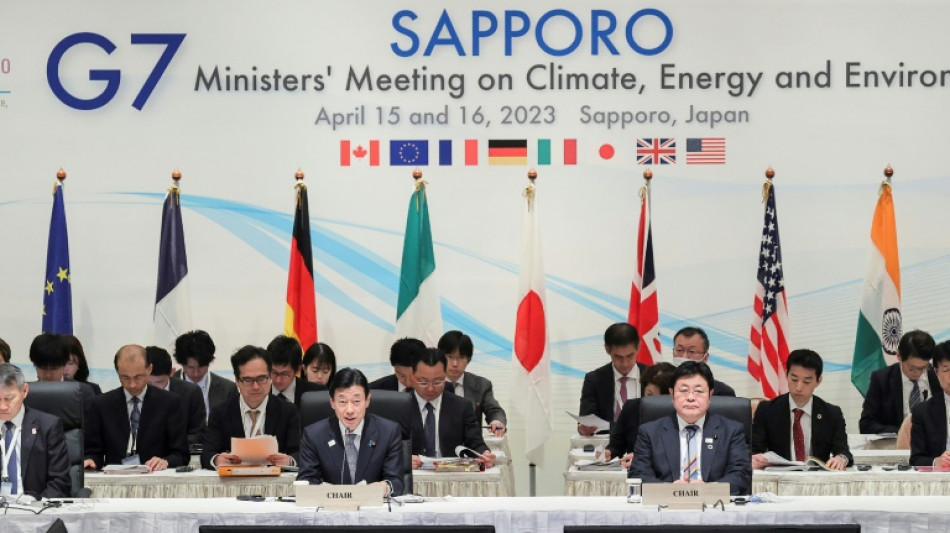
G7 faces pressure on fossil fuels at Japan climate talks / Photo: STR - JIJI Press/AFP

 اليورو يستقر في البنوك المصرية وأعلى سعر للبيع 59.85 جنيه

 الأرصاد السعودية تتوقع سيولاً وأمطاراً رعدية في خمس مناطق

 Lights out in Laos as electricity exports surge

 Steven Strogatz weighs AI mathematics advances and their consequences for researchers

 Anthropic boss calls for AI slowdown, Altman and Musk agree

 French IT giant Capgemini sells subsidiary after row over ICE links

 Quebec Brokerage Qubit Insurance Announces New Data on Coverage Shortfalls as Rebuilding Costs Rise

 Lady Gaga welcomes first child with fiance: US media

 Bhutan business bets on hazelnuts for farming future

 'Widow's Bay' and 'The Pitt' are favorites for Emmys night

 Coastal erosion forces cancellation of California music festival

 Argentina's Dirty War rears its head in Venice film

 UK lawmakers throw out bill to legalise assisted dying

 US inflation steady in August, fueling Fed rate hike expectations

 New York marks 25th anniversary of 9/11 attacks

 Nepal flood reconstruction bill to be $4.78 bn: foreign ministry

 JUMO and Standard Bank launch Social Finance Framework to scale inclusive finance in Africa

 Doomsday tech: could AI really kill us all?

 French comedy show 'Call my agent' makes film comeback

 It's all coming back: Celine Dion fans gear up for Paris return

 Researchers eye AI revolution in natural disaster forecasts

 US braces for inflation report that may push Fed to hike rates

 Musk threatens legal action over documentary

 Latin America fact-check group asks Meta not to replace verification practice

 AI Risks to Enter 60–80% of Liability and Cyber Insurance Underwriting by 2028, ScienceSoft Predicts

G7 allies kicked off two days of "difficult" climate talks in northern Japan on Saturday, facing pressure to show progress on key fossil fuel commitments in an example to other major economies including China.
Campaigners have warned climate and environment ministers from the group of developed countries against backsliding on pledges on the shift away from coal and gas at home and abroad.
But a leaked third draft of a statement to be issued at the meeting in Sapporo has relieved some experts, who had feared a more ringing endorsement of the need for overseas gas investments as proposed by Japan.
"All in, given low expectations, it now seems a better outcome than many expected," said Ed King from the climate-oriented communications firm GSCC.
The ministers want to show unity after a major UN climate report warned last month that 1.5 degrees Celsius of global warming would be seen in about a decade. It called for "rapid and far-reaching" action to keep increases within relatively safe limits.
However, as as the energy crisis sparked by the Ukraine war squeezes G7 countries, including this year's president Japan, divisions have arisen among the group.
A French government source said their minister was trying to "avoid or put a stop to any form of reversal on fossil fuel" commitments, while describing "difficult" discussions among the bloc.
The draft statement calls on nations to take action "in this critical decade", urging a peak in global greenhouse emissions by 2025 at the latest.
Experts say this language is aimed at China, the world's largest carbon emitter, which is targeting a peak in its carbon emissions by 2030.
The draft also stresses the "urgency" of slashing global emissions by 60 percent by 2035 from 2019 levels, as recommended by the UN's IPCC panel of climate experts.
- Coal and gas promises -
Other phrasing has been more contentious, with the final statement sure to be closely scrutinised for signs of the direction of talks at the G20 in New Delhi and the COP28 climate meeting in Dubai later this year.
Ministers pledged at the last G7 climate ministerial in Germany in May 2022 to largely end fossil fuel use in their electricity sectors by 2035.
They also agreed to stop new direct public support the same year for overseas fossil fuel projects that take no steps to offset carbon dioxide emissions.
But this was watered down a month later when G7 leaders said the "exceptional circumstances" of Russia's war in Ukraine made gas investments "appropriate as a temporary response".
Japan has sought language that would solidify that exception, and trade minister Yasutoshi Nishimura has said a one-size-fits-all approach is inappropriate.
"It's necessary to work towards the common goal of net zero by taking various approaches according to the circumstances of each country," he said at the event's opening speech on Saturday.
The latest draft of the G7 climate statement, seen by AFP, recognises "the primary need to accelerate the clean energy transition through energy savings and gas demand reduction".
And on coal -- another hotly debated topic -- the United States has proposed wording that acknowledges the need to "call on international partners to end new unabated coal power generation projects globally".
Canada's environment and climate change minister Steven Guilbeault told AFP that "in terms of phasing out fossil fuel from the electricity sector... we would be, as Canada, very comfortable with having strong language on that".
The draft also includes recognition of nuclear power's potential to reduce dependence on fossil fuels, and supports the International Atomic Energy Agency's review of Japan's plan to start releasing treated water from its devastated Fukushima plant into the sea.
Japan had sought G7 recognition for its controversial strategy of burning hydrogen and ammonia alongside fossil fuels to reduce carbon emissions -- which climate activists say only serves to extend the lifespan of polluting plants.
But the draft statement simply notes that "some countries are exploring" the potential of the two fuels in the journey to net-zero emissions.
And it says this should be "aligned with a 1.5°C pathway and our collective goal for a fully or predominantly decarbonised power sector by 2035".
burs-kaf/mtp
P.Kolisnyk--CPN