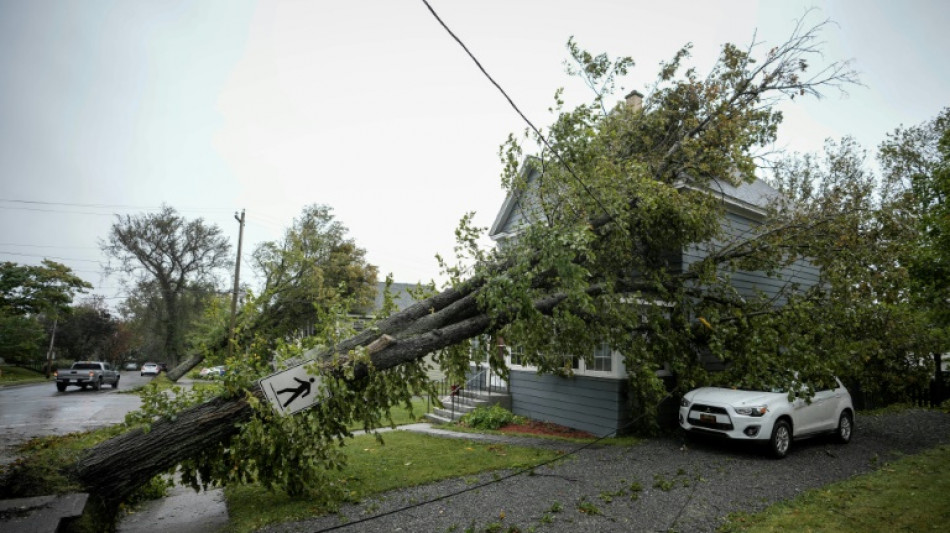
Names Fiona, Ian removed from UN's hurricane roster / Photo: Drew Angerer - GETTY IMAGES NORTH AMERICA/AFP

 اليورو يستقر في البنوك المصرية وأعلى سعر للبيع 59.85 جنيه

 الأرصاد السعودية تتوقع سيولاً وأمطاراً رعدية في خمس مناطق

 Lights out in Laos as electricity exports surge

 Steven Strogatz weighs AI mathematics advances and their consequences for researchers

 Anthropic boss calls for AI slowdown, Altman and Musk agree

 French IT giant Capgemini sells subsidiary after row over ICE links

 Quebec Brokerage Qubit Insurance Announces New Data on Coverage Shortfalls as Rebuilding Costs Rise

 Lady Gaga welcomes first child with fiance: US media

 Bhutan business bets on hazelnuts for farming future

 'Widow's Bay' and 'The Pitt' are favorites for Emmys night

 Coastal erosion forces cancellation of California music festival

 Argentina's Dirty War rears its head in Venice film

 UK lawmakers throw out bill to legalise assisted dying

 US inflation steady in August, fueling Fed rate hike expectations

 New York marks 25th anniversary of 9/11 attacks

 Nepal flood reconstruction bill to be $4.78 bn: foreign ministry

 JUMO and Standard Bank launch Social Finance Framework to scale inclusive finance in Africa

 Doomsday tech: could AI really kill us all?

 French comedy show 'Call my agent' makes film comeback

 It's all coming back: Celine Dion fans gear up for Paris return

 Researchers eye AI revolution in natural disaster forecasts

 US braces for inflation report that may push Fed to hike rates

 Musk threatens legal action over documentary

 Latin America fact-check group asks Meta not to replace verification practice

 AI Risks to Enter 60–80% of Liability and Cyber Insurance Underwriting by 2028, ScienceSoft Predicts

The death and destruction caused by Hurricanes Fiona and Ian last year has prompted the UN weather agency to remove the names from a rotating list of storm titles, it said Wednesday.
The World Meteorological Organization said that "Farrah" would replace "Fiona", while "Idris" would replace "Ian", after meteorologists determined during a meeting in Costa Rica that the future use of the names could be upsetting.
Fiona was a large, powerful and destructive category-four Atlantic hurricane, which hit communities in the Antilles, Puerto Rico and the Dominican Republic, before striking Canada as a strong post-tropical cyclone in mid-September last year.
It was the costliest extreme weather event on record in Atlantic Canada. It left 29 people dead and caused over $3 billion in damages there and across the Caribbean.
Ian arrived only days later, first slamming into Cuba before hitting the United States as a category-four hurricane, and was one of the most powerful storms ever in that country.
It caused more than 150 deaths in the US, almost all in Florida, where it made landfall on September 28.
Ian, which caused more than $112 billion in damages, was the costliest hurricane in Florida's history and the third costliest in the United States.
It flattened whole neighbourhoods and knocked out power for millions of people. Storm surges and immense downpours left even inland neighbourhoods submerged.
Throughout the annual Atlantic hurricane season, which officially runs from June 1 to November 30, storms are named to make them easier to identify in warning messages.
Storms are assigned alternating male and female names in alphabetical order.
They are reused every six years, though if any hurricane is particularly devastating, its name is retired.
In total, 96 names have been retired from the list since the system was first put in place in 1953.
Many more storms than that have proved deadly, however.
There are dozens of named tropical cyclones each year globally, which over the past half century have on average killed 43 people and caused $78 million in losses every day, the UN agency said.
And the situation is worsening as a result of climate change, with scientists saying the Earth's warming surface temperature is amplifying the impact of extreme weather disasters.
But the UN agency said the death toll has fallen dramatically, thanks to improvements in forecasting, warning and disaster risk reduction efforts coordinated by WMO's Tropical Cyclone Programme.
In total, the 2022 Atlantic hurricane season produced 14 named storms, with winds of 63 kilometres (39 miles) per hour or greater, of which eight became hurricanes.
Fiona and Ian were the only ones that intensified to major hurricanes, with winds of more than 178 kmh, according to the end of season tally from the US National Oceanic and Atmospheric Administration.
U.Ndiaye--CPN