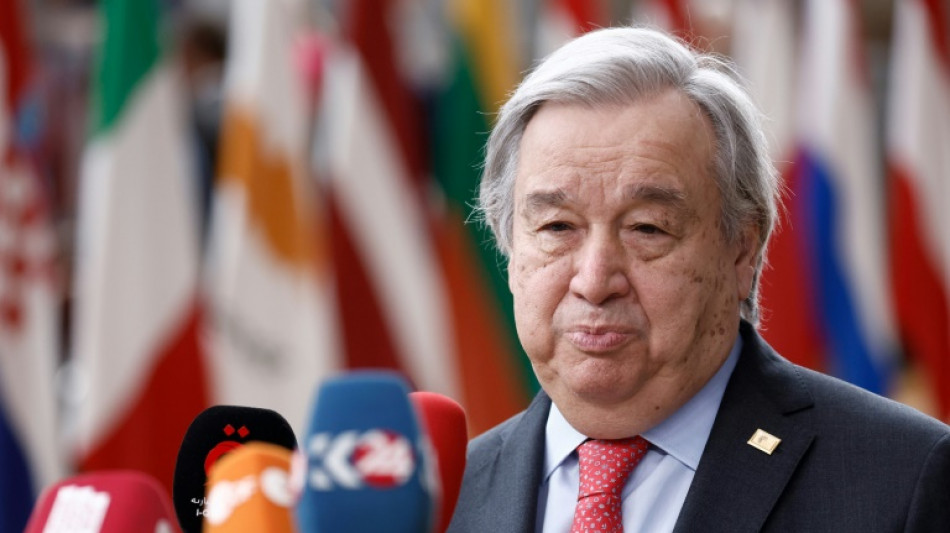
Humanity must chart new course on water use: UN chief / Photo: Kenzo TRIBOUILLARD - AFP

 اليورو يستقر في البنوك المصرية وأعلى سعر للبيع 59.85 جنيه

 الأرصاد السعودية تتوقع سيولاً وأمطاراً رعدية في خمس مناطق

 Lights out in Laos as electricity exports surge

 Steven Strogatz weighs AI mathematics advances and their consequences for researchers

 Anthropic boss calls for AI slowdown, Altman and Musk agree

 French IT giant Capgemini sells subsidiary after row over ICE links

 Quebec Brokerage Qubit Insurance Announces New Data on Coverage Shortfalls as Rebuilding Costs Rise

 Lady Gaga welcomes first child with fiance: US media

 Bhutan business bets on hazelnuts for farming future

 'Widow's Bay' and 'The Pitt' are favorites for Emmys night

 Coastal erosion forces cancellation of California music festival

 Argentina's Dirty War rears its head in Venice film

 UK lawmakers throw out bill to legalise assisted dying

 US inflation steady in August, fueling Fed rate hike expectations

 New York marks 25th anniversary of 9/11 attacks

 Nepal flood reconstruction bill to be $4.78 bn: foreign ministry

 JUMO and Standard Bank launch Social Finance Framework to scale inclusive finance in Africa

 Doomsday tech: could AI really kill us all?

 French comedy show 'Call my agent' makes film comeback

 It's all coming back: Celine Dion fans gear up for Paris return

 Researchers eye AI revolution in natural disaster forecasts

 US braces for inflation report that may push Fed to hike rates

 Musk threatens legal action over documentary

 Latin America fact-check group asks Meta not to replace verification practice

 AI Risks to Enter 60–80% of Liability and Cyber Insurance Underwriting by 2028, ScienceSoft Predicts

UN Secretary-General Antonio Guterres on Friday delivered an urgent call for the world to modify and safeguard water resources to avert conflict and ensure future global prosperity.
Water is "the most precious common good," and "needs to be at the center of the global political agenda," Guterres said at the end of a three-day UN conference that experts said held a measure of promise.
"All of humanity's hopes for the future depend, in some way, on charting a new science-based course to bring the water action agenda to life," Guterres said.
"Now is the time to act."
The world is not on track to meet its 2030 water goals, including access to safe drinking water and sanitation for all.
Guterres earlier in the week described water as humanity's "lifeblood" and said its "vampiric overconsumption" had "broken the water cycle" and led to more natural disasters.
NGOs, governments and the private sector offered nearly 700 commitments before and during the three days of the UN gathering that drew some 10,000 participants. Pledges ranged from the construction of toilets to the restoration of 300,000 kilometers (186,400 miles) of degraded rivers and massive areas of wetlands.
Less than a third of the commitments have funding said Charles Iceland of the World Resources Institute think tank, adding that about a third "are going to have substantial impact."
Despite this, "these voluntary commitments are a good start," he told AFP, referring in particular to a project led by Germany on the management of the Niger River basin which touches nine nations in Africa.
- 'Pleasantly surprised' -
"It's probably the part of the world that is the most fragile, and where we're starting to see actual violent conflict over water between different groups," he said.
But at the global level, the issue of water "is a huge problem and one conference is not going to do it," Iceland added, pleading for annual conferences on water.
"You hear a lot of pledges," Stuart Orr of WWF told AFP. "But this feels somehow quite different."
While it "is not all rosy," Orr added, "a lot of the commitments that have been made this week are very good."
He said he was "pleasantly surprised," in part, at the variety of institutions and organizations now talking about water.
"This issue is not going away. The water issue is only going to get worse. And I think that's why everybody is starting to feel maybe now really is the time to get going," Orr said.
The conference pleaded for Guterres to appoint a UN special envoy for water, which the secretary-general says is under consideration.
Without a dedicated UN agency or global treaty, "water has no home here at the UN," said Henk Ovink, water envoy of the Netherlands, which was a coorganizer of the conference.
In 2020, two billion people were still without safe drinking water and 3.6 billion lacked access to safely managed sanitation services, including 494 million who had to relieve themselves in the open, according to the latest figures compiled by the UN-Water website.
At least two billion people drink water contaminated with feces, and 2.3 billion lack basic sanitation services -- conditions conducive to the spread of cholera, dysentery and polio.
While climate change makes droughts more frequent and intense, UN climate experts (IPCC) also estimate that about half of the world's population suffers from "severe" water shortages during at least part of the year.
A young Dutch woman, Aniek Moonen, addressed the conference as if she were speaking from the year 2050.
She suggested that the summit could be a pivotal moment for water management "to become more sustainable, equitable and just than ever before."
"This is the future speaking. Don't forget to listen," she told the delegates.
A.Samuel--CPN