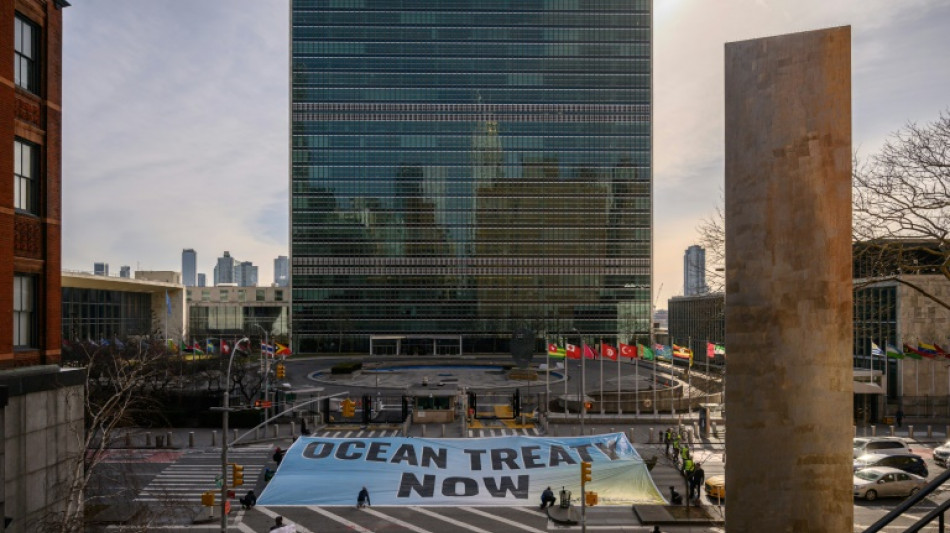
Treaty ahoy! UN states finally agree deal to protect high seas / Photo: Ed JONES - AFP/File

 ستاندرد آند بورز تثبت تصنيف السعودية عند A+
 Lights out in Laos as electricity exports surge

 Steven Strogatz weighs AI mathematics advances and their consequences for researchers

 Anthropic boss calls for AI slowdown, Altman and Musk agree

 French IT giant Capgemini sells subsidiary after row over ICE links

 Quebec Brokerage Qubit Insurance Announces New Data on Coverage Shortfalls as Rebuilding Costs Rise

 Lady Gaga welcomes first child with fiance: US media

 Bhutan business bets on hazelnuts for farming future

 'Widow's Bay' and 'The Pitt' are favorites for Emmys night

 Coastal erosion forces cancellation of California music festival

 Argentina's Dirty War rears its head in Venice film

 UK lawmakers throw out bill to legalise assisted dying

 US inflation steady in August, fueling Fed rate hike expectations

 New York marks 25th anniversary of 9/11 attacks

 Nepal flood reconstruction bill to be $4.78 bn: foreign ministry

 JUMO and Standard Bank launch Social Finance Framework to scale inclusive finance in Africa

 Doomsday tech: could AI really kill us all?

 French comedy show 'Call my agent' makes film comeback

 It's all coming back: Celine Dion fans gear up for Paris return

 Researchers eye AI revolution in natural disaster forecasts

 US braces for inflation report that may push Fed to hike rates

 Musk threatens legal action over documentary

 Latin America fact-check group asks Meta not to replace verification practice

 AI Risks to Enter 60–80% of Liability and Cyber Insurance Underwriting by 2028, ScienceSoft Predicts

 Tribal Launches Campfire, Letting Business and Technical Teams Build on Salesforce Together

UN member states finally agreed Saturday, following years of talks, to a text on the first international treaty to protect the high seas, a fragile and vital treasure that covers nearly half the planet.
"The ship has reached the shore," conference chair Rena Lee announced at the UN headquarters in New York shortly before 9:30 pm (0230 GMT Sunday), to applause from delegates.
After more than 15 years of discussions, including four years of formal talks, the third so-called final negotiating session in less than a year heralded the long-awaited consensus.
The treaty is seen as essential to conserving 30 percent of the world's land and ocean by 2030, as agreed by world governments in a historic accord signed in Montreal in December.
Following two weeks of intense talks at the United Nations headquarters in New York, including a marathon overnight session Friday into Saturday, delegates finalized a text that cannot be significantly altered.
"There will be no reopening or discussions of substance," Lee told negotiators.
The agreement will be formally adopted at a later date once it has been vetted by lawyers and translated into the United Nations' six official languages, she announced.
The high seas begin at the border of countries' exclusive economic zones, which extend up to 200 nautical miles (370 kilometers) from coastlines. They thus fall under the jurisdiction of no country.
Even though the high seas comprise more than 60 percent of the world's oceans and nearly half the planet's surface, they have long drawn far less attention than coastal waters and a few iconic species.
Ocean ecosystems create half the oxygen humans breathe and limit global warming by absorbing much of the carbon dioxide emitted by human activities.
But they are threatened by climate change, pollution and overfishing.
Only about one percent of the high seas are currently protected.
When the new treaty comes into force after being formally adopted, signed and ratified by enough countries, it will allow the creation of marine protected areas in these international waters.
The treaty on the "conservation and sustainable use of marine biodiversity in areas beyond national jurisdiction" also obliges countries to conduct environmental impact assessments of proposed activities on the high seas.
A highly sensitive chapter on the sharing of potential benefits of newly discovered marine resources was one of the focal points of tensions before it was finally overcome as the scheduled talks, due to end Friday, overran by a day.
- 'Profits' -
Developing countries, without the means to afford costly research, had fought not to be excluded from the expected windfall from the commercialization of potential substances discovered in the international waters.
Eventual profits are likely from the pharmaceutical, chemical or cosmetic use of newly discovered marine substances that belong to no one.
As in other international forums, notably climate negotiations, the debate ended up being a question of ensuring equity between the poorer global South and richer North, observers noted.
In a move seen as an attempt to build trust between rich and poor countries, the European Union pledged 40 million euros ($42 million) in New York to facilitate the ratification of the treaty and its early implementation.
The EU also announced $860 million for research, monitoring and conservation of oceans in 2023 at the Our Ocean conference in Panama that ended Friday.
Panama said a total of $19 billion, including a $6 billion commitment from the United States, was pledged at the conference to protect seas.
In 2017, the UN General Assembly adopted a resolution calling on nations to establish a high seas treaty.
It originally planned four negotiating sessions but had to pass two resolutions to ensure two additional sessions.
C.Smith--CPN