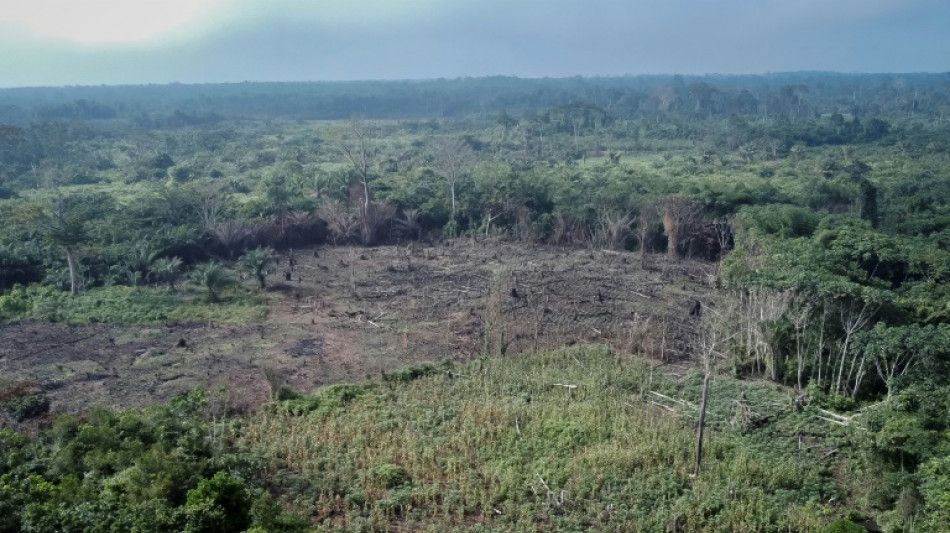
Tropical deforestation significantly reduces rainfall: study / Photo: Guerchom Ndebo - AFP/File

 ستاندرد آند بورز تثبت تصنيف السعودية عند A+
 Lights out in Laos as electricity exports surge

 Steven Strogatz weighs AI mathematics advances and their consequences for researchers

 Anthropic boss calls for AI slowdown, Altman and Musk agree

 French IT giant Capgemini sells subsidiary after row over ICE links

 Quebec Brokerage Qubit Insurance Announces New Data on Coverage Shortfalls as Rebuilding Costs Rise

 Lady Gaga welcomes first child with fiance: US media

 Bhutan business bets on hazelnuts for farming future

 'Widow's Bay' and 'The Pitt' are favorites for Emmys night

 Coastal erosion forces cancellation of California music festival

 Argentina's Dirty War rears its head in Venice film

 UK lawmakers throw out bill to legalise assisted dying

 US inflation steady in August, fueling Fed rate hike expectations

 New York marks 25th anniversary of 9/11 attacks

 Nepal flood reconstruction bill to be $4.78 bn: foreign ministry

 JUMO and Standard Bank launch Social Finance Framework to scale inclusive finance in Africa

 Doomsday tech: could AI really kill us all?

 French comedy show 'Call my agent' makes film comeback

 It's all coming back: Celine Dion fans gear up for Paris return

 Researchers eye AI revolution in natural disaster forecasts

 US braces for inflation report that may push Fed to hike rates

 Musk threatens legal action over documentary

 Latin America fact-check group asks Meta not to replace verification practice

 AI Risks to Enter 60–80% of Liability and Cyber Insurance Underwriting by 2028, ScienceSoft Predicts

 Tribal Launches Campfire, Letting Business and Technical Teams Build on Salesforce Together

From the Amazon to the evergreen forests of Africa and Southeast Asia, large-scale deforestation threatens reductions in rainfall across the tropics, according to new research.
The threat is most acute in the Congo Basin -- forecast to endure rapid deforestation in the coming years -- which could see rainfall reduced by up to ten percent by the end of the century, researchers found.
The study, published Wednesday in the journal Nature, used satellite observations over recent decades to confirm predictions in climate change computer models that rainfall would be reduced across the tropics as more forest is cut down.
The findings add to concerns that "we could come to a point where the rainforests cannot sustain themselves," said the study's lead author, Callum Smith of the University of Leeds.
He called for increased commitment to conservation, with researchers concluding that restoring large areas of destroyed forest could reverse some of the rainfall loss.
While the importance of tropical forests for the global climate is well known -- because they absorb and store planet-warming carbon dioxide -- the impacts of tree loss on local weather conditions have been observed only in specific areas.
The study comes as leaders and experts from around the world gather in Gabon for the One Forest Summit with the aim of protecting forests worldwide.
A major focus at the conference will be the Congo Basin, a crucial carbon "sink" and haven to rare species that is second in size to the Amazon rainforest.
Deforestation -- driven by commodity crops such as palm oil and soy, cattle pasture and timber exploitation -- threatens to worsen climate change and destroy important biodiversity.
It also risks harming communities.
Despite an expanding agricultural footprint, researchers said crop yields could decline along with forest cover, while increased dryness can increase the frequency of fires, resulting in an overall reduction in productivity in tropical forest regions.
Using data gathered across the tropical Amazon, Congo and Southeast Asia regions between 2003 and 2017, Smith and his colleagues found that large-scale deforestation disrupts the water cycle and leads to significant rain reduction, with the greatest loss occurring during wet seasons.
Trees return water vapor into the air through their leaves, which can cause localised rainfall.
In the Amazon basin, the world's largest tropical biome, climate change coupled with forest destruction are pushing the tropical forest towards a "tipping point" where it will shift to a savannah-like state, scientists warn.
H.Cho--CPN