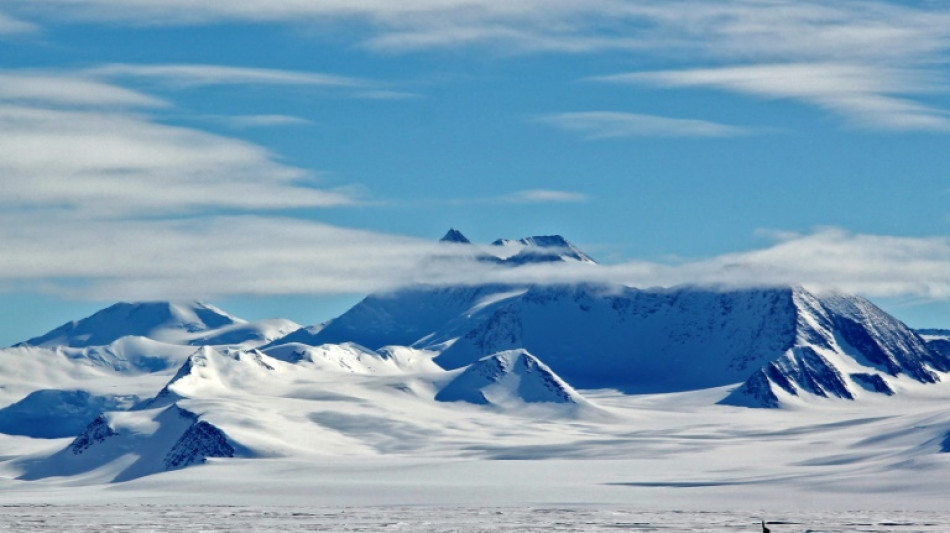
Sea ice in Antarctic at record low: US data center / Photo: Felipe TRUEBA - INACH/AFP

 ستاندرد آند بورز تثبت تصنيف السعودية عند A+

 Lights out in Laos as electricity exports surge

 Steven Strogatz weighs AI mathematics advances and their consequences for researchers

 Anthropic boss calls for AI slowdown, Altman and Musk agree

 French IT giant Capgemini sells subsidiary after row over ICE links

 Quebec Brokerage Qubit Insurance Announces New Data on Coverage Shortfalls as Rebuilding Costs Rise

 Lady Gaga welcomes first child with fiance: US media

 Bhutan business bets on hazelnuts for farming future

 'Widow's Bay' and 'The Pitt' are favorites for Emmys night

 Coastal erosion forces cancellation of California music festival

 Argentina's Dirty War rears its head in Venice film

 UK lawmakers throw out bill to legalise assisted dying

 US inflation steady in August, fueling Fed rate hike expectations

 New York marks 25th anniversary of 9/11 attacks

 Nepal flood reconstruction bill to be $4.78 bn: foreign ministry

 JUMO and Standard Bank launch Social Finance Framework to scale inclusive finance in Africa

 Doomsday tech: could AI really kill us all?

 French comedy show 'Call my agent' makes film comeback

 It's all coming back: Celine Dion fans gear up for Paris return

 Researchers eye AI revolution in natural disaster forecasts

 US braces for inflation report that may push Fed to hike rates

 Musk threatens legal action over documentary

 Latin America fact-check group asks Meta not to replace verification practice

 AI Risks to Enter 60–80% of Liability and Cyber Insurance Underwriting by 2028, ScienceSoft Predicts

 Tribal Launches Campfire, Letting Business and Technical Teams Build on Salesforce Together

Antarctic sea ice likely shrunk to a record low last week, US researchers said Monday, its lowest extent in the 45 years of satellite record-keeping.
The National Snow and Ice Data Center (NSIDC) at the University of Colorado Boulder said that Antarctica's sea ice fell to 1.79 million square kilometers (691,000 million square miles) on February 21.
That exceeded the previous record low set in 2022 by 136,000 square kilometers (52,500 square miles).
NSIDC scientists stressed that the latest figure was preliminary since further late-season melt was still possible. They said they would issue a final number on the extent of ice in early March.
Melting sea ice exposes the thicker ice shelves buttressing Antarctica's ground ice sheet to waves and warmer temperatures.
Melting sea ice has no discernible impact on sea levels because the ice is already in ocean water.
But the sea ice rings Antarctica's massive ice shelves, the extensions of the freshwater glaciers that threaten catastrophic sea level rise over centuries if they continue melting as global temperatures rise.
"Antarctica's response to climate change has been different from the Arctic's," said Ted Scambos, a senior research scientist at the Cooperative Institute for Research in the Environmental Sciences (CIRES).
"The downward trend in sea ice may be a signal that global warming is finally affecting the floating ice around Antarctica, but it will take several more years to be confident of it," Scambos said.
The Antarctic cycle undergoes significant annual variations during its summers of thawing and winters of freezing, and the continent has not experienced the rapid melting of the past four decades that plague the ice sheets of Greenland and the Arctic due to global warming.
But the high melt rate since 2016 raises concerns that a significant downward trend may be taking hold.
Melting of the sea ice is problematic because it helps accelerate global warming.
When white sea ice -- which bounces up to 90 percent of the Sun's energy back into space -- is replaced by dark, unfrozen sea, the water absorbs a similar percentage of the Sun's heat instead.
Globally, last year was the fifth or sixth warmest on record despite the cooling influence of a natural La Nina weather pattern.
A.Samuel--CPN