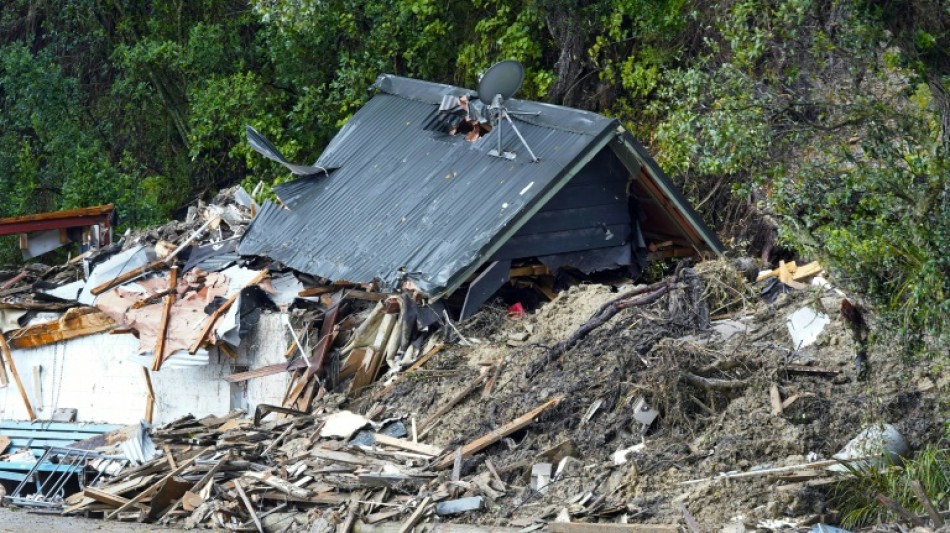
Cyclone-battered New Zealand declares national emergency / Photo: Diego OPATOWSKI - AFP

 ستاندرد آند بورز تثبت تصنيف السعودية عند A+
 Lights out in Laos as electricity exports surge

 Steven Strogatz weighs AI mathematics advances and their consequences for researchers
 Anthropic boss calls for AI slowdown, Altman and Musk agree

 French IT giant Capgemini sells subsidiary after row over ICE links

 Quebec Brokerage Qubit Insurance Announces New Data on Coverage Shortfalls as Rebuilding Costs Rise

 Lady Gaga welcomes first child with fiance: US media

 Bhutan business bets on hazelnuts for farming future

 'Widow's Bay' and 'The Pitt' are favorites for Emmys night

 Coastal erosion forces cancellation of California music festival

 Argentina's Dirty War rears its head in Venice film

 UK lawmakers throw out bill to legalise assisted dying

 US inflation steady in August, fueling Fed rate hike expectations

 New York marks 25th anniversary of 9/11 attacks

 Nepal flood reconstruction bill to be $4.78 bn: foreign ministry

 JUMO and Standard Bank launch Social Finance Framework to scale inclusive finance in Africa

 Doomsday tech: could AI really kill us all?

 French comedy show 'Call my agent' makes film comeback

 It's all coming back: Celine Dion fans gear up for Paris return

 Researchers eye AI revolution in natural disaster forecasts

 US braces for inflation report that may push Fed to hike rates

 Musk threatens legal action over documentary

 Latin America fact-check group asks Meta not to replace verification practice

 AI Risks to Enter 60–80% of Liability and Cyber Insurance Underwriting by 2028, ScienceSoft Predicts

 Tribal Launches Campfire, Letting Business and Technical Teams Build on Salesforce Together

New Zealand declared a national state of emergency Tuesday as Cyclone Gabrielle swept away roads, inundated homes and left more than 100,000 people without power.
High winds and heavy rain lashed the country's populous North Island, in what officials called an "unprecedented weather event".
"It's been a big night for New Zealanders. A lot of families are displaced, a lot of homes are without power," Prime Minister Chris Hipkins told reporters in Auckland.
"There has been extensive damage across the country."
This is only the third time New Zealand has declared a state of emergency -- following the 2019 Christchurch attacks and the Covid-19 pandemic.
Daylight revealed the severity of the disaster: roads eaten away by landslips and collapsed homes buried in mud, silt and a slew of storm detritus.
Falling trees smashed power lines and flood waters blocked several roads, leaving communities across the country's north stranded.
Local media reported some were forced to swim from their homes to safety.
Others waded through stormwaters on foot.
"At about midnight we got the emergency text saying 'evacuate'," recalled Jane Scott, a resident of coastal community Muriwai, who gathered a torch and a few essentials before seeking refugee in a local community centre.
"It was pitch black and pouring with rain," she told local channel TVNZ. "It was very scary."
- 'Too early to say' -
Cyclone Gabrielle formed off the northeastern coast of Australia in the Coral Sea on February 8, before barrelling across the South Pacific.
It bore down on New Zealand's northern coast on Sunday, bringing gusts of 140 kilometres (87 miles) an hour, spraying coastal communities with 20 centimetres (almost eight inches) of rain in 24 hours and 11-metre (36-foot) high waves.
More than three-quarters of New Zealand's five million residents live on the North Island, where the brunt of the storm is being felt.
Hipkins said it "was too early to say" how many people had been evacuated from their homes and were without power or cellphone coverage.
Electricity providers estimated that more than 100,000 people are without power.
International and domestic flights have been grounded, with Air New Zealand alone reporting 592 flights cancelled and 35,000 customers affected.
- 'Cascading' crises -
Many parts of northern New Zealand were already waterlogged when Cyclone Gabrielle hit, having been drenched by record rainfall two weeks ago.
Massey University Professor Christine Kenney warned that New Zealand is living in the age of "cascading" natural disasters -- where the impacts of repeated severe weather events build up over time.
"Cascading natural hazard events fuelled by climate change are the new norm for Auckland," she said ahead of Tuesday's emergency.
Climate scientist Daithi Stone said Cyclone Gabrielle had been feeding off unusually warm seas, driven by a combination of climate change and La Nina weather patterns.
"Gabrielle is very much part of the story this summer of a warm nearby ocean using a warm atmosphere to pump rain onto Aotearoa," he said Tuesday, using the Maori-language name for New Zealand.
"It is also part of the global story of tropical cyclones becoming more intense under human-induced climate change."
More rain and high winds were expected Tuesday, further hampering rescue efforts.
"The emergency services are working night and day, but the unstable ground, flood waters and closed roads are making things hard," said Minister for Emergency Management Kieran McAnulty.
The New Zealand Fire and Emergency services said a firefighter is missing and another is in critical condition after a house collapsed in West Auckland.
"It's been a tough night for the North Island as a whole, but it's been especially tough for fire and emergency," said Kerry Gregory, chief executive of the fire service.
Hipkins has promised an aid package of 11.5 million New Zealand dollars ($7.25 million) to help recovery efforts, but McAnulty admitted the cost of the clean-up was set to spiral.
"The honest answer is that it's not going to be cheap, but that isn't what we are worried about right now," he said.
A.Agostinelli--CPN