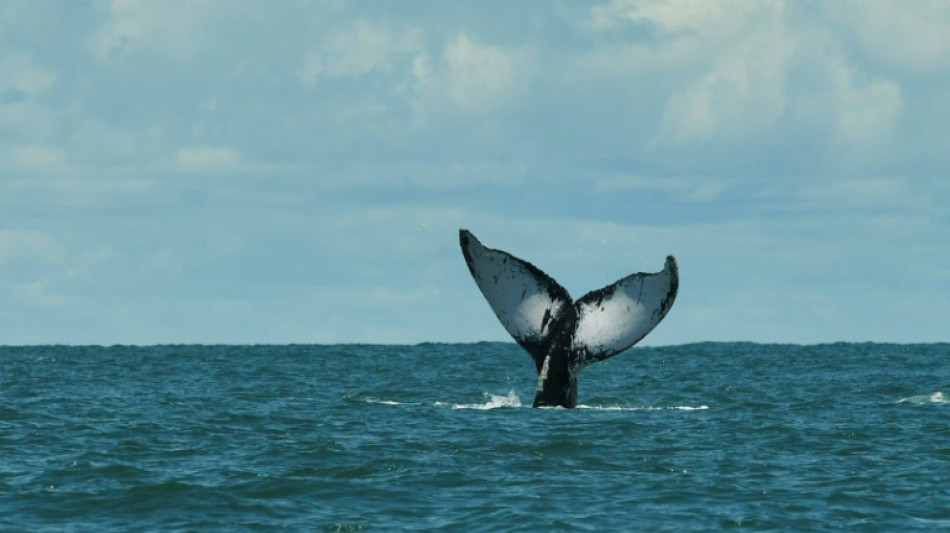
Protecting 30 percent of oceans a huge challenge for the planet / Photo: JOAQUIN SARMIENTO - AFP/File

 ستاندرد آند بورز تثبت تصنيف السعودية عند A+

 Lights out in Laos as electricity exports surge

 Steven Strogatz weighs AI mathematics advances and their consequences for researchers

 Anthropic boss calls for AI slowdown, Altman and Musk agree

 French IT giant Capgemini sells subsidiary after row over ICE links

 Quebec Brokerage Qubit Insurance Announces New Data on Coverage Shortfalls as Rebuilding Costs Rise

 Lady Gaga welcomes first child with fiance: US media

 Bhutan business bets on hazelnuts for farming future

 'Widow's Bay' and 'The Pitt' are favorites for Emmys night

 Coastal erosion forces cancellation of California music festival

 Argentina's Dirty War rears its head in Venice film

 UK lawmakers throw out bill to legalise assisted dying

 US inflation steady in August, fueling Fed rate hike expectations

 New York marks 25th anniversary of 9/11 attacks

 Nepal flood reconstruction bill to be $4.78 bn: foreign ministry

 JUMO and Standard Bank launch Social Finance Framework to scale inclusive finance in Africa

 Doomsday tech: could AI really kill us all?

 French comedy show 'Call my agent' makes film comeback

 It's all coming back: Celine Dion fans gear up for Paris return

 Researchers eye AI revolution in natural disaster forecasts

 US braces for inflation report that may push Fed to hike rates

 Musk threatens legal action over documentary

 Latin America fact-check group asks Meta not to replace verification practice

 AI Risks to Enter 60–80% of Liability and Cyber Insurance Underwriting by 2028, ScienceSoft Predicts

 Tribal Launches Campfire, Letting Business and Technical Teams Build on Salesforce Together

How do we go from protecting eight percent of marine areas to 30 percent in less than 10 years? This question is at the heart of a global forum in Canada this weekend aiming to save marine ecosystems under threat from overfishing, pollution and climate change.
On the heels of the historic biodiversity agreement signed at COP15 in Montreal late last year, about 3,000 officials, scientists, NGOs and Indigenous groups are meeting in Vancouver for the fifth International Marine Protected Areas Congress (IMPAC5), which opened Friday and runs until February 9.
Scientists have said the meeting is crucial for setting up a framework to reach the agreed target at COP15 of protecting 30 percent of the planet's lands and oceans by 2030.
It's an immense step for ocean conservation, which will see a tripling of areas made off-limits to most human activities, with an aim to preserve sensitive ecosystems and species at risk.
The summit, usually held every four years, is taking place two years late due to the Covid-19 pandemic.
"We must re-think our policies, economies, priorities, and processes in ways that reflect the important role nature plays in our own health, equity, well-being and economic sustainability," said host Canada, which has some of the world's longest coastlines.
Covering almost three-quarters of the earth's surface, oceans are home to a quarter of known species and absorb 30 percent of CO2 emissions from human activities.
"COP15 marked a historic inflection point in conservation efforts for nature... but the pressure is on now not just to reach the numerical target, but to make sure that we do it right, that our marine protected areas are in the right places (and) that they're managed well," Pepe Clarke of the World Wide Fund For Nature (WWF) told AFP.
Some experts fear the "politics of figures."
- Resistance to climate change -
Biodiversity hotspots or particularly vulnerable areas that deserve urgent conservation measures have been identified, scientists have said.
Now it is essential to have discussions to "establish a global network, ecologically representative and which adequately protects the whole range of ecosystem types," according to Clarke.
Especially since protecting and managing our oceans more sustainably will make them more resistant to climate change.
But even if the world achieves "the ambitious target of protecting 30 percent of the oceans by 2030 within high-quality (marine protected areas), the goals of the framework cannot be fully met without appropriate management of the other 70 percent of the oceans," said the Pew Charitable Trusts, a non-profit.
For Sian Owen, director of the Deep Sea Conservation Coalition (DSCC), "it is crucial that both existing and emerging industries that threaten our deep ocean are quickly and unequivocally rejected and that we sustainably manage the remaining 70 percent."
UN member states will meet again at the end of February to try and hammer out a treaty for the protection of the high seas, a session that should in principle be the last.
Protecting international waters, which cover nearly half the planet, is crucial for the health of the entire ocean and its biodiversity, and for limiting global warming.
"Governments must restrict activities that destroy and disturb vital ecosystems that support life on Earth," said DSCC.
H.Meyer--CPN